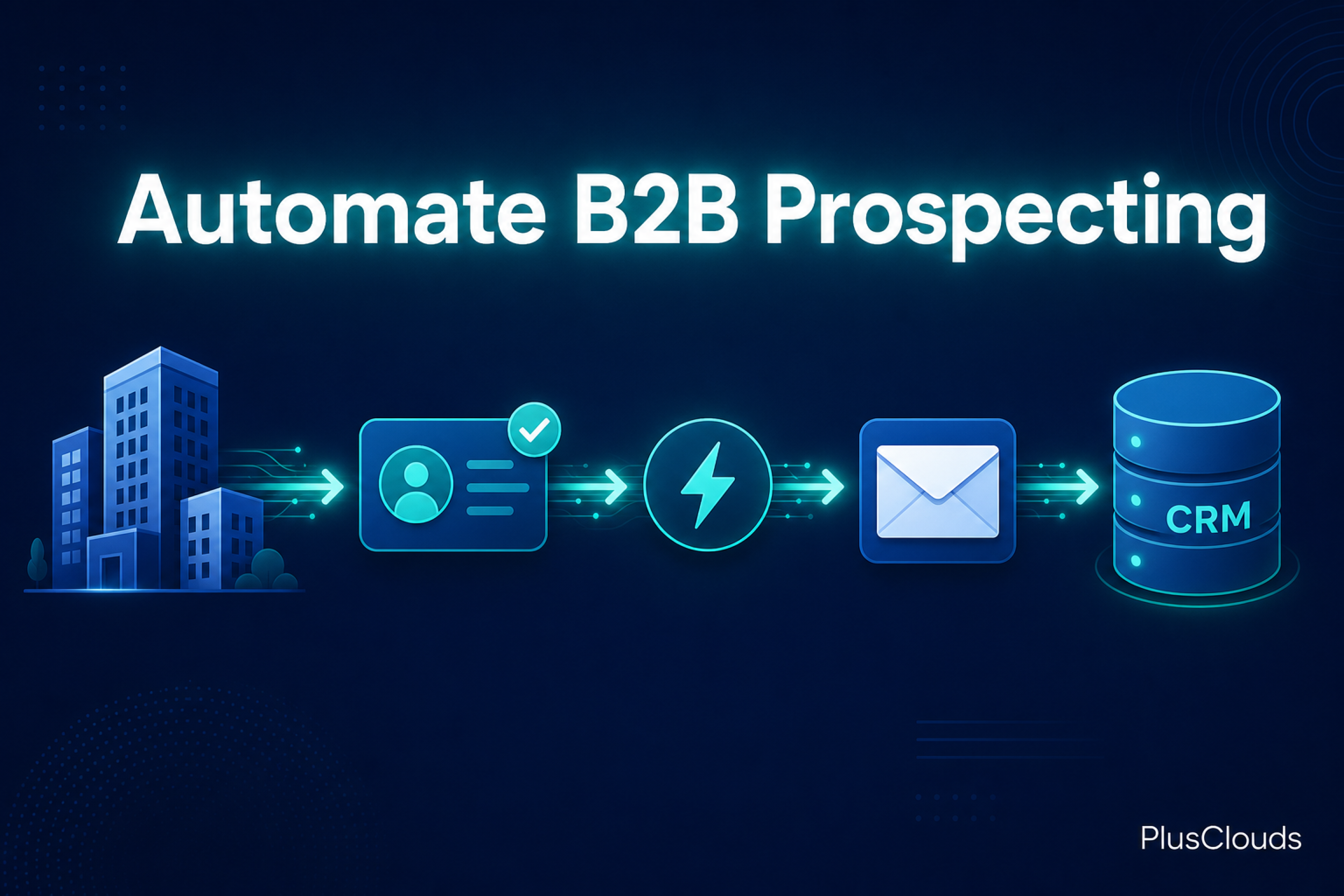
Your SDR team is spending four hours a day on research that used to take eight. That feels like progress, until you realize the companies that are actually winning in 2026 have cut that same research time to under thirty minutes, automated the follow-up entirely, and still book more qualified meetings per rep than you do. The gap is not effort. It is architecture.
B2B prospecting has always been a volume-plus-precision problem: you need enough leads to fill a pipeline, but the leads have to be the right ones or your reply rates collapse and your reps burn out chasing ghosts. For years, the only answer was hiring more SDRs. That answer is getting expensive fast. According to research compiled by Martal on lead generation benchmarks, companies using AI-driven lead generation are reporting customer acquisition costs up to 60% lower than those running purely manual processes.
What changed is not just the tools. It is the workflow. AI lead generation in 2026 is not about plugging a chatbot into your CRM and hoping for the best. It is about building a connected sequence of stages, where each one feeds the next automatically, and humans step in only when a conversation is genuinely ready to happen. This guide walks through exactly that workflow, stage by stage.
Key Takeaways
- AI-powered B2B prospecting automation cuts SDR research time from hours to under 30 minutes per day.
- A complete workflow spans five connected stages: lead discovery, decision-maker identification, buying signal detection, AI outreach sequences, and CRM sync.
- Contact verification is non-negotiable. Bounce rates above 3% degrade sender domain reputation and hurt deliverability for valid addresses too.
- Speed-to-lead matters. Automated workflows that respond to buying signals in under two hours consistently outperform manual processes that take 24 to 72 hours.
- Tools like LeadOcean (discovery, signals, CRM sync) and Eaglet (outreach sequences) connect every stage into a single pipeline that runs without manual handoffs.
Table of Contents
- Why Manual Prospecting Is Breaking Your Sales Team in 2026
- The 5 Stages of a Fully Automated B2B Prospecting Workflow
- Stage 1: AI-Powered Lead Discovery at Scale
- Stage 2: Decision-Maker Identification and Contact Verification
- Stage 3: Buying Signal Detection for Better Outreach Timing
- Stage 4: AI Outreach Sequences and Personalization at Scale
- Stage 5: CRM Sync and Pipeline Handoff for HubSpot and Salesforce
- How LeadOcean and Eaglet Fit into Each Stage
- Key Metrics to Track: Speed-to-Lead, Reply Rate, and Pipeline Conversion
- Common B2B Prospecting Automation Pitfalls and How to Avoid Them
Why Manual Prospecting Is Breaking Your Sales Team in 2026
The math is straightforward and brutal. A typical SDR spends somewhere between 30% and 40% of their working week on list building, contact research, and data verification, before they write a single email. That is time that generates zero revenue. It is also the work that AI handles best: structured, repetitive, and dependent on large data sets no human can process at speed.
The problem goes deeper than time, though. Manual prospecting is inconsistent by nature. One rep builds a list using LinkedIn Sales Navigator filters, another uses a purchased database, a third relies on referrals and conference badge scans. The result is a pipeline built on incompatible data quality standards, with no reliable way to know which leads are actually worth pursuing before a rep has already spent an hour on them.
Meanwhile, industry analysis from DW Media on B2B lead generation trends in 2026 points to a clear split emerging between teams that have systematized prospecting with AI and those that have not. The gap in pipeline velocity, not just lead volume, is widening. Teams running automated workflows are reaching decision-makers faster, personalizing at scale, and converting pipeline to revenue at rates that manual teams simply cannot match.
The fix is not firing your SDRs. It is redirecting them toward the work only humans can do: building relationships, running discovery calls, handling objections, and closing. Everything before that conversation can be automated.
The 5 Stages of a Fully Automated B2B Prospecting Workflow
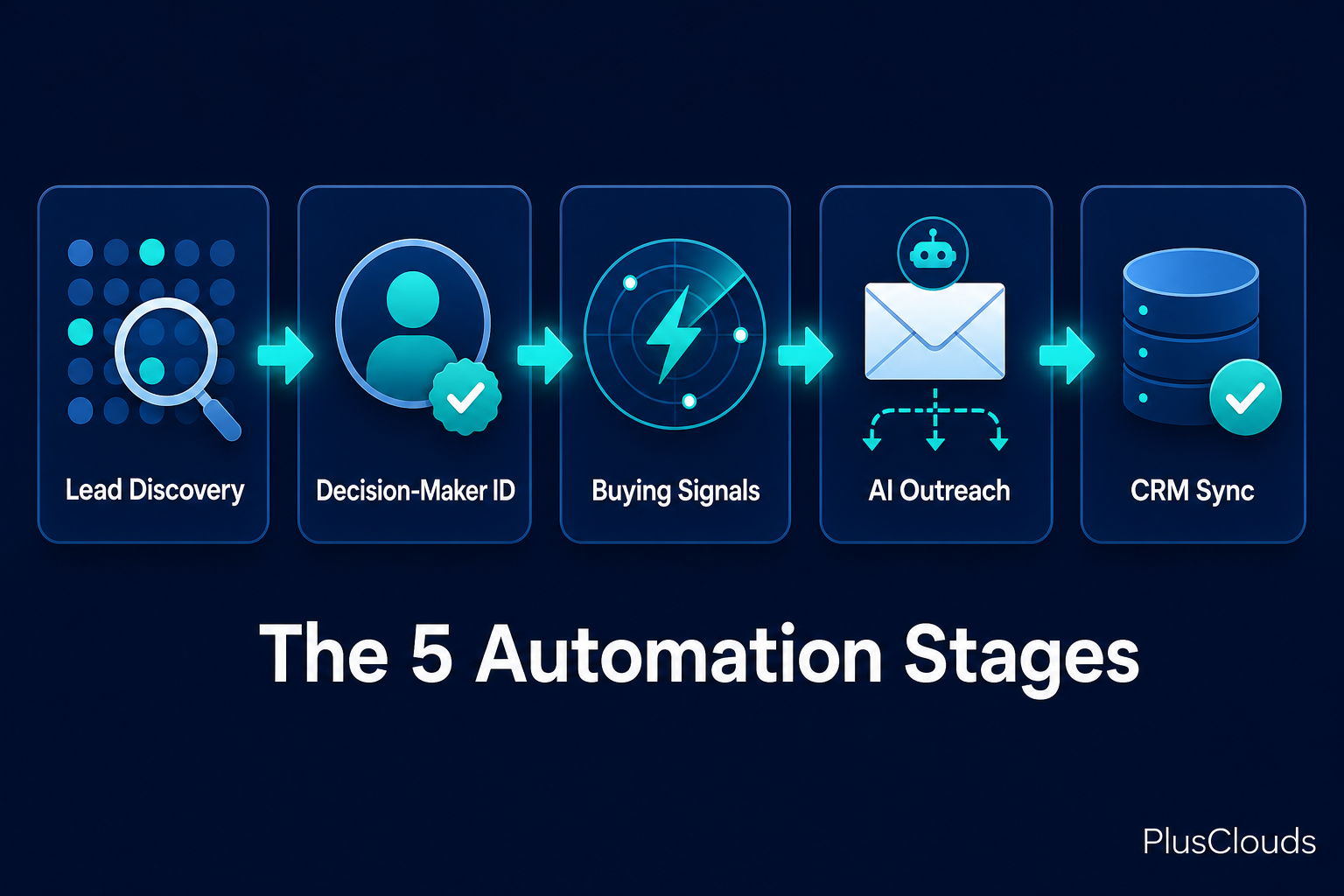
A complete sales pipeline automation workflow covers five distinct stages, and they have to be connected. Running any one of them in isolation gives you a marginal improvement. Running all five as a system is where the compounding effect kicks in.
The stages are: lead discovery, decision-maker identification and contact verification, buying signal detection, AI outreach sequences, and CRM sync with pipeline handoff. Each stage has its own tooling requirements, data inputs, and outputs that feed the next stage. The rest of this guide breaks down each one.
Stage 1: AI-Powered Lead Discovery at Scale
Lead discovery is where most automation efforts start, and where the quality ceiling is set for everything downstream. If you feed bad company data into the top of the funnel, every subsequent stage amplifies that problem rather than correcting it.
AI-powered discovery works differently from static list purchases. Instead of buying a snapshot of company records that was accurate six months ago, an AI match engine continuously scores companies against your ideal customer profile (ICP) across live data signals: hiring activity, funding announcements, technology stack changes, headcount growth, and more. The output is a ranked list of companies that match your ICP right now, not at the time the list was compiled.
The practical setup looks like this. You define your ICP parameters:
Industry: SaaS, B2B Tech, Professional Services
Company size: 50-500 employees
Geography: US, UK, DACH
Tech stack: HubSpot or Salesforce (CRM signal)
Growth signal: 20%+ headcount growth in last 6 months
An AI match engine takes those parameters and runs them against its company database continuously, surfacing new matches as companies enter your ICP criteria and removing ones that fall out of scope. The list is always current.
LeadOcean by PlusClouds searches across 1.8 billion company records with exactly this kind of AI Match Engine, scoring and ranking companies against your ICP parameters automatically. Rather than building lists manually, your team reviews a prioritized feed of companies that already meet your criteria.
Stage 2: Decision-Maker Identification and Contact Verification
Finding the right company is half the problem. The other half is finding the right person inside that company, and confirming their contact information is actually valid before your outreach sequence fires.
This stage is where manual workflows waste the most time. Identifying the correct decision-maker for a given product category requires cross-referencing job titles, reporting structures, and seniority levels, then hunting for verified email addresses or LinkedIn profiles. A good SDR can do this for maybe 20 to 30 companies per day. An automated system does it for thousands.
The automation here works in two layers. First, role-based filtering narrows the company record to the specific personas you target: VP of Sales, Head of Revenue Operations, Director of Demand Generation, and so on. Second, contact verification runs each identified email address through real-time validation to confirm deliverability before it enters any sequence.
Verification matters more than most teams realize. An email list with 15% invalid addresses does not just mean 15% of your emails bounce. It means your sender domain reputation degrades, your deliverability on the remaining 85% drops, and eventually your emails start landing in spam folders even for valid addresses. Verification is not optional hygiene; it is the foundation your outreach deliverability stands on.
For teams looking to go deeper on building effective outreach once contacts are verified, the 11 Best B2B Lead Generation Email Templates post covers proven messaging frameworks that pair well with automated sequences.
Stage 3: Buying Signal Detection for Better Outreach Timing
Timing is the variable that most prospecting automation ignores, and it is the one that moves reply rates more than almost anything else. Reaching a VP of Sales the week their company announces a Series B funding round is a fundamentally different conversation than reaching the same person on a random Tuesday in a flat quarter.
Buying signals are behavioral and contextual events that indicate a company is more likely to be in an active buying cycle. Common signals include:
- Job postings for roles that suggest a new initiative (e.g., a SaaS company posting for a "Head of Revenue Operations" signals CRM investment)
- Funding events that typically precede technology purchasing decisions
- Technology stack changes detected through job descriptions, engineering blog posts, or third-party tracking
- Leadership changes at the VP or C-suite level, which often trigger tool re-evaluation
- Competitor contract renewals approaching known renewal windows
The automation challenge is monitoring these signals continuously across thousands of target accounts. No human team can do that at scale. AI systems can, and they can score the urgency of each signal so your outreach queue prioritizes the hottest accounts automatically.
This is one of the core capabilities inside LeadOcean's buying-signal detection layer. Rather than waiting for your SDRs to manually check LinkedIn for job postings or set up Google Alerts for funding news, the system surfaces signal-triggered accounts directly into your workflow, ranked by signal strength and ICP fit.
Stage 4: AI Outreach Sequences and Personalization at Scale
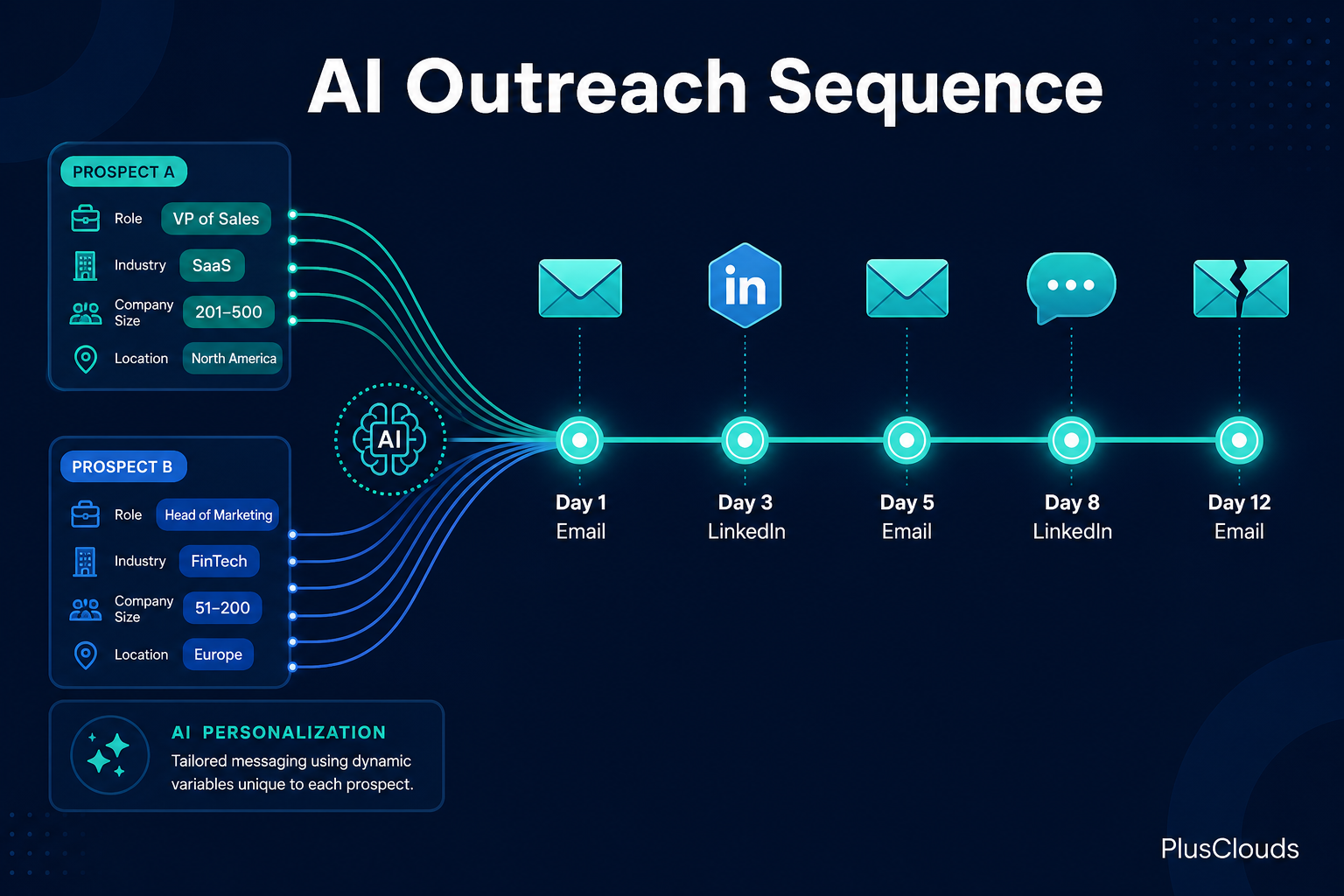
Personalization at scale sounds like a contradiction, but it is not, provided you understand what personalization actually requires. Most of what makes an outreach email feel personal is not a deep knowledge of the recipient's childhood. It is relevance: the right company context, the right pain point framing, the right signal reference, delivered at the right moment.
AI outreach automation handles this by pulling structured data from the previous stages (company profile, decision-maker role, detected buying signal) and injecting it into sequence templates dynamically. A message to a VP of Sales at a 200-person SaaS company that just posted three RevOps roles looks different from a message to a Head of Marketing at a professional services firm that just closed a funding round, even if the underlying product pitch is the same.
A basic multi-touch sequence structure looks like this:
Day 1:  Email, ICP-specific pain point + signal reference
Day 3:  LinkedIn connection request (no pitch)
Day 5:  Email, Case study or social proof relevant to their vertical
Day 8:  LinkedIn message, Brief, direct ask
Day 12: Email, Break-up frame / last reach-out
The key variables that AI personalizes at each touchpoint: company name, decision-maker name and title, detected buying signal, industry-specific pain point, and relevant case study or proof point. Everything else in the template stays consistent.
Eaglet by PlusClouds is built specifically for this stage, running AI-driven outreach sequences that adapt messaging based on the prospect data flowing in from discovery and signal detection. It operates as a standalone platform or as a LeadOcean add-on, depending on how your stack is structured.
Stage 5: CRM Sync and Pipeline Handoff for HubSpot and Salesforce
Automation that does not write back to your CRM creates a new problem: a parallel data universe that your revenue operations team cannot see, report on, or manage. Every automated touchpoint, reply, bounce, and meeting booked needs to land in your CRM as a structured record, not a forwarded email thread.
A properly configured CRM sync handles three things. First, it creates or updates contact and company records automatically when a new lead enters the workflow, so your CRM stays current without manual data entry. Second, it logs every outreach activity, open, reply, and meeting booked, against the correct contact record. Third, it triggers pipeline stage changes based on defined criteria: a reply moves a contact to "Engaged," a meeting booked moves them to "Opportunity."
For HubSpot, this typically means using native API integration to map lead properties from your prospecting tool to HubSpot contact fields, then using workflows to automate stage transitions. For Salesforce, the same logic applies through the Salesforce API, with leads flowing into the correct campaign or opportunity record.
LeadOcean's native HubSpot and Salesforce integration handles this sync automatically, so the pipeline your sales leaders see in their CRM reflects the actual state of every automated sequence in real time. For a detailed walkthrough of the CRM pipeline setup, the LeadOcean ve PlusClouds CRM Entegrasyonu post covers the configuration in depth.
How LeadOcean and Eaglet Fit into Each Stage
The five stages above describe a workflow. LeadOcean and Eaglet are the tools that run it.
LeadOcean covers stages one through three and five: AI-powered company discovery against your ICP, decision-maker identification with verified contacts, buying-signal detection that triggers prioritized outreach queues, and CRM sync that keeps HubSpot or Salesforce current throughout. The AI Match Engine handles the continuous scoring, so your SDRs are not building lists; they are reviewing a ranked feed of accounts that already meet your criteria and are showing active buying signals.
Eaglet handles stage four: the outreach sequences themselves. It takes the verified, signal-scored contacts from LeadOcean and runs personalized multi-touch sequences across email and LinkedIn, adapting message variables based on the prospect data it receives. Used together, the two platforms cover the full workflow from company discovery to booked meeting without requiring manual intervention at any stage except the meeting itself.
The combination is particularly effective for SDR teams that are currently running these stages as separate, disconnected tools, where data has to be exported from one system and imported into another manually. Connecting discovery, signals, outreach, and CRM sync in a single workflow eliminates that data loss and the time cost that comes with it.
Key Metrics to Track: Speed-to-Lead, Reply Rate, and Pipeline Conversion
Automating your prospecting workflow without measuring it is just moving the problem. The metrics that matter most are the ones that tell you whether the automation is actually improving pipeline quality, not just volume.
Speed-to-lead measures the time between a buying signal being detected and the first outreach touchpoint firing. Manual workflows typically run 24 to 72 hours here, because someone has to notice the signal, build the contact record, and write the email. Automated workflows should be under two hours. Research from Gravitasin on AI B2B lead generation consistently shows that faster response to intent signals correlates directly with higher reply rates.
Reply rate by sequence step tells you where your messaging is breaking down. If step one gets a 4% reply rate and step three gets 0.5%, the problem is probably the message at step three, not the sequence length. Track reply rates at each touchpoint separately, not as a blended average.
Pipeline conversion rate measures what percentage of leads entering the automated workflow eventually become opportunities in your CRM. This is the metric that justifies the automation investment to leadership. A well-tuned workflow should convert at a meaningfully higher rate than your previous manual process, because you are reaching better-fit companies at better moments with more relevant messaging.
Bounce rate and deliverability score are the early warning system. If bounce rates climb above 3%, your contact verification layer has a problem. If deliverability scores from tools like Google Postmaster or Microsoft SNDS start dropping, your sending infrastructure or sequence cadence needs adjustment.
Common B2B Prospecting Automation Pitfalls and How to Avoid Them
The most common failure mode is treating automation as a volume lever rather than a quality filter. Teams that automate bad prospecting processes at scale do not get better results; they get worse results faster, and they damage their sender reputation in the process.
Over-sequencing is the first trap. Running a 12-touch sequence over 30 days to every contact in your database is not persistence; it is noise. Contacts who have not replied after five touches in two weeks are almost certainly not going to reply at touch twelve. Shorter sequences with higher signal thresholds for entry perform better than long sequences with low entry criteria.
Skipping verification is the second. Every contact that enters an outreach sequence should have a verified email address. No exceptions. The short-term gain of skipping verification (a slightly larger outreach list) is not worth the deliverability damage that accumulates from bounces.
Ignoring unsubscribes and opt-outs is both a legal and a performance problem. In most jurisdictions, B2B cold outreach requires a functioning unsubscribe mechanism and prompt removal from sequences. Beyond compliance, contacts who opt out are giving you a signal: they are not a fit right now. Continuing to contact them wastes sequence capacity on people who have explicitly disqualified themselves.
Treating CRM sync as an afterthought is the final common mistake. If your automation runs in a silo and your CRM is updated manually, you will never have an accurate picture of pipeline health, and your revenue operations team will not trust the data. Build the CRM sync into the workflow from day one, not as a later integration project.
The good news is that all of these pitfalls are avoidable with the right workflow design upfront. The teams that get automation right are not the ones with the most sophisticated tools; they are the ones that thought carefully about data quality, sequence logic, and CRM integration before they turned anything on.
Building a B2B prospecting workflow that runs from company discovery to booked meeting without manual intervention at every step is not a distant aspiration in 2026. The tooling is mature, the patterns are well-understood, and the teams doing it are seeing measurable improvements in both pipeline velocity and rep productivity. The question is whether you build it now or spend another quarter watching your reps do work that a well-configured system could handle for them.
If you want to see how the workflow described here maps to actual tooling, explore LeadOcean for the discovery, signal detection, and CRM integration layers, and Eaglet for the outreach automation. Both are available to try, and both are built to connect directly into the workflow stages covered above.