You picked a niche. You wrote twenty articles about it. Six months later, you rank for none of them, and the blog has quietly become a graveyard of posts that each target a different keyword with no connective tissue between them. Sound familiar?
This is the most common failure mode in B2B content marketing, and it has a specific cause: search engines no longer evaluate your articles one at a time. They evaluate whether your site, as a whole, demonstrates deep expertise on a subject. That evaluation has a name, topical authority, and in 2026 it matters more than ever because AI search engines like ChatGPT, Perplexity, and Google's AI Overviews prefer to cite brands that cover a topic comprehensively rather than brands that rank for scattered individual keywords.
The good news is that building topical authority no longer requires a ten-person content team. AI can now handle keyword mapping, research, drafting, optimization, and even publishing. What it cannot handle is strategy. The cluster architecture, the sequencing, the intent separation: those decisions are still yours, and they are the difference between 365 published articles that build authority and 365 published articles that cannibalize each other.
This guide walks you through the complete playbook, from mapping your first content cluster to auto-publishing a full year of articles to WordPress and measuring what actually worked.
Table of Contents
- Key takeaways
- What Topical Authority Is and Why It Beats Single-Keyword SEO in 2026
- How to Map a Content Cluster: Pillar Pages, Supporting Articles, and Internal Links
- Step 1: Choose a Niche and Define Topical Depth
- Step 2: Use AI to Generate a Full Keyword Cluster Map
- Step 3: Sequence Your Articles to Build Authority Progressively
- Step 4: Automate Research, Drafting, and SEO Optimisation
- Step 5: Auto-Publish to WordPress on a Consistent Cadence
- Avoiding AI Content Cannibalization: How to Keep Intents Distinct
- Tracking Cluster Performance: Rankings, AI Citations, and Organic Traffic
- How AutoQuill Handles the Full Pipeline from Keyword to Published Article
- Conclusion: Authority Is Architecture, Not Volume
Key takeaways
- Topical authority is inferred from the structure and depth of your content, not measured by a single metric. It determines whether search engines and AI answer engines trust your site as a comprehensive source.
- A content cluster has three components: one pillar page targeting a head term, supporting articles targeting single-intent long-tail keywords, and descriptive internal links connecting them.
- Publishing order matters. Ship the pillar first, supporting articles in waves of 3 to 5 per week, then expand the pillar last so it compounds with every supporting piece.
- AI automates research, drafting, optimization, and publishing, but strategy, intent separation, and fact-checking remain human jobs. Cannibalization is the default outcome at high volume unless you actively prevent it.
- Measure three layers: article rankings, cluster-level traffic and keyword coverage, and AI citations from ChatGPT, Perplexity, and Google AI Overviews.
What Topical Authority Is and Why It Beats Single-Keyword SEO in 2026
Topical authority is the degree to which search engines and AI systems trust your site as a comprehensive source on a specific subject. It is not a metric you can pull from a dashboard. It is an inference Google and AI answer engines make from the structure and depth of your content.
The mechanics are straightforward. When you publish a pillar page covering a broad topic, surrounded by a dense cluster of supporting articles that each cover a subtopic in depth, linked together with descriptive internal links, you send two signals simultaneously:
- Breadth: you cover the topic from every angle a searcher might care about.
- Depth: you go beyond surface-level definitions into implementation details, edge cases, and trade-offs.
Sites that do this well rank for keywords they never explicitly targeted, because the engine infers expertise from the cluster as a whole. Sites that chase individual keywords in isolation have to win every ranking fight from scratch.
The stakes have risen because of AI search. When Perplexity or ChatGPT composes an answer, it favors sources that demonstrate structured, comprehensive coverage of a topic. A single well-written article on a thin site is less likely to be cited than the same article sitting inside a thirty-piece cluster on a site that clearly owns the subject. If you want your brand to be the answer rather than a blue link, cluster architecture is the prerequisite.
There is also a compounding effect that single-keyword SEO never gives you. Every new supporting article strengthens the pillar, which strengthens every other article in the cluster. Content begets rankings, which begets more content leverage. That is why the topical authority content strategy has become one of the most searched SEO approaches of 2026, and why the teams executing it well are pulling away from the teams still writing one-off posts.
How to Map a Content Cluster: Pillar Pages, Supporting Articles, and Internal Links
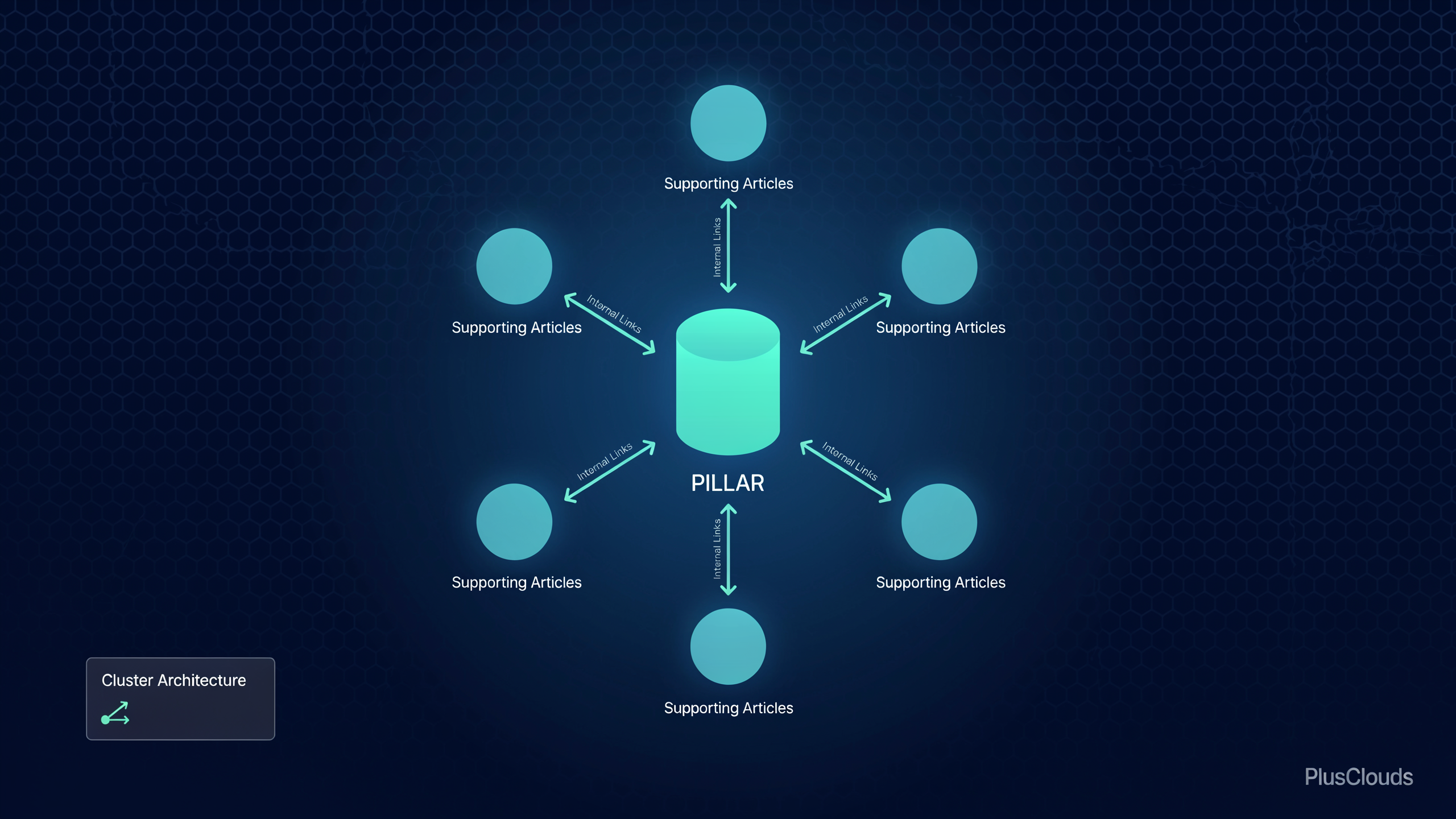
Before any AI tool touches your workflow, you need to understand the anatomy of a cluster. Every well-built cluster has three components.
The pillar page is a long-form, comprehensive resource covering the broad topic. Think "Cloud Cost Optimization: The Complete Guide." It targets a head term with high volume and high competition. Its job is not to rank for everything. Its job is to be the hub that signals to search engines what your cluster is about, and to pass authority down to the supporting pages.
Supporting articles each target one specific long-tail subtopic. "How to Cut Kubernetes Costs Without Killing Performance" or "Cloud Egress Fees in 2026" style pieces. These are where you win rankings, because long-tail queries have clearer intent and lower competition. Each supporting article targets a single primary keyword and a single search intent.
Internal links are the connective tissue. Every supporting article links up to the pillar with descriptive anchor text, and the pillar links down to each supporting article. Supporting articles also link to each other where topically relevant. Google's own guidance on creating helpful, reliable content emphasizes that clear structure and logical organization help both users and search systems understand your site, and Google Search Central's SEO starter guidance explicitly recommends organizing content so visitors know where they are and how to navigate related topics.
A simple mental model: the pillar is the trunk, supporting articles are the branches, and internal links are the circulatory system. Miss any one of the three and the cluster underperforms.
Step 1: Choose a Niche and Define Topical Depth
The most common strategic mistake is choosing a niche that is either too broad or too shallow. "Marketing" is not a niche. "Best practices for cold email deliverability" is barely a topic. You need something in between.
A workable test: your niche should support 30 to 60 distinct articles where each article answers a question a real buyer would type or ask an AI assistant, but should not support 500 without drifting off-topic. If you cannot list 30 subtopics in an afternoon of brainstorming, the niche is too narrow. If you can list 500 without repeating yourself, you have picked an industry, not a niche.
Define topical depth with three questions:
- Who is the searcher? A cluster aimed at "what is X" searchers builds traffic but not pipeline. A cluster aimed at practitioners with implementation questions builds authority with the audience that buys.
- What is the commercial radius? Every article should sit within two clicks of a product or service decision. If a topic cannot plausibly lead someone toward what you sell, it belongs to a different cluster.
- What can you credibly claim? Topical authority is partly an authenticity signal. If you have run Kubernetes in production for five years, a K8s FinOps cluster is defensible. If you have not, pick the niche where you have receipts.
Write the niche definition down in one sentence. Every downstream decision, from keyword mapping to sequencing, gets checked against it.
Step 2: Use AI to Generate a Full Keyword Cluster Map
Manual keyword clustering used to take a strategist a week. AI does it in an hour, and in some ways does it better, because large language models are good at exactly the thing clustering requires: understanding semantic relationships between queries.
The process has three passes.
Pass one: enumerate the topic space. Prompt your AI tool with the niche definition and ask for every subtopic, question, comparison, and objection a practitioner might have. Aim for volume first. A prompt like "List 80 questions a cloud infrastructure decision-maker at a mid-market SaaS company would ask, grouped by buyer journey stage" produces raw material fast.
Pass two: map queries to intent. For each candidate keyword, classify the intent: informational (learn), comparative (evaluate), or transactional (decide). This classification matters enormously later, when you are trying to avoid cannibalization. AI handles this well if you give it your product context, because intent is relative to what you sell.
Pass three: assign each keyword a role. One pillar, everything else supporting. Flag any keyword that could plausibly serve as a second pillar; those become the seeds of adjacent clusters later.
Validate the AI's output against real search data. Cross-check volume and difficulty in your keyword tool of choice, and manually review the intent labels for the twenty highest-value terms. AI gets the shape of the cluster right; you should still verify the edges. For a deeper look at how AI agents fit into modern SEO workflows, the team at Frase has a practical breakdown of AI agents for SEO that pairs well with this step.
The output of this step is a spreadsheet: keyword, intent, cluster role, target article type, and suggested pillar linkage. That spreadsheet is your build plan.
Step 3: Sequence Your Articles to Build Authority Progressively
Here is a detail most cluster guides skip: the order in which you publish matters.
Publishing all 40 articles in one week is the worst option. Search engines treat a sudden flood of interlinked pages on a brand-new topic with suspicion, and you get no compounding benefit because nothing has had time to earn rankings or links before the rest of the cluster lands on it.
The sequencing pattern that works:
- Publish the pillar first, but incomplete. Ship a strong pillar covering the topic at a high level, with a visible outline of the subtopics you will cover. This establishes the hub and lets it start indexing.
- Publish supporting articles in waves of 3 to 5 per week, starting with the lowest-competition, clearest-intent long-tail pieces. These rank fastest and start sending engagement signals to the pillar.
- Interlink as you go. Each new article links to the pillar and to the two or three most relevant previously published articles. This is where an AI system earns its keep, because remembering which of your 30 existing articles is topically relevant to article 31 is exactly the kind of bookkeeping humans do badly.
- Expand the pillar last. Once the supporting articles are live and indexed, flesh out the pillar with sections that summarize and link to each one. The pillar gets stronger with every supporting piece, and its rankings lift the whole cluster.
A realistic cadence for a one-person team using AI assistance is 3 to 5 articles per week, which means a full 40-article cluster ships in about two to three months. That pace is fast enough to compound and slow enough to look like an editorial program rather than a content dump.
Step 4: Automate Research, Drafting, and SEO Optimisation
With the map built and the sequence set, the production work is where AI genuinely changes the economics. The old bottleneck was that quality content cost either money (freelancers) or time (writing it yourself). AI collapses both, provided you automate the right parts and keep humans on the right parts.
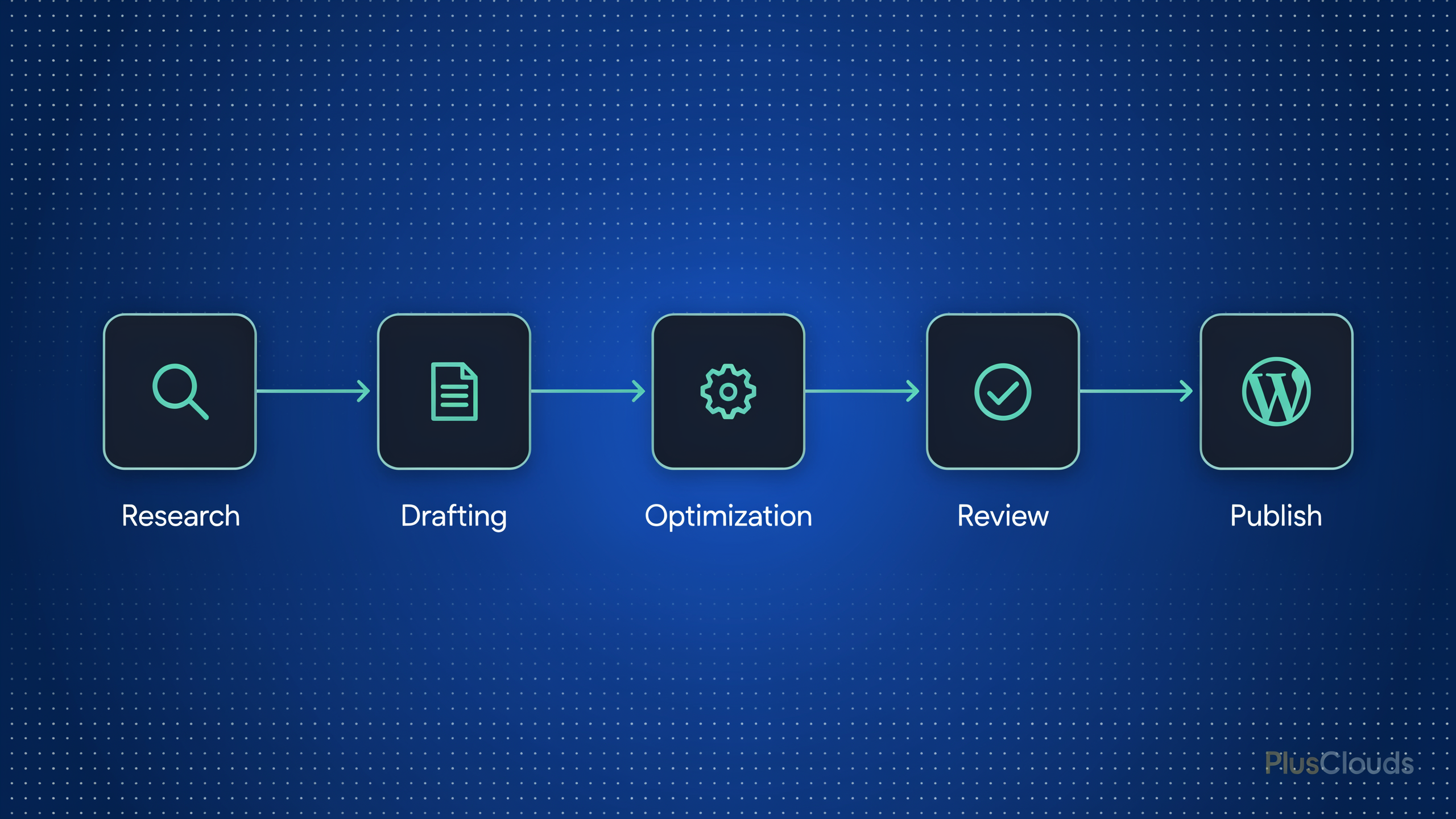
Break production into four automatable stages:
Research. AI can pull competitor headings, common questions from People Also Ask data, forum discussions, and recent developments on a topic into a structured research brief. Feeding the writer (human or AI) a brief with the top ten SERP titles, the five most common subheadings, and three unique angles competitors missed eliminates the blank-page problem.
Drafting. This is where judgment matters. AI drafts are fast and structurally sound but generic unless you inject three things: your niche definition from Step 1, first-hand expertise or data, and a specific point of view. An article that says "consider your workload requirements" is worthless. An article that says "for bursty SaaS workloads, run steady-state on bare metal and burst on cloud VMs" is worth ranking. The more specific your source material, the better the draft.
Optimization. Run each draft through an on-page checklist: primary keyword in the title, H1, URL slug, and first 100 words; semantic variants distributed across H2s; descriptive internal links to the pillar and two supporting articles; meta description under 160 characters; and a schema markup pass where appropriate. AI tools can automate most of this checklist mechanically.
Review. Keep a human in the loop for factual claims, brand voice, and anything that could embarrass you. The failure mode of fully automated content is not that AI writes badly; it is that nobody catches the confident hallucination. A 15-minute human review per article is the cheapest insurance in this entire pipeline.
If you are weighing which tools to stack for each stage, the practical question is less about which AI writer is "best" and more about which parts of the pipeline you want stitched together versus kept separate. Some teams prefer a modular stack (one tool for research, one for drafting, one for optimization, one for publishing). Others prefer a single pipeline that handles all four stages, which is the approach we will come back to at the end of this guide.
Step 5: Auto-Publish to WordPress on a Consistent Cadence
Consistency is the underrated variable in topical authority. A cluster published in erratic bursts, three articles one week and nothing for a month, underperforms a cluster published at a steady, boring, metronomic pace. Search engines reward freshness patterns, and readers (and AI crawlers) learn your site updates reliably.
Manual publishing breaks cadences. Someone goes on vacation, a launch week eats the calendar, and suddenly your two-month cluster plan becomes six months. Automation fixes this.
The mechanics of a solid auto-publish setup on WordPress:
- Draft queue with scheduled dates. Articles are generated, reviewed, and slotted into a publishing calendar with fixed slots (for example, Tuesday and Thursday at 9:00 AM).
- Structured data handled at publish time. Headings, meta descriptions, slugs, internal links, and schema get applied programmatically so no article ships unoptimized.
- Featured images and categories applied consistently, because the small stuff is what makes a 40-article cluster look like one coherent publication rather than forty separate efforts.
- A rollback path. If a reviewed article needs edits after scheduling, you need the ability to pull it from the queue without breaking the schedule for everything behind it.
One infrastructure note: if you are running the WordPress site itself on a cloud VM, publishing 365 articles a year means nothing if the site falls over every time a cluster starts ranking and traffic spikes. Hosting on infrastructure with guaranteed performance matters. PlusClouds Cloud Servers run on AMD EPYC processors with NVMe storage, deploy in 60 seconds, and come with a 99.98% uptime SLA and zero egress fees, which means a traffic surge from a ranking article does not turn into a surprise bandwidth bill. If you have been burned by egress charges before, we have written a whole piece on how to audit and eliminate cloud egress costs.
Avoiding AI Content Cannibalization: How to Keep Intents Distinct
Cannibalization is the disease of high-volume AI content programs. When two of your articles target the same intent, they compete with each other in the SERP, split link equity, and often both rank worse than either would alone. At 365 articles per year, cannibalization is not an edge case; it is the default outcome unless you actively prevent it.
The prevention happens at three points in the pipeline.
At the mapping stage, enforce one intent per keyword and one keyword per article. When your AI generates the cluster map, run a similarity pass: any two keywords with overlapping intent get merged, differentiated, or cut. "Best CRM for startups" and "top CRM tools for small businesses" are the same article. Pick one.
At the drafting stage, give each article a one-line intent statement the AI must satisfy and must not exceed. An article whose intent is "how to change your SSH port" should not drift into a general server-hardening guide, because that drift is what creates the overlap with your server-hardening article. Scope discipline in the prompt prevents scope creep in the draft.
At the audit stage, monitor for the symptoms monthly: two URLs from your site appearing for the same query, or a page whose rankings dropped right after a similar article shipped. The fix is usually straightforward: consolidate the two into the stronger one, 301 the weaker, and update internal links. Catching it early matters because cannibalization compounds quietly.
A useful rule of thumb: if you cannot explain in one sentence how article A and article B serve different searchers, they are the same article and one of them should not exist.
Tracking Cluster Performance: Rankings, AI Citations, and Organic Traffic
Measuring a cluster is different from measuring individual articles, and most teams measure the wrong things. Three layers of metrics, in increasing order of strategic value.
Layer one: article-level rankings. Track each article's primary keyword position over time. This is diagnostic, not strategic. It tells you which pieces need optimization, but a cluster can succeed at the portfolio level even when a third of the articles never crack the top ten.
Layer two: cluster-level organic traffic and coverage. The metrics that actually reflect topical authority: total organic sessions to cluster pages month over month, the number of keywords for which any cluster page ranks in the top 20, and the share of cluster traffic landing on the pillar. Rising coverage with flat per-article rankings is the signature of authority compounding, and it is the number to report to leadership.
Layer three: AI citations. This is the new one, and in 2026 it may be the most important. Track how often ChatGPT, Perplexity, Google AI Overviews, and Claude cite your domain for queries in your niche. Tools in this space are maturing quickly, but even a manual monthly check (asking each assistant the ten questions your cluster targets and recording whether you are cited) gives you a directional read. AI citations lag traditional rankings by months, so start measuring before you need the data.
Set a review cadence: weekly checks on new articles, monthly cluster-level reviews, quarterly strategy reassessments of whether the niche definition still holds. And connect the measurement to revenue where you can. If your cluster feeds a sales motion, the articles that generate pipeline matter more than the articles that generate traffic, and the same buying-signal logic that applies to outbound applies to inbound. We cover that in depth in our guide to turning buying signals into booked meetings.
How AutoQuill Handles the Full Pipeline from Keyword to Published Article
Everything above describes a pipeline: niche definition, cluster mapping, sequencing, research, drafting, optimization, review, scheduling, publishing, measurement. Most teams assemble that pipeline from five or six tools and a spreadsheet, then watch it break at the handoffs.
AutoQuill by PlusClouds was built to run the whole pipeline as one system. It researches, writes, and SEO-optimizes articles and auto-publishes them directly to WordPress, at a rate of up to 365 articles per year. That is a full cluster program, shipped on a consistent cadence, without a content team behind it.
The parts that matter for the playbook in this guide:
- Cluster-aware production. Because AutoQuill handles research and drafting together, each article is written with awareness of the cluster structure rather than in isolation, which is precisely what prevents the cannibalization problems that plague high-volume programs.
- SEO optimization applied at generation time, not as a separate pass: titles, meta descriptions, heading structure, and internal linking handled before the article ever reaches your queue.
- WordPress auto-publishing on schedule, so the cadence you set in Step 5 is enforced by the system rather than by whoever remembers to click publish.
- Human review stays in the loop. Articles land in your workflow for approval, so the hallucination insurance from Step 4 is built in rather than bolted on.
For a founder or marketing manager who has the strategy but not the headcount, this is the difference between a cluster plan that lives in a spreadsheet and a cluster that actually exists on your site, compounding, month after month.
Conclusion: Authority Is Architecture, Not Volume
The teams winning organic search in 2026 are not the ones publishing the most articles. They are the ones publishing the right articles, in the right structure, at a consistent pace. Topical authority comes from cluster architecture: one pillar, deep supporting coverage, deliberate internal links, distinct intents, and a publishing rhythm that search engines and AI assistants can rely on.
AI removes the production bottleneck that used to make this strategy the exclusive province of well-staffed content teams. What remains for you is the strategic layer, and now you have the playbook for it.
If you are ready to put the playbook into practice, AutoQuill by PlusClouds runs the full pipeline from keyword to published article, up to 365 times a year, straight to your WordPress site. Define the niche, review the drafts, and let the system handle everything in between. Your competitors are still writing one-off posts. You could be building the cluster they will spend 2027 trying to catch up to.