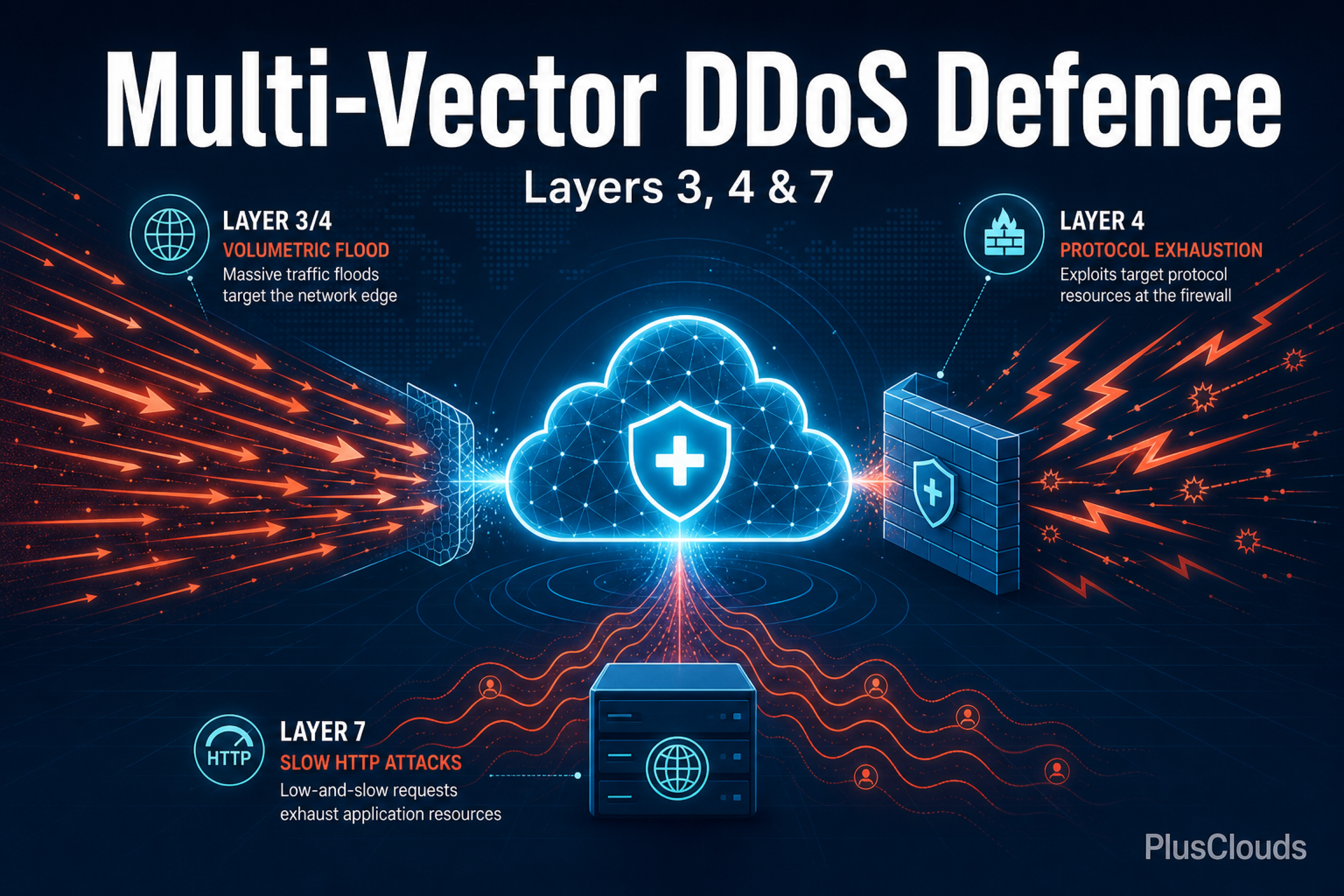
Attackers do not wait for your on-call engineer to wake up. They do not wait for your mitigation subscription to spin up. And in 2026, they are no longer sending a single flood of UDP packets and hoping for the best. They are running coordinated, multi-vector campaigns that hit your network edge, exhaust your stateful firewall connections, and simultaneously hammer your application layer with slow HTTP requests that look, to most detection systems, like slightly impatient legitimate users. If your defence was designed to handle one of those problems at a time, you are already behind.
This guide walks through how multi-vector DDoS attacks are structured in 2026, why the old threshold-based models fail against them, and how to build a layered defence that covers all three attack planes without rebuilding your infrastructure from scratch.
Key takeaways:
- Multi-vector DDoS attacks now represent roughly 65% of all DDoS incidents in 2026, combining five or more vectors in a single campaign.
- Peak recorded attack capacity has crossed 3 Tbps, making 1 Tbps+ always-on upstream mitigation a practical minimum for public-facing workloads.
- More than 70% of DDoS attacks last under ten minutes, making on-demand scrubbing operationally insufficient against short-burst attacks.
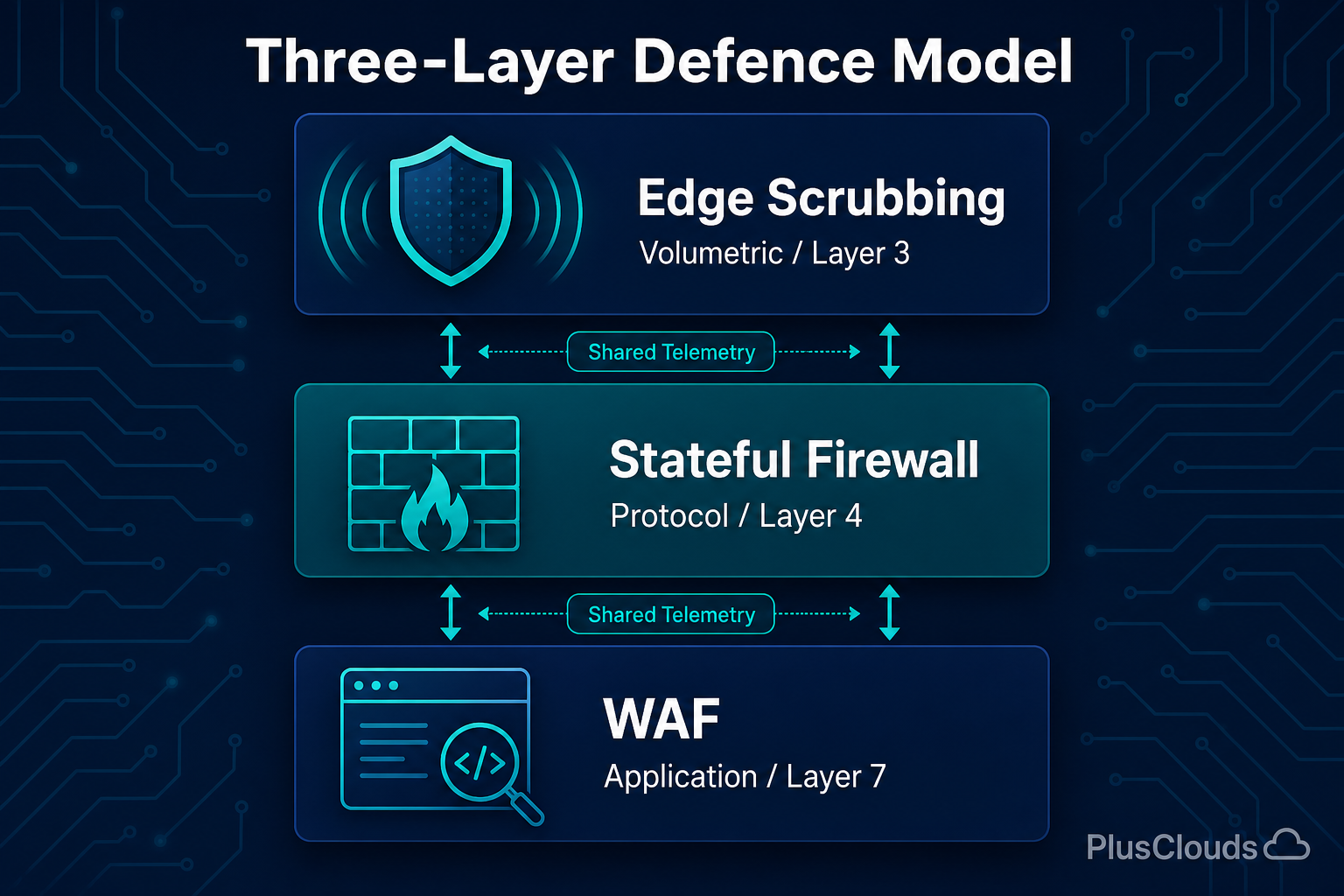
- Effective defence requires three coordinated layers: network edge scrubbing (Layer 3/4), stateful firewall (Layer 4), and WAF (Layer 7), all sharing traffic telemetry.
- Sub-1 Gbps reconnaissance bursts are often the setup for larger targeted campaigns and will not trigger threshold-based alerts.
Table of Contents
- Why 2026 Is the Most Dangerous DDoS Year on Record: Key Statistics You Cannot Ignore
- How Multi-Vector Attacks Work: Volumetric, Protocol, and Layer 7 Hits Running in Parallel
- The Sub-1 Gbps Reconnaissance Problem: Why Small Attacks Are the Biggest Threat
- Why Traditional Threshold-Based Defences Are Already Obsolete
- The Three-Layer Defence Model: Network Edge, Stateful Firewall, and WAF Working Together
- Always-On vs. On-Demand Mitigation: Why the 35-Second Attack Window Changes Everything
- OWASP Top 10 and Layer 7 DDoS: How WAF Rule Sets Overlap with Attack Mitigation
- How to Validate Your DDoS Posture: A Practical Stress-Test Checklist
- PlusClouds Cloud Security: 1 Tbps Always-On Mitigation and WAF from One Control Plane
- The Architecture You Choose Now Determines What a 2026 Attack Costs You
Why 2026 Is the Most Dangerous DDoS Year on Record: Key Statistics You Cannot Ignore
The trajectory has been bad for a while, but the pace accelerated sharply. Multi-vector DDoS attacks surged 83% in 2025, and current projections put them at roughly 65% of all DDoS incidents in 2026. Peak recorded attack capacity has crossed 3 Tbps. These are not edge cases anymore. They are the median attack profile.
A few numbers worth keeping on your radar:
- According to NETSCOUT's threat intelligence research, multi-vector attacks now routinely combine five or more distinct attack vectors in a single campaign.
- Corero's analysis shows that more than 70% of DDoS attacks last under ten minutes, making manual response operationally useless.
- FlowTraq's state-of-DDoS research documents a clear shift toward application-layer targeting, with Layer 7 attacks growing faster than volumetric attacks year-over-year.
The practical implication is this: the era of "we'll add DDoS mitigation when we get attacked" is over. By the time you are activating an on-demand scrubbing service, the attack has already caused damage. Whether that damage is a five-minute outage, a failed transaction batch, or a cascading failure that takes your database offline depends entirely on what you had in place before the first packet arrived.
How Multi-Vector Attacks Work: Volumetric, Protocol, and Layer 7 Hits Running in Parallel
A single-vector attack is a blunt instrument. Flood a pipe with UDP amplification traffic, and a well-provisioned upstream scrubber handles it. The reason multi-vector attacks are so effective is not that any individual vector is more powerful. It is that they force your defences to operate on multiple fronts simultaneously, and most defence stacks are not designed for that.
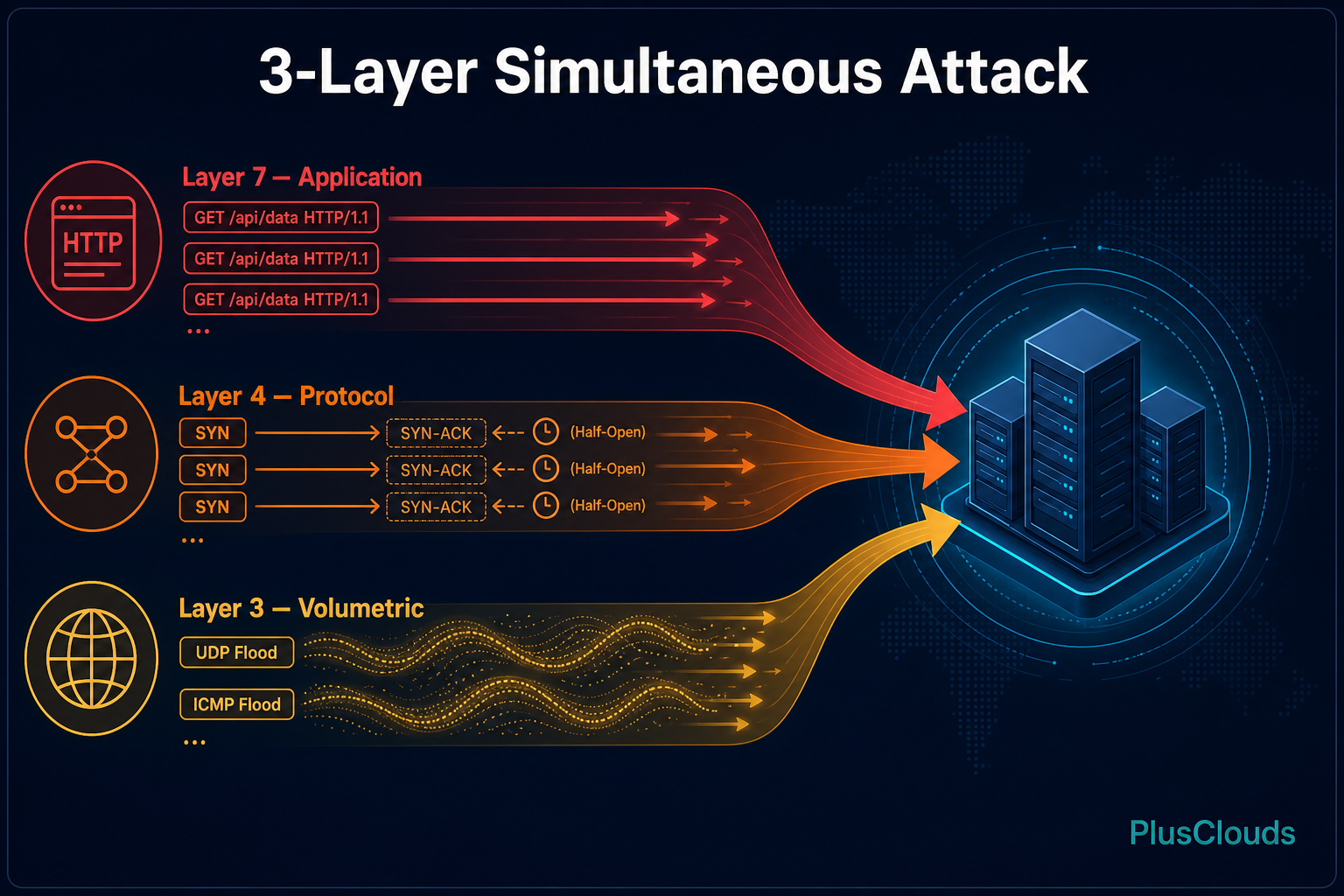
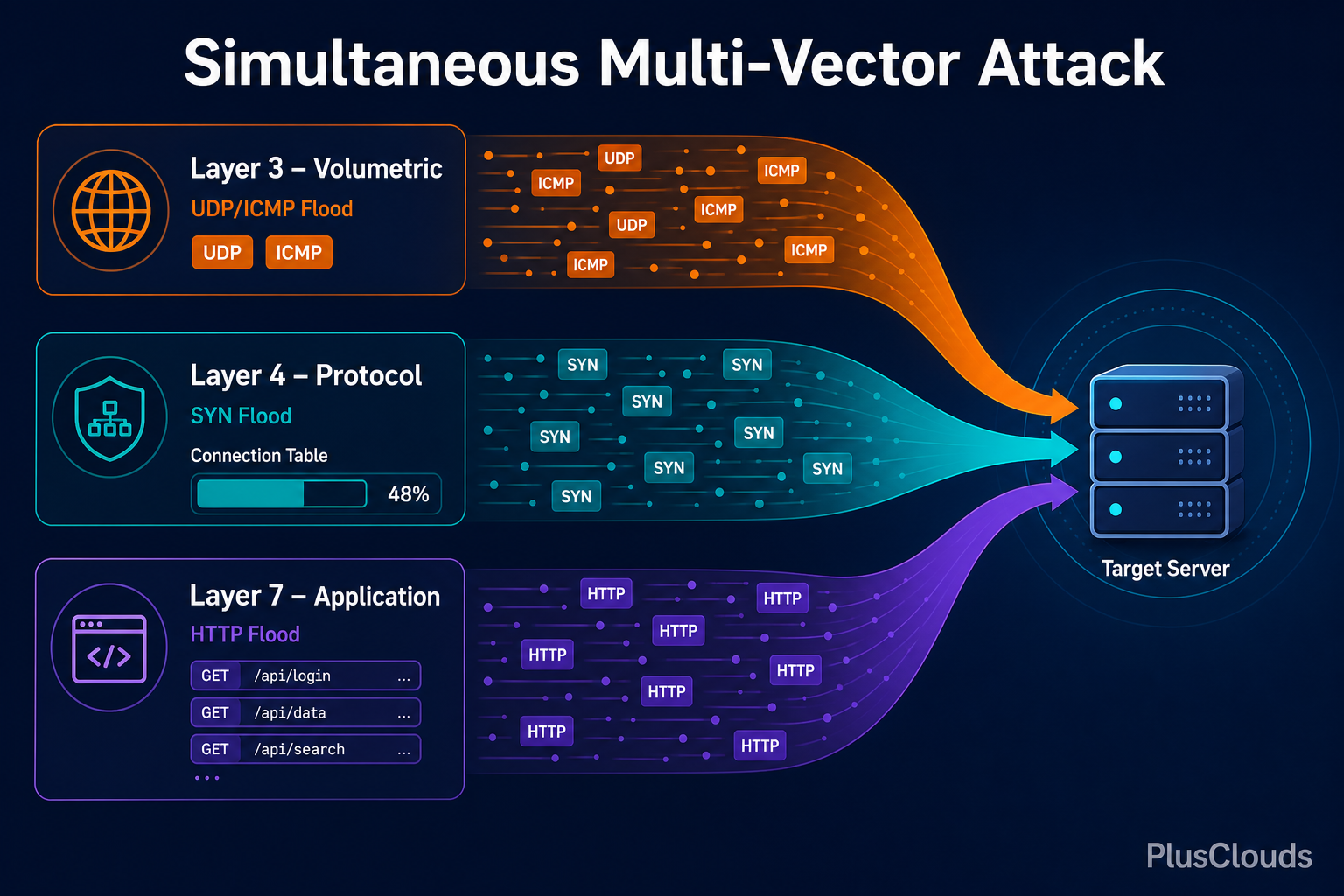
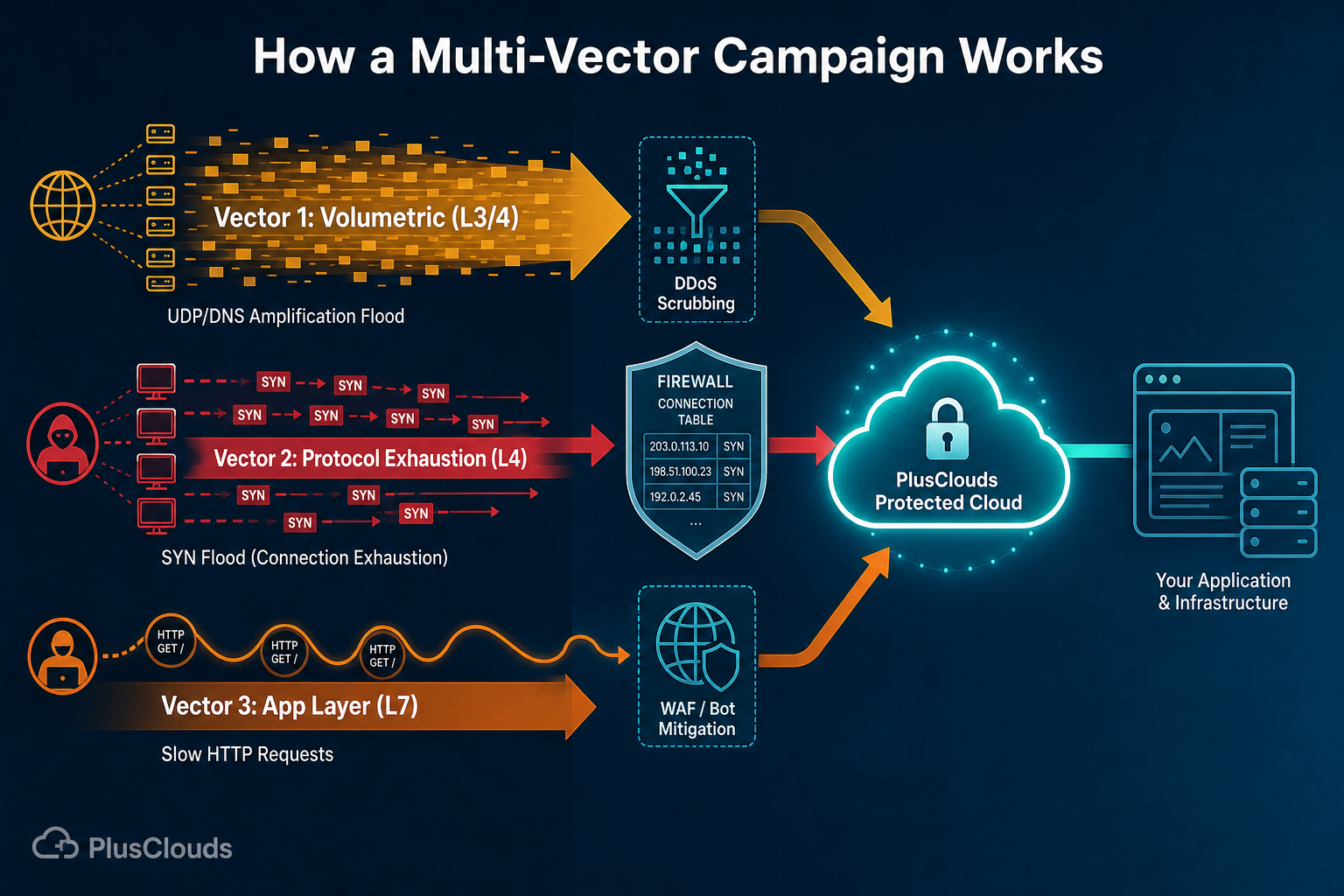
Here is what a typical 2026 multi-vector DDoS campaign looks like in practice:
Vector 1: Volumetric (Layer 3/4). A DNS amplification or NTP reflection flood saturates your upstream bandwidth. The goal is not necessarily to knock you offline. The goal is to consume your mitigation capacity and distract your detection systems.
Vector 2: Protocol exhaustion (Layer 4). Simultaneously, SYN floods or ACK floods exhaust your stateful firewall's connection table. A firewall tracking 500,000 half-open connections is not tracking your legitimate traffic properly. This is where services start degrading even if your bandwidth is technically still available.
Vector 3: Application layer (Layer 7). While the first two vectors are running, HTTP/S floods, Slowloris connections, or credential-stuffing bursts arrive at your web application. These requests are individually valid. They complete TCP handshakes. They send proper HTTP headers. A firewall cannot block them because they look legitimate at the network layer. Only a Web Application Firewall (WAF) with behavioural analysis can distinguish them from real users.
The vectors are timed to interact. The volumetric flood keeps your upstream mitigation busy. The protocol exhaustion degrades your firewall's ability to inspect traffic. And the application-layer attack slips through the gap. Sound familiar? If you have ever had a "partial outage" where your network was technically up but your application was unreachable, there is a reasonable chance you were hit by exactly this pattern.
The Sub-1 Gbps Reconnaissance Problem: Why Small Attacks Are the Biggest Threat
Here is the counterintuitive part. The most dangerous attacks in 2026 are often the small ones.
A 500 Mbps burst lasting 20 seconds does not trigger most threshold-based detection systems. It does not saturate a modern upstream link. It does not make headlines. But it does several useful things for an attacker: it maps your response latency, it identifies which of your IP ranges have mitigation active, and it probes for stateful firewall limits. These sub-1 Gbps reconnaissance bursts are the setup for a larger campaign that arrives hours or days later, precisely targeted at the gaps the attacker just discovered.
SentinelOne's DDoS statistics research documents this pattern clearly. Attackers are running automated tooling that conducts infrastructure reconnaissance at low traffic volumes, then escalates based on what it finds. Your perimeter looks fine during the probe. The real attack is designed around what the probe revealed.
The implication for your defence architecture is uncomfortable: you need to be detecting and analysing traffic that never triggers a volume alert. That requires behavioural baselining, not just threshold monitoring.
Why Traditional Threshold-Based Defences Are Already Obsolete
Most DDoS defences deployed before 2023 work on a simple principle: if traffic from a source exceeds X packets per second or Y Gbps, block it. This works against the DDoS attacks of 2015. Against 2026 attacks, it has three fatal weaknesses.
The threshold problem. Multi-vector attacks are specifically designed to stay under detection thresholds on each individual vector while causing cumulative damage. 400 Mbps of UDP, 200 Mbps of SYN floods, and 50,000 HTTP requests per minute are each individually below most alert thresholds. Together, they take down a mid-sized application server.
The latency problem. Threshold-based systems detect, then alert, then a human or automated system responds. Corero's research is specific about this: the average attack duration is under ten minutes. A system that takes two to five minutes to detect and another two to three minutes to propagate a block rule is spending half its response window on overhead. By the time mitigation is active, the damage is done.
The context problem. A packet-count threshold has no idea whether the traffic it is seeing is a DDoS attack or a product launch that just went viral. Blocking legitimate traffic spikes is its own form of outage. Effective mitigation requires understanding what normal looks like for your specific application, which is a behavioural problem, not a counting problem.
This is why the security industry has moved toward always-on, behavioural DDoS mitigation. Not because it is fashionable, but because the attack patterns have made threshold-only approaches genuinely insufficient.
The Three-Layer Defence Model: Network Edge, Stateful Firewall, and WAF Working Together
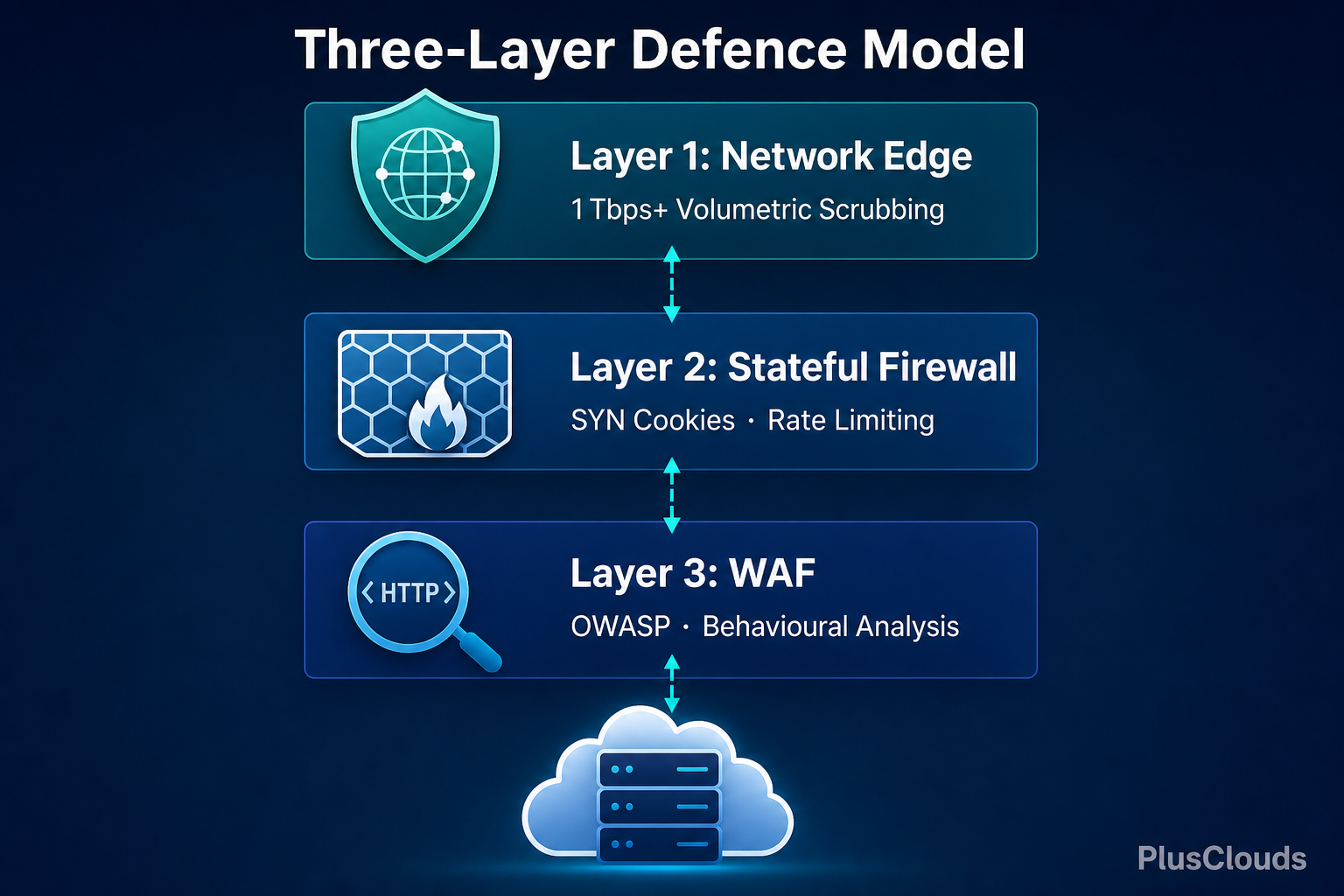
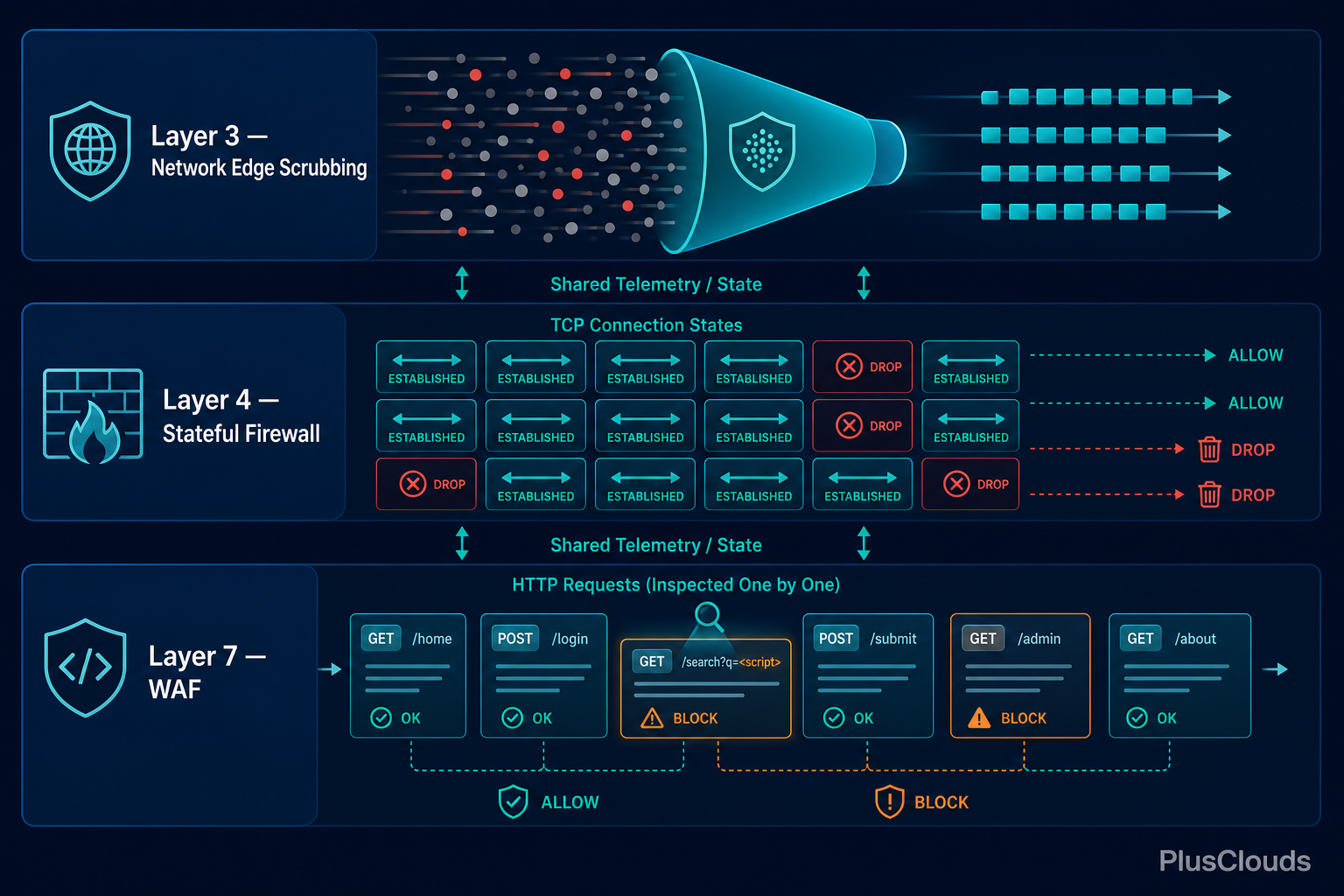
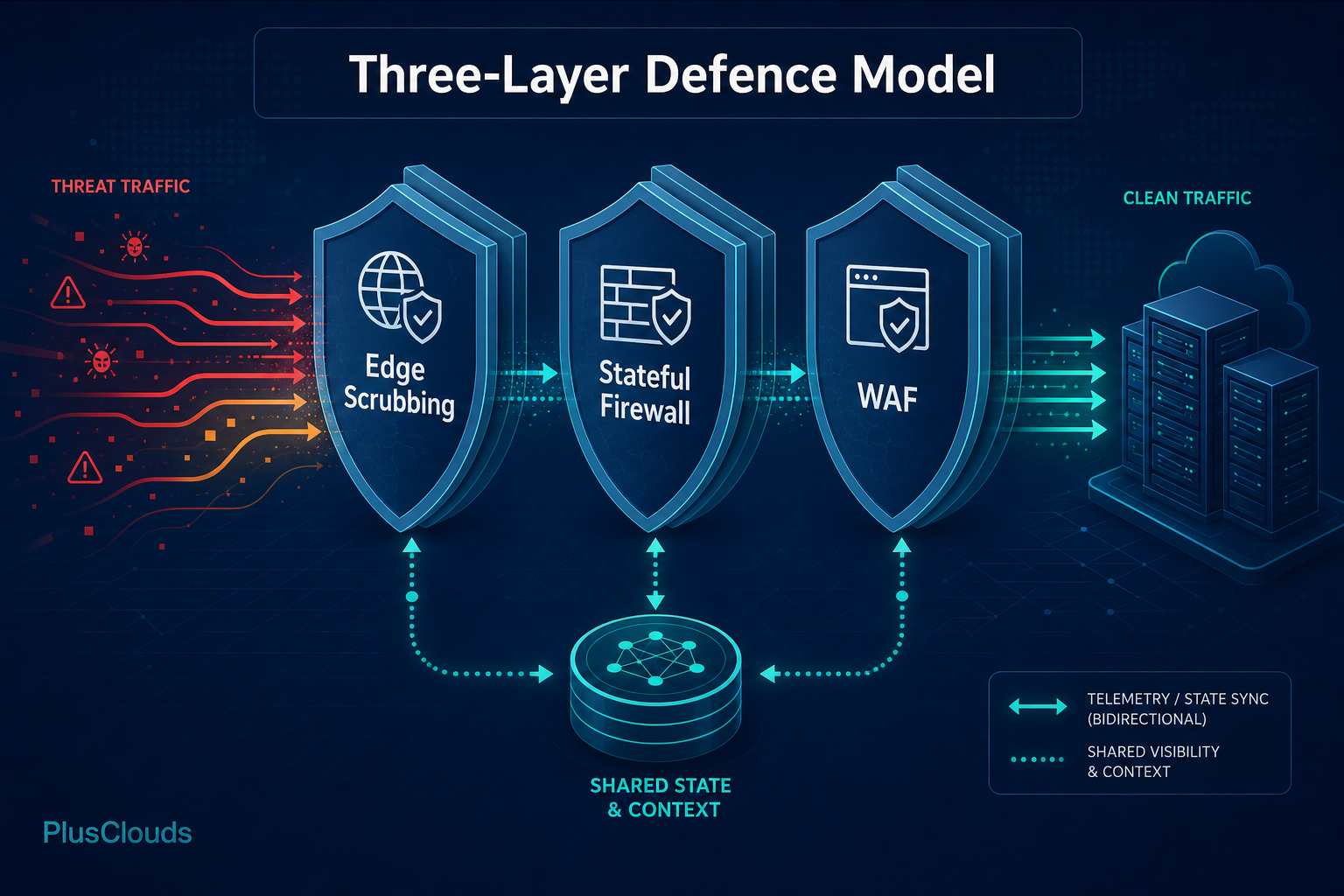
Defending against multi-vector attacks requires that each layer of your defence handles what it is actually good at, and that all three layers share context. Here is how the model works:
Layer 1: Network edge mitigation (Layers 3 and 4, volumetric). This is your first line. It needs to absorb or null-route volumetric attacks before they reach your infrastructure. The capacity requirement is non-negotiable: you need upstream mitigation capacity that exceeds the largest plausible attack against you. In 2026, that means 1 Tbps or more as a practical floor for any public-facing workload. This layer handles UDP floods, DNS amplification, NTP reflection, and ICMP floods.
Layer 2: Stateful firewall (Layer 4, protocol exhaustion). Once volumetric traffic is scrubbed, your stateful firewall handles connection-state attacks. SYN cookies to defeat SYN floods, connection rate limiting per source IP, and TCP state table protection all live here. This layer also enforces your network segmentation policy, which matters because a multi-vector attack that gets past Layer 1 will probe for lateral movement opportunities.
Layer 3: WAF (Layer 7, application attacks). Your Web Application Firewall operates on the HTTP/S layer and handles what the first two layers cannot see. HTTP floods, Slowloris, credential stuffing, API abuse, and bot traffic all require Layer 7 inspection. A WAF with behavioural rate limiting, challenge-response mechanisms (CAPTCHA, JavaScript challenges), and OWASP Core Rule Set (CRS) rules is the only component that can distinguish a slow HTTP attack from a slow legitimate user.
The critical architectural point is that these three layers must be coordinated. A WAF that cannot signal the firewall to block a source IP is only half a defence. A network-edge scrubber that does not share traffic telemetry with the WAF leaves the application layer flying blind. The value of a unified control plane is not convenience. It is the ability to correlate signals across all three layers and respond to multi-vector DDoS attacks as a single coordinated system rather than three separate tools that happen to be installed on the same infrastructure.
For teams thinking about how isolation models affect their security posture, the comparison of multi-tenant cloud versus single-tenant bare metal architectures is worth reading alongside this model.
Always-On vs. On-Demand Mitigation: Why the 35-Second Attack Window Changes Everything
On-demand DDoS mitigation has a seductive cost profile. You pay for scrubbing only when you need it. You redirect traffic to a scrubbing centre during an attack and redirect it back when the attack stops. For attacks that last hours, this is a reasonable model.
For attacks that last 35 seconds, it is useless.
The median DDoS attack duration has been shrinking for years. Short-burst attacks, sometimes called "carpet bombing" or "pulse wave" attacks, are specifically designed to be faster than any on-demand system can respond. They cause real damage (dropped connections, failed transactions, application crashes from resource exhaustion) and then disappear before mitigation is active. The attacker achieves disruption at minimal cost and with no risk of their attack infrastructure being identified and blocked.
Always-on DDoS mitigation means your traffic is continuously inspected and scrubbed inline. There is no detection-to-response window because mitigation is always running. The cost difference between always-on and on-demand is real, but so is the protection gap. For any workload where a 35-second outage has business consequences (e-commerce checkout, payment processing, real-time APIs, authentication services), always-on is not a premium feature. It is the minimum viable defence.
The 35-second window also changes your capacity planning calculus. On-demand systems are sized for sustained attacks. Always-on systems need to handle peak burst capacity without degradation, which is why the 1 Tbps or more threshold matters even for organisations whose normal traffic is measured in megabits.
OWASP Top 10 and Layer 7 DDoS: How WAF Rule Sets Overlap with Attack Mitigation
The OWASP Top 10 is primarily a vulnerability classification, but several of the categories map directly to Layer 7 DDoS vectors. Understanding this overlap helps you configure your WAF more effectively and avoid the mistake of treating DDoS mitigation and application security as separate concerns.
A05: Security Misconfiguration covers exposed endpoints and verbose error responses that attackers use to identify high-cost operations to flood. An endpoint that triggers a database query for every unauthenticated request is an amplification target.
A07: Identification and Authentication Failures overlaps with credential-stuffing attacks, which are a common Layer 7 DDoS vector. High-volume authentication requests exhaust session handling capacity and, if the application is not rate-limited properly, generate database load that cascades into broader outages.
A04: Insecure Design includes missing rate limiting, which is the single most common application-layer DDoS enabler. An API with no per-client rate limit is an invitation for HTTP flood attacks.
A well-configured WAF addresses all of these. OWASP Core Rule Set (CRS) rules, combined with custom rate-limiting policies and bot management, give you coverage against both exploitation attacks and volumetric application-layer floods from the same rule set. This is not an accident of design. It reflects the reality that the line between a DDoS attack and an application exploit is increasingly blurry. A credential-stuffing campaign that takes down your authentication service is simultaneously a DDoS attack and an account takeover attempt.
For teams operating under compliance frameworks, the relationship between WAF configuration and regulatory requirements is covered in detail in the PCI DSS 4.0.1 compliance guide for cloud infrastructure.
How to Validate Your DDoS Posture: A Practical Stress-Test Checklist
Reading about defence architecture is not the same as knowing your architecture actually works. Use this checklist to validate your current posture before an attacker does it for you.
Network edge:
- Confirm your upstream mitigation capacity in writing from your provider. "We have DDoS protection" is not a number. Get the Tbps figure.
- Verify that always-on scrubbing is active, not on-demand. Check whether there is a detection-to-activation delay in your service agreement.
- Test BGP blackholing or RTBH (Remotely Triggered Black Hole) routing as a fallback. Know the commands before you need them.
- Confirm your provider's anycast scrubbing network covers your primary user geographies. A scrubbing centre in Frankfurt does not help if your attack traffic is coming from Asia-Pacific botnets.
Stateful firewall:
- Review your connection table limits. What happens when the table is full? Does the firewall drop new connections silently or generate an alert?
- Verify SYN cookie support is enabled. This is not always on by default.
- Check your rate-limiting rules per source IP. Are they granular enough to catch distributed low-rate floods from large botnets?
- Confirm your firewall rules are reviewed quarterly. Stale rules accumulate and create gaps.
WAF:
- Verify OWASP Core Rule Set version. CRS 3.3 or later is the current baseline; older versions have known bypass techniques.
- Check that rate limiting is configured per endpoint, not just globally. A global rate limit of 10,000 requests per minute does nothing if a single API endpoint can be overwhelmed at 500 requests per minute.
- Test your challenge-response mechanism. Does it serve a JavaScript challenge or CAPTCHA under high load, or does it fail open?
- Review your bot management policy. Are known bad bot signatures blocked, or just logged?
Detection and response:
- Confirm your alerting pipeline. Who gets paged at 2 AM when attack traffic is detected? Is the runbook documented?
- Run a tabletop exercise for a multi-vector scenario. Walk through what happens if your WAF is handling an HTTP flood at the same time your firewall connection table is being exhausted.
- Review your incident log for sub-1 Gbps traffic spikes in the past 90 days. Look for patterns that suggest reconnaissance activity.
This checklist does not require a penetration test to execute. Most of it is configuration review and documentation verification. The gaps it reveals are usually not exotic. They are missing rate limits, wrong default settings, and undocumented escalation paths.
PlusClouds Cloud Security: 1 Tbps Always-On Mitigation and WAF from One Control Plane
The defence model described in this article requires three coordinated layers. The practical challenge for most SMB and mid-market teams is that sourcing and integrating those three layers from separate vendors creates exactly the coordination gap that multi-vector attacks exploit. You end up with a network-edge scrubber that does not talk to your WAF, and a WAF that cannot signal your firewall.
PlusClouds Cloud Security addresses this directly. The platform combines always-on 1 Tbps or more DDoS mitigation, a stateful firewall, and a WAF with OWASP Top 10 coverage in a single control plane. All three layers share traffic telemetry, so a signal detected at the WAF can propagate a block rule to the network edge in seconds rather than requiring a manual escalation across vendor support queues. The platform is ISO 27001, SOC 2, and GDPR compliant, which matters if you are operating under regulatory constraints.
The Networking and Load Balancers infrastructure integrates with the same control plane, giving you the ability to configure your DMZ, private network, and public-facing segments as a coherent security architecture rather than a collection of independently managed components. If you are thinking about network segmentation as part of your defence posture (and you should be), having your load balancer topology and your firewall policy managed from the same interface removes a significant operational risk.
If you are already running workloads on PlusClouds Cloud Servers, enabling always-on mitigation does not require a migration. It is a configuration change, not an infrastructure rebuild.
The Architecture You Choose Now Determines What a 2026 Attack Costs You
Most organisations do not discover they have a DDoS problem during a quiet Tuesday afternoon. They discover it during a product launch, a peak sales period, or a high-stakes demo. That timing is not accidental. Attackers monitor public signals too.
The uncomfortable truth is that multi-vector DDoS attacks are not technically sophisticated in the way that zero-day exploits are. They do not require novel vulnerabilities. They require that your defence was designed for a simpler threat model than the one that actually exists in 2026. A volumetric scrubber without a WAF is a door with a deadbolt and no lock on the window. A WAF without always-on upstream mitigation is a careful inspection process that gets overwhelmed before it can inspect anything.
Getting all three layers right, and getting them to work together, is achievable without a six-figure security budget. The zero trust on a budget guide covers the broader hardening picture if you want to extend this defence model into identity and access controls. But for DDoS protection specifically, the architecture is well-understood, the tooling exists, and the cost of getting it wrong is measured in outage minutes during the moments when uptime matters most.
Start with the checklist. Find the gaps. Close them before someone else finds them first.