If you have ever tried to explain to a compliance auditor why your cloud environment is "HIPAA compliant" based on a signed Business Associate Agreement and a policy document last updated in 2019, you already know how that conversation ends. The auditor smiles politely, asks for your encryption key management logs, and the room goes quiet. That moment is about to become far more common, because the 2026 HIPAA Security Rule overhaul does not accept policy as a substitute for proof.
The Department of Health and Human Services finalized the most substantial update to the HIPAA Security Rule since it was first enacted, with compliance deadlines that put real pressure on healthcare IT teams right now. For covered entities and business associates running workloads in the cloud, the changes are not cosmetic. They reach directly into how your servers are configured, how your storage is encrypted, how your backups are tested, and how your firewall rules are documented. This guide walks you through exactly what changed, what it demands from your infrastructure, and how to build a cloud stack that can survive a technical audit in 2026 and beyond.
Key Takeaways
- The 2026 HIPAA Security Rule converts previously "addressable" technical safeguards into hard mandatory requirements.
- Four controls are non-negotiable: MFA for all ePHI access, AES-256 encryption at rest, scheduled vulnerability scanning, and a tested 72-hour RTO.
- A signed Business Associate Agreement (BAA) is necessary but no longer sufficient. Annual technical verification of your cloud provider is now an explicit obligation.
- Audit logging must capture all ePHI access, authentication events, and configuration changes, retained for a minimum of six years in a tamper-evident store.
- Network segmentation of ePHI workloads and WAF protection for web-facing systems are explicitly required, not merely recommended.
- A structured 180-day remediation checklist can close the gap between current configurations and 2026 compliance requirements.
Table of Contents
- Why 2026 Is the Most Significant HIPAA Compliance Year in a Decade
- What Changed: From Addressable to Mandatory Technical Enforcement
- The Four Non-Negotiable Technical Controls: MFA, Encryption at Rest, Vulnerability Scanning, and 72-Hour Recovery
- How to Map HIPAA Security Rule Requirements to Your Cloud Server Configuration
- HIPAA Cloud Storage and Backup: Encryption at Rest and 72-Hour RTO in Practice
- Network Segmentation and Firewall Rules for HIPAA-Compliant ePHI Environments
- Vendor Verification: Proving Your Cloud Provider Meets HIPAA Technical Safeguards Annually
- Building a HIPAA Audit Trail: Logging, Monitoring, and Evidence That Holds Up
- How PlusClouds Cloud Servers, Storage, Automated Backup, and Security Meet the 2026 HIPAA Requirements
- A 180-Day HIPAA Cloud Compliance Checklist for Infrastructure Teams
Why 2026 Is the Most Significant HIPAA Compliance Year in a Decade
The original HIPAA Security Rule dates to 2003. A lot has changed since then: cloud computing barely existed in its current form, ransomware was not a line item in hospital risk registers, and multi-factor authentication was something banks used, not clinics. The 2013 Omnibus Rule extended obligations to business associates, but it did not fundamentally rewrite the technical safeguard requirements. The 2026 update does.
The HHS Notice of Proposed Rulemaking introduced several hard requirements that previously sat in an ambiguous "addressable" category. That distinction matters enormously. Under the old framework, an addressable specification meant an organization could document why it was not implementing a control and substitute an equivalent measure. In practice, this gave organizations a lot of room to defer expensive or complex technical work behind a policy memo. That room is now significantly smaller.
The timing is not accidental. Healthcare is the most targeted sector for ransomware attacks globally, and the HHS has cited the surge in breach notifications, many involving cloud-hosted electronic Protected Health Information (ePHI), as a direct driver of the rulemaking. If your organization handles ePHI in any cloud environment, 2026 is the year your technical controls get scrutinized like never before.
What Changed: From Addressable to Mandatory Technical Enforcement
The core structural change in the 2026 rule is the elimination of the addressable-versus-required distinction for a specific set of technical safeguards. Previously, organizations could treat controls like encryption and automatic logoff as addressable, meaning they could opt out with documentation. The updated rule makes several of these controls explicitly mandatory regardless of organizational size or risk assessment outcome.
According to analysis of the final rule, the mandatory technical safeguards now include encryption of ePHI both in transit and at rest, multi-factor authentication for all systems that access ePHI, documented vulnerability scanning and patch management cycles, and defined recovery time objectives for ePHI systems following a disruption. The rule also introduces explicit requirements around network segmentation, access control reviews, and audit log retention.
For cloud environments specifically, this means the informal arrangement where a covered entity signs a Business Associate Agreement (BAA) with a cloud provider and considers the job done is no longer sufficient. You need to demonstrate, with evidence, that the technical controls are actually in place and functioning. The difference between a policy that says "we encrypt ePHI at rest" and a configuration that enforces AES-256 encryption on every storage volume containing ePHI is now the difference between compliant and non-compliant.
The Four Non-Negotiable Technical Controls: MFA, Encryption at Rest, Vulnerability Scanning, and 72-Hour Recovery
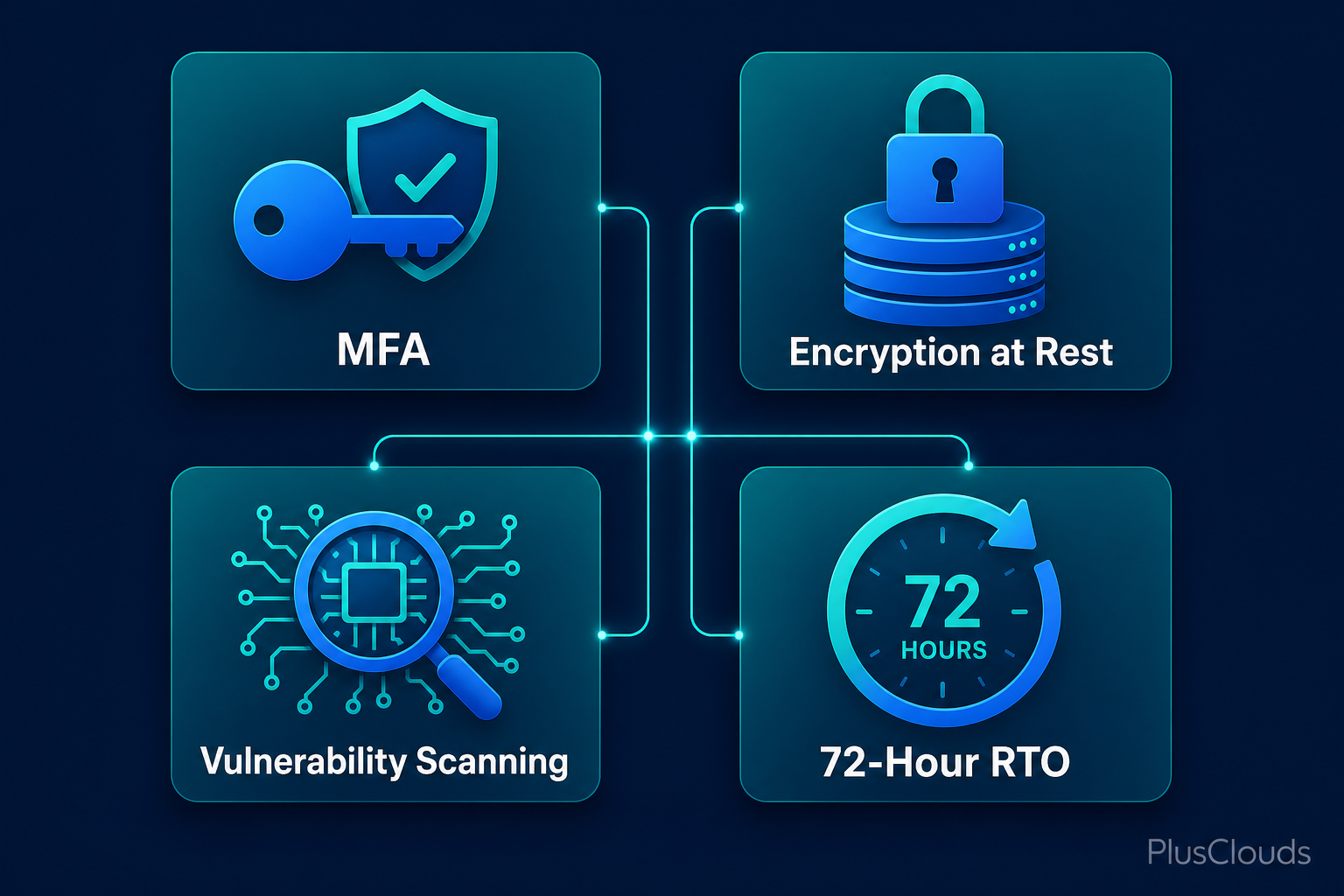
These four controls are worth treating as a separate category because they represent the areas where the 2026 rule is most likely to generate audit findings for organizations that have not updated their cloud configurations.
Multi-factor authentication (MFA) is now required for all workforce members accessing systems that store, process, or transmit ePHI. This includes administrative consoles, remote access tools, and any cloud management interfaces. Passwordless authentication methods that meet the NIST SP 800-63B assurance level requirements are acceptable, but a username and password alone is not.
Encryption at rest must cover all ePHI stored in cloud environments. The rule does not mandate a specific algorithm by name, but HHS guidance consistently references AES-256 as the accepted standard. Critically, encryption must be implemented at the storage layer, not just at the application layer. A database that encrypts its own fields but sits on an unencrypted volume does not satisfy the requirement. Every disk, every object store bucket, every snapshot containing ePHI needs to be encrypted with keys that are managed and auditable.
Vulnerability scanning must now occur on a defined schedule, with documented remediation timelines. Critical vulnerabilities in ePHI systems must be remediated within a specified window, and the evidence of both scanning and remediation must be retained. Ad hoc scanning when something goes wrong is not enough.
72-hour recovery is the Recovery Time Objective (RTO) that the updated rule references for restoring access to ePHI following a disruption. Your backup and recovery architecture must be able to demonstrate that ePHI systems can be restored within 72 hours. This is not a target to aspire to; it is a requirement to document, test, and prove. If you have not run a full restore test against your cloud backup environment recently, that gap needs to close before your next audit.
For teams thinking about ransomware-proof backup design, the 3-2-1-1 backup rule architecture provides a solid foundation that maps well to these recovery requirements.
How to Map HIPAA Security Rule Requirements to Your Cloud Server Configuration
Mapping the HIPAA Security Rule to actual server configuration is where compliance work gets concrete. At the server level, the 2026 requirements translate into a specific set of configuration baselines.
Every server that processes ePHI should be built from a hardened image. That means disabling unnecessary services, enforcing SSH key authentication (with MFA for privileged access), setting automatic session timeouts, and applying OS-level audit logging from first boot. If you are deploying Linux virtual machines, your /etc/ssh/sshd_config should explicitly disable password authentication:
PasswordAuthentication no
PubkeyAuthentication yes
AuthenticationMethods publickey,keyboard-interactive
Patch management needs to be automated where possible and tracked where it cannot be. Every server should report its patch state to a central system, and unpatched critical CVEs on ePHI servers should trigger an incident workflow, not just a ticket in a backlog.
Disk encryption must be enforced at the hypervisor or storage layer, not left to individual server administrators. If your cloud provider offers encrypted volumes as an option, that option must be the default for any workload that touches ePHI. Key management must be separate from the encrypted data, and access to encryption keys must be logged.
Access control reviews, now explicitly required, mean you need a process to audit who has access to which ePHI systems, and evidence that this review happened on a regular schedule. Role-based access control (RBAC) with the principle of least privilege is not optional configuration; it is a compliance requirement.
PlusClouds Cloud Servers deploy on AMD EPYC processors with NVMe storage and support full root access, which gives your team the control needed to apply these configuration baselines without fighting a managed environment's restrictions.
HIPAA Cloud Storage and Backup: Encryption at Rest and 72-Hour RTO in Practice
Storage compliance under the 2026 rule has two distinct dimensions: the encryption of live data and the recoverability of that data under a tested, documented process.
For live storage, every volume, object store bucket, or file share containing ePHI must be encrypted with AES-256 or equivalent. Encryption keys must be managed through a dedicated key management service (KMS), with access logging enabled. Key rotation must happen on a defined schedule, typically annually at minimum. If a key is compromised, you need a documented procedure for re-encrypting affected data and rotating access credentials.
For backups, the 72-hour RTO requirement means your backup architecture must be tested, not just configured. A backup that has never been restored is not a backup; it is an assumption. Your recovery runbook should specify exactly which steps restore ePHI systems, how long each step takes, and who is responsible for each action. That runbook should be tested at least annually, with results documented and retained as audit evidence.
Automated Backup by PlusClouds provides automated backup and recovery with explicit RPO and RTO targets and SLA tracking, which directly supports the documentation requirements the 2026 rule introduces. When an auditor asks how you demonstrate your 72-hour recovery capability, having SLA-tracked restore metrics is a far stronger answer than a policy document.
Object storage used for ePHI archiving must also be encrypted at rest. PlusClouds Cloud Storage uses tiered HDD, SSD, and NVMe storage with encryption support, giving compliance teams the storage layer they need without managing the underlying hardware.
Network Segmentation and Firewall Rules for HIPAA-Compliant ePHI Environments
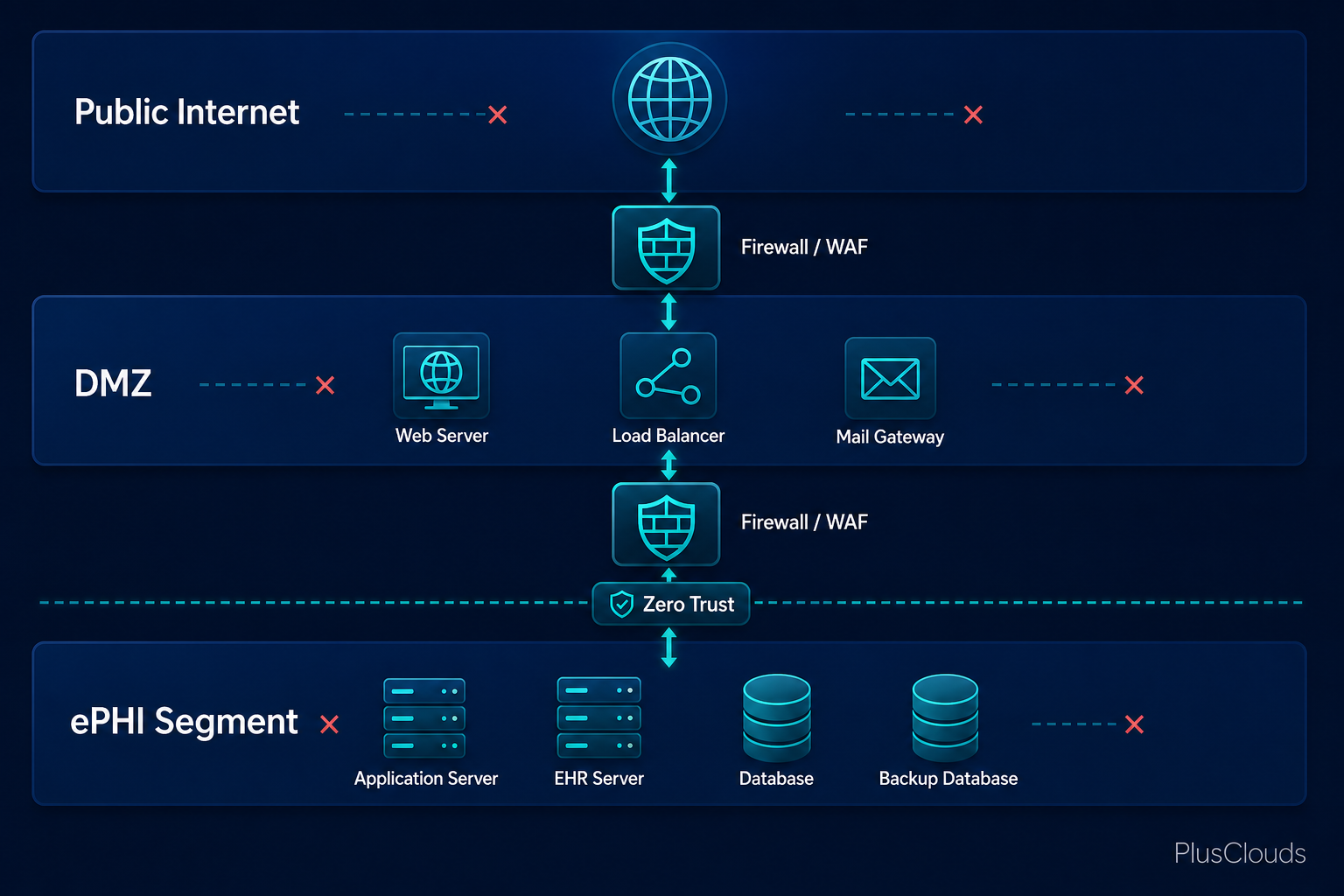
Network segmentation is one of the most frequently cited gaps in healthcare cloud environments. The 2026 rule makes explicit what was previously implied: ePHI systems must be isolated from general-purpose network traffic, and access must be controlled at the network layer, not just the application layer.
In practical terms, this means ePHI workloads should run in a dedicated network segment, with firewall rules that allow only the specific traffic those systems need. A database server holding patient records should not be reachable from a development environment, a marketing analytics server, or any other system that has no legitimate need for that access.
Your firewall rule documentation should be explicit and current. Rules should reference the business justification for each permitted flow, and rules that no longer have a justification should be removed. Undocumented firewall rules are a common audit finding because they suggest the network has grown organically without deliberate access control decisions.
For cloud environments, a zero trust approach to network access is the most defensible architecture. Rather than trusting traffic because it originates inside a network perimeter, every connection is authenticated and authorized at the session level. If you are building or rebuilding your network security posture, the zero trust cloud security guide covers practical implementation approaches that do not require a six-figure security budget.
Web-facing ePHI systems also need Web Application Firewall (WAF) protection. The 2026 rule's vulnerability management requirements implicitly cover web application vulnerabilities, and a WAF that covers the OWASP Top 10 is the standard mitigation. PlusClouds Cloud Security includes a stateful firewall plus WAF with OWASP Top 10 coverage, always-on DDoS mitigation at 1 Tbps+, and ISO 27001 / SOC 2 certifications that directly support your vendor verification obligations.
Vendor Verification: Proving Your Cloud Provider Meets HIPAA Technical Safeguards Annually
A Business Associate Agreement is necessary but not sufficient. The 2026 HIPAA Security Rule requires covered entities to verify that their business associates, including cloud providers, actually implement the required technical safeguards. Annual verification is now an explicit expectation.
What does verification look like in practice? At minimum, you should obtain and review your cloud provider's current SOC 2 Type II report, ISO 27001 certificate, and any HIPAA-specific attestation they offer. These documents should be reviewed by someone who can evaluate whether the controls described actually cover your use case. A SOC 2 report that covers the provider's corporate systems but excludes the specific services you use for ePHI storage is not adequate verification.
You should also review the provider's penetration testing schedule and results, their incident response procedures and notification timelines, their data deletion and media sanitization policies, and their subprocessor list (the vendors they use who might also touch your data).
Document this review process. Keep copies of the certificates and reports you reviewed, note the date of review, and record who performed it. If your cloud provider updates their certifications annually, your review process should align with that cycle.
The PlusClouds Datacenter operates Tier 3 facilities with N+1 redundancy and a 40 Gbps backbone, with ISO 27001 and SOC 2 certifications that give compliance teams a documented starting point for annual vendor verification.
Building a HIPAA Audit Trail: Logging, Monitoring, and Evidence That Holds Up
Audit logging under the 2026 rule is not optional, and it is not satisfied by turning on a logging service and forgetting about it. The rule requires that you capture specific event types, retain logs for a defined period, and be able to produce those logs in response to an audit or investigation.
The event types that must be logged include all access to ePHI (successful and failed), all administrative actions on ePHI systems, all authentication events (including MFA), all configuration changes to security controls, and all data exports or transfers involving ePHI. Logs must be tamper-evident, which in practice means they should be written to a separate, append-only log storage system that the servers themselves cannot modify.
Log retention must cover a minimum of six years under the HIPAA record retention requirements. Cloud log storage is cost-effective for this purpose, but you need to verify that the retention policy is enforced and that logs are actually retrievable after extended periods.
Monitoring should be active, not just archival. Real-time alerting on anomalous access patterns, failed authentication spikes, and unexpected data transfers gives you the ability to detect and respond to incidents before they become breach notifications. Your monitoring rules should be documented, reviewed periodically, and tested to confirm they actually fire when the conditions they are meant to detect occur.
How PlusClouds Cloud Servers, Storage, Automated Backup, and Security Meet the 2026 HIPAA Requirements
Building HIPAA-compliant cloud infrastructure from scratch is a significant project. The infrastructure components you choose either make that project easier or harder. The right provider gives you encrypted storage by default, network isolation tools that do not require custom engineering, backup systems with documented RTO and RPO targets, and security certifications you can hand to an auditor.
PlusClouds Cloud Servers deploy in 60 seconds on AMD EPYC hardware with NVMe storage, with full root access that lets your team apply hardened OS configurations without fighting platform restrictions. The 99.98% uptime SLA supports the availability requirements the HIPAA Security Rule imposes on ePHI systems. The networking layer supports five distinct network types including private and DMZ configurations, which maps directly to the network segmentation requirements described earlier.
Cloud Storage provides tiered encrypted storage for ePHI data at rest, while Automated Backup delivers the tested, SLA-tracked recovery capability the 72-hour RTO requirement demands. Cloud Security adds the stateful firewall, WAF, and DDoS mitigation layer that protects ePHI systems from the external threats the vulnerability management requirements are designed to address. The ISO 27001 and SOC 2 certifications across the platform give your compliance team the third-party attestation they need for annual vendor verification.
This combination covers the four non-negotiable technical controls: MFA support at the infrastructure level, AES-256 encryption at rest, integrated security scanning, and documented backup recovery within the required 72-hour window.
A 180-Day HIPAA Cloud Compliance Checklist for Infrastructure Teams
Use this checklist to structure your compliance work across a realistic timeline. The items are sequenced so that foundational controls are in place before dependent controls are built on top of them.
Days 1-30: Inventory and Gap Assessment
- Complete a full inventory of all cloud resources that store, process, or transmit ePHI
- Map each resource to the four mandatory technical controls (MFA, encryption at rest, vulnerability scanning, 72-hour RTO)
- Identify gaps between current configuration and 2026 requirements
- Review existing Business Associate Agreements for technical safeguard language
- Obtain current SOC 2 Type II and ISO 27001 certificates from all cloud providers
Days 31-60: Access Control and Authentication
- Enable MFA for all accounts with access to ePHI systems
- Implement RBAC with least-privilege access across all ePHI environments
- Disable password-only authentication on all servers handling ePHI
- Conduct an initial access review and document the results
- Establish a quarterly access review schedule
Days 61-90: Encryption and Storage Configuration
- Verify encryption at rest is enforced on all storage volumes and object stores containing ePHI
- Implement or migrate to a dedicated KMS with access logging enabled
- Enable key rotation on a defined schedule
- Audit all database configurations to confirm encryption is at the storage layer, not only the application layer
- Document encryption configurations with screenshots or configuration exports for audit evidence
Days 91-120: Network Segmentation and Firewall Rules
- Segment ePHI workloads into dedicated network environments
- Audit existing firewall rules and remove or document all rules touching ePHI segments
- Deploy WAF protection for all web-facing ePHI systems
- Enable and test network-level logging for ePHI segments
- Document the network architecture with a diagram showing segmentation boundaries
Days 121-150: Backup, Recovery, and Vulnerability Management
- Configure automated backups for all ePHI systems with explicit RPO and RTO targets
- Run a full restore test and document the time required
- Establish a vulnerability scanning schedule and run the first scan
- Remediate all critical vulnerabilities within the required window and document the remediation
- Create or update the incident response plan to reference the 72-hour recovery requirement
Days 151-180: Logging, Monitoring, and Audit Readiness
- Verify all required event types are being logged to a tamper-evident, append-only log store
- Confirm log retention policies enforce the six-year minimum
- Configure real-time alerting for anomalous access and authentication events
- Test alerting rules to confirm they fire correctly
- Assemble the audit evidence package: certificates, configuration exports, access review records, backup test results, vulnerability scan reports
The 2026 HIPAA Security Rule update rewards organizations that have already built their cloud infrastructure on defensible technical controls, and it creates real exposure for those who have relied on policy documentation as a substitute for actual configuration. The gap between those two positions is closable, but it requires treating compliance as an engineering problem, not a paperwork exercise.
If you are building or rebuilding your healthcare cloud infrastructure to meet the 2026 requirements, PlusClouds Cloud Servers, Storage, Automated Backup, and Cloud Security provide the technical foundation your compliance team needs, backed by the certifications your auditor will ask for. The 180-day checklist above is a starting point. The configuration work that follows is what makes it real.