You get the alert at 3:14 AM. Checkout is down. Your monitoring shows CPU pinned at 100% on every web node, and the traffic graphs look like someone plugged the internet directly into your load balancer. By the time your on-call engineer has SSH'd in and run the first diagnostic, the attack is over. Total duration: under ten minutes. Damage done: a full hour of failed transactions, a page-one incident channel, and a very awkward morning standup.
That is what application-layer DDoS looks like in 2026. It is short, surgical, and specifically engineered to slip past the defenses most teams already have. The Radware 2026 Global Threat Report puts numbers on what many security teams have been feeling anecdotally: network-layer DDoS attacks jumped 168% year over year, web DDoS rose 101%, and malicious application and API traffic climbed 128%. The battleground has moved up the stack, and it moved fast.
This guide walks through what is actually happening in the 2026 threat landscape, why Layer 7 (L7) attacks evade the tools most teams rely on, and how always-on mitigation architecture differs from the on-demand scrubbing model that keeps failing short attacks. By the end, you will have a concrete checklist for network design, detection, and incident response that holds up against a 35-second flood.
Table of Contents
- Key Takeaways
- The 2026 DDoS Landscape: 168% YoY Growth, 31.4 Tbps Records, and Why the Threat Is Compounding
- Why L7 Attacks Are the New Normal: How 89% of Attacks Now Last Under 10 Minutes
- How Multi-Vector Attacks Work: Blending Volumetric Floods, Protocol Exploits, and HTTP Request Floods
- Why Your Existing Stack Falls Short: The Detection Gap Between Static Thresholds and Realistic Traffic
- Always-On Mitigation vs. On-Demand Scrubbing: What the Architecture Difference Means in a 35-Second Attack
- 1 Tbps+ DDoS Mitigation in Practice: How Stateful Firewall, WAF, and Backbone Capacity Work Together
- Network Design for DDoS Resilience: Using DMZ, Public, and Management Zones to Contain Blast Radius
- Incident Response Playbook: From Detection to Mitigation in Under 60 Seconds
- The Takeaway: Assume the Attack Has Already Started
Key Takeaways
- Network-layer DDoS attacks grew 168% year over year in 2026, web DDoS grew 101%, and malicious application and API traffic grew 128%, according to the Radware 2026 Global Threat Report.
- Roughly 89% of DDoS attacks now complete in under ten minutes, with some botnet toolkits cycling an entire attack in about 35 seconds.
- L7 DDoS attacks use valid-looking HTTP requests, often routed through residential proxies, so signature-based WAFs and static rate limits cannot detect them. Behavioral analysis is required.
- On-demand scrubbing takes 15 to 45 minutes to activate, which is useless against a 35-second attack. Always-on mitigation is the only architecture whose response time matches the threat.
- Effective defense combines terabit-class capacity (1 Tbps+), a stateful firewall, a behavioral WAF covering OWASP Top 10, segmented network zones, and an automated incident response loop measured in seconds.
The 2026 DDoS Landscape: 168% YoY Growth, 31.4 Tbps Records, and Why the Threat Is Compounding
Start with the raw numbers, because they tell a story on their own.
According to Radware's 2026 Global Threat Report, network-layer DDoS activity surged 168% year over year, web DDoS attacks (HTTP floods targeting your actual applications) grew 101%, and malicious traffic against applications and APIs rose 128%. Peak attack sizes have reached record territory, with industry trackers documenting floods in the multiple-terabit range, including attacks approaching 31.4 Tbps against major providers. Aggregated DDoS statistics consistently show both frequency and scale trending sharply upward across every sector.
Three forces are compounding behind these numbers:
- Cheap amplification. Booter-for-hire services and misconfigured reflection protocols mean an attacker with a modest budget can rent a terabit-scale flood. The barrier to entry has collapsed.
- The API economy. Every SaaS product now exposes dozens or hundreds of API endpoints. Each one is an L7 attack surface that cannot be protected by raw bandwidth alone.
- Geopolitical and financial motivation. DDoS has become a routine tool for extortion, hacktivism, and competitive sabotage, which means attack volume tracks with global tension and business cycles rather than with any single vulnerability you can patch.
The important nuance for capacity planners: raw attack size is the headline, but it is not the primary threat to most businesses. A 30 Tbps flood against your transit provider is their problem. A 40 Gbps HTTP request flood that mimics real users and exhausts your application workers is your problem, and no amount of upstream bandwidth solves it.
Why L7 Attacks Are the New Normal: How 89% of Attacks Now Last Under 10 Minutes
Here is the statistic that should change how you architect your defenses: industry analysis of attack telemetry shows roughly 89% of DDoS attacks now complete in under ten minutes, with a large share finishing in under five. Some modern botnet toolkits can cycle an entire attack in around 35 seconds.
Why so short? Because short attacks are rational.
A prolonged attack gives defenders time to engage scrubbing services, block source ranges, and gather evidence for law enforcement. A burst attack that ends before your mitigation pipeline even triggers achieves the disruption goal with near-zero risk of countermeasures. Attackers have learned that they do not need to hold your infrastructure down. They only need to knock it down repeatedly, at the moments that hurt most: flash sales, product launches, quarterly closes, live events.
This timing asymmetry breaks the traditional mitigation contract. The classic model assumes you detect an attack, make a phone call or flip an API switch, traffic gets rerouted to a scrubbing center, BGP propagates, and filtering begins. That cycle takes 15 to 45 minutes in a good case. Against a 35-second attack, it takes zero minutes of effectiveness. You are mitigating an attack that already ended, and the next one arrives while your team is still reading the runbook.
The defense implication is simple but demanding: mitigation must be running before the attack starts. That is the core argument for always-on architecture, which we will get to shortly.
How Multi-Vector Attacks Work: Blending Volumetric Floods, Protocol Exploits, and HTTP Request Floods
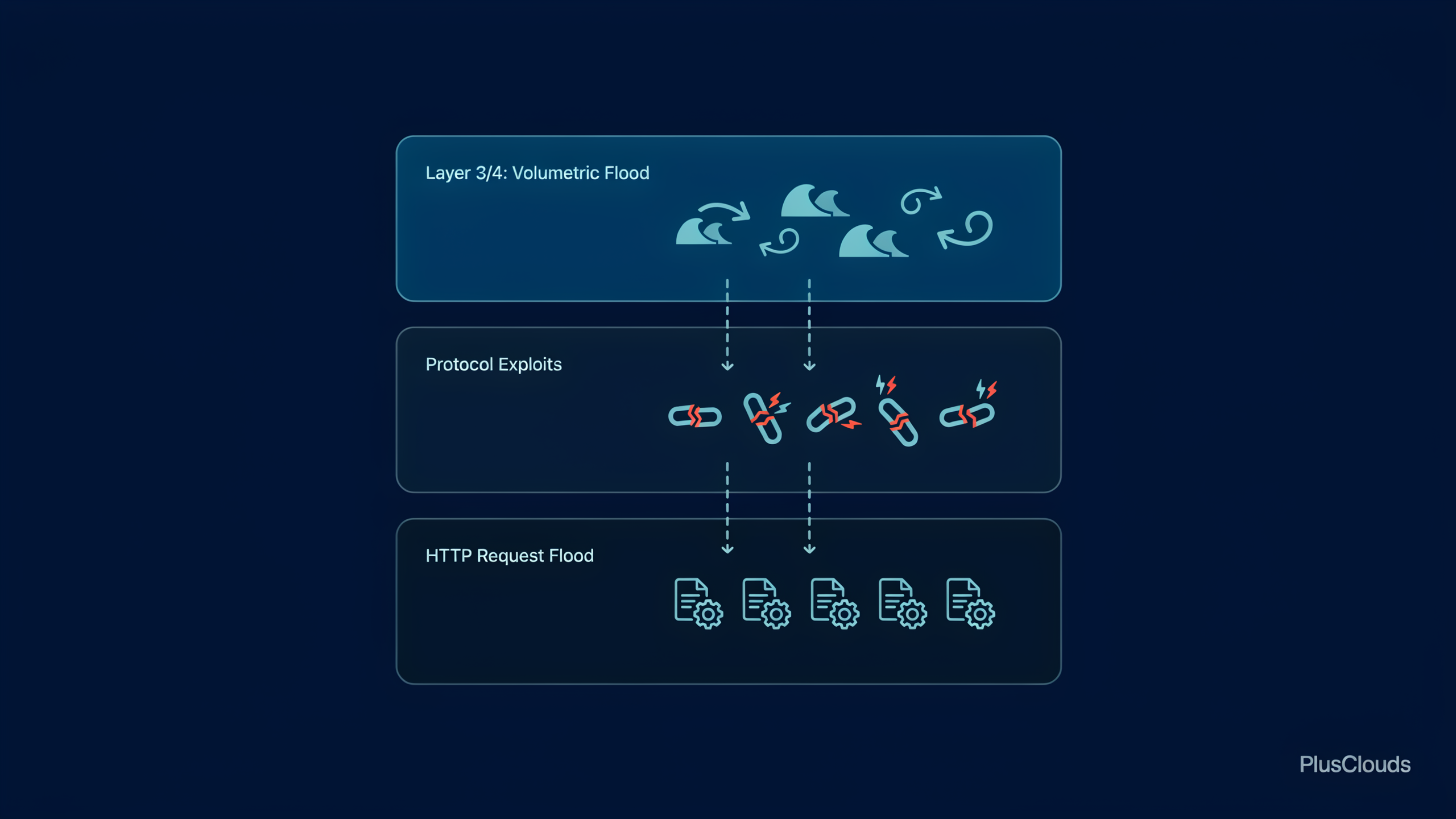
Modern attacks rarely come in one flavor. A multi-vector DDoS hits Layers 3, 4, and 7 simultaneously, and the layering is deliberate.
A typical campaign looks like this:
- Layer 3/4 volumetric flood (UDP amplification, SYN flood): saturates bandwidth and fills state tables. This is the noise, designed to consume your attention and your upstream capacity.
- Protocol exploits (slowloris-style connections, malformed packets): target middlebox and load balancer session limits, exhausting connection pools without needing much bandwidth.
- HTTP request flood: the payload. Requests that look like legitimate traffic, hitting expensive endpoints such as search, login, checkout, or report generation, designed to exhaust CPU, database connections, and cache.
The layering defeats point solutions. If you scale bandwidth to absorb the volumetric layer, the HTTP flood still kills your application. If you filter aggressively at the application layer, the attacker varies the flood mix to slip past whatever signature you just deployed. Defending each layer in isolation means defending none of them well.
The L7 layer deserves special attention because it is the hardest. Consider what a realistic HTTP flood looks like:
GET /api/v2/search?q=wireless+headphones&sort=price HTTP/1.1
Host: shop.example.com
User-Agent: Mozilla/5.0 (Windows NT 10.0; Win64; x64) ...
Accept: text/html,application/xhtml+xml
Cookie: session=7f3a9c... (valid-looking session token)
No malformed headers. No obvious bot signature. Possibly requests sourced from residential proxy networks, so IP reputation gives you nothing. Possibly rotating through thousands of valid-looking sessions scraped from a credential-stuffing run last month. The only reliable signal is behavioral: request rate per session, endpoint cost distribution, header-order fingerprints, TLS fingerprints, and ratio anomalies (for example, search-to-product-view ratios that no human cohort produces).
This is why L7 DDoS protection is fundamentally a detection and behavioral-analysis problem, not a bandwidth problem.
Why Your Existing Stack Falls Short: The Detection Gap Between Static Thresholds and Realistic Traffic
Most teams have some defense in place already. So why does it keep failing? Three structural gaps.
Gap 1: Static thresholds versus dynamic baselines. The classic rate-limit rule ("block IPs exceeding 100 requests per minute") breaks in both directions. During a product launch or a viral moment, legitimate traffic spikes past your thresholds and you block real customers. Meanwhile, a modern flood spreads across tens of thousands of IPs, each staying politely under your per-IP limit while collectively exhausting your pool. Static rules cannot distinguish a flash crowd from a flood, because at the request level they look identical.
Gap 2: Signature-based WAF rules versus adaptive attacks. A WAF tuned to block known-bad patterns (scanners, injection payloads, obvious bot user agents) is necessary but not sufficient. L7 DDoS traffic is often valid HTTP. It carries no payload signature to match. Signature-based tools were built to stop exploits, not to stop 200,000 legitimate-looking search queries per second.
Gap 3: Human-speed response versus machine-speed attacks. Even with good telemetry, the median security team's detection-to-mitigation loop involves an alert, a human, a decision, and a configuration change. That loop is measured in minutes. The attack is measured in seconds. Unless detection and mitigation are automated and always-on, the loop loses by construction.
There is also a subtler failure mode: over-blocking as self-inflicted downtime. Teams that respond to L7 floods with aggressive blanket rate limits frequently take themselves offline to legitimate users. The attacker achieves the same result without the bandwidth bill. Effective mitigation has to be surgical, which requires the behavioral layer most in-house stacks lack.
Always-On Mitigation vs. On-Demand Scrubbing: What the Architecture Difference Means in a 35-Second Attack
This is the decision that matters most in your 2026 DDoS architecture, so let's be precise about the difference.
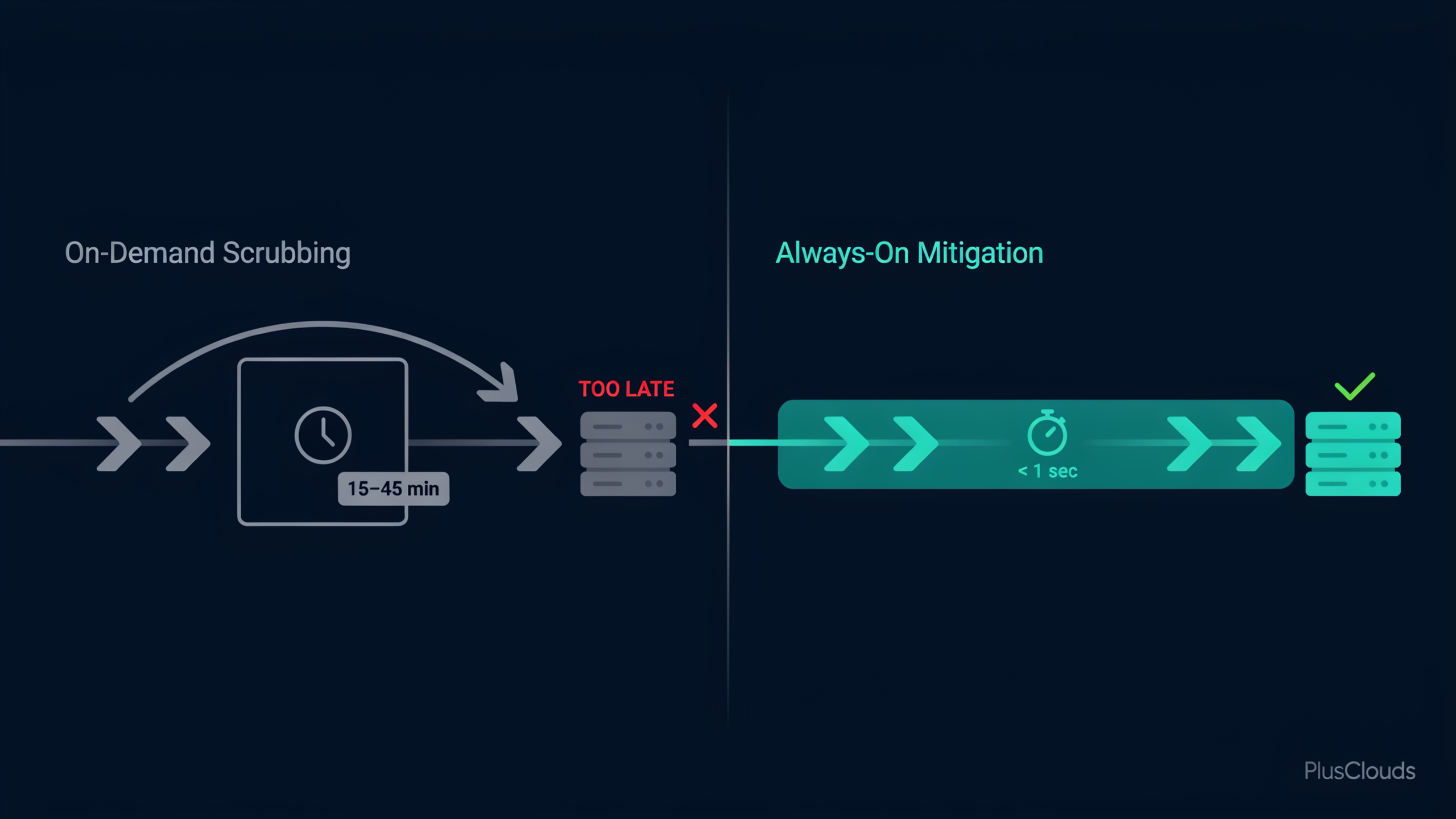
On-demand scrubbing means your traffic normally flows directly to your infrastructure. When an attack is detected, you (or your provider) redirect traffic through a scrubbing center, typically via BGP announcement changes. The scrubbing center filters the attack traffic and forwards clean traffic back. It is cost-efficient for rare, long attacks. Its weakness is the activation cycle: detection, decision, BGP propagation, filter tuning. Realistically 15 to 45 minutes before full protection.
Always-on mitigation means all of your traffic passes through the mitigation layer continuously, in normal times and during attacks. Filtering is always active. There is no activation step, no propagation delay, no cold start. An attack that begins at T+0 is being filtered at T+0.
Now run the 35-second attack through both architectures:
- On-demand: the attack starts and ends before the reroute decision is even made. Your mitigation invoice buys you a post-mortem, not protection.
- Always-on: the flood hits the mitigation layer, behavioral models classify the anomalous request patterns within seconds, filtering engages automatically, and your origin servers may never notice.
Given that 89% of attacks finish in under ten minutes and a meaningful share finish in under a minute, always-on is not a luxury tier anymore. It is the only architecture whose response time matches the threat's. The trade-off is that always-on filtering must be extremely accurate in steady state, because it touches every legitimate request all the time. That is why the quality of the behavioral detection engine matters as much as the raw capacity behind it.
When evaluating DDoS mitigation for cloud infrastructure, the checklist we recommend: confirm mitigation is always-on by default (not a toggle), confirm capacity in the terabit class (1 Tbps+ is the sane 2026 baseline given record attacks above 30 Tbps upstream), and confirm L7 behavioral filtering, not just volumetric absorption.
1 Tbps+ DDoS Mitigation in Practice: How Stateful Firewall, WAF, and Backbone Capacity Work Together
Capacity without intelligence is a bigger pipe filling up slower. Effective mitigation is a layered pipeline where each layer handles the attacks it is best at.
Layer 1: Backbone and edge capacity. Raw headroom absorbs volumetric floods. This is why mitigation capacity is measured in terabits: the scrubbing layer needs enough headroom that a multi-hundred-gigabit flood does not saturate the path before filtering. A provider running a 40 Gbps backbone per data center with N+1 redundancy, like PlusClouds' Tier 3 facilities, pairs that backbone directly with always-on scrubbing capacity in the 1 Tbps+ class, so volumetric layers die at the edge.
Layer 2: Stateful firewall filtering. Stateful inspection drops spoofed packets, invalid protocol behavior, and non-application junk before it ever reaches your web tier. This is where protocol-layer exploits (malformed SYN sequences, connection-exhaustion attempts) get handled. A stateful firewall enforces connection-state sanity, which cheap stateless filtering cannot.
Layer 3: Web Application Firewall. The WAF is your L7 workhorse. It inspects HTTP requests against the OWASP Top 10 categories (injection, broken access control, security misconfiguration, and so on) and, critically for DDoS, applies rate and behavioral rules per session, per endpoint, and per fingerprint. A well-tuned WAF distinguishes a burst of legitimate checkout traffic from a flood targeting /checkout specifically, because it understands endpoint cost and session behavior, not just request counts.
Layer 4: Application hardening. Your own contribution: expensive endpoints cached aggressively, database connection pools sized with headroom, queue-based decoupling for heavy operations, and graceful degradation so that a flooded search endpoint does not take down checkout.
The layers compose. Volumetric noise is absorbed by capacity, protocol abuse is dropped by the stateful firewall, malicious or anomalous HTTP is filtered by the WAF, and whatever survives is handled by an application that was designed not to fall over. If you are running payment workloads, this same stack maps directly onto PCI DSS requirements, which we cover in detail in our PCI DSS 4.0.1 compliance guide.
Network Design for DDoS Resilience: Using DMZ, Public, and Management Zones to Contain Blast Radius
Mitigation capacity is external. Network architecture is what you control, and it determines how much damage any traffic that slips through can do.
The core principle is segmentation with an explicit blast radius. If your application tier, database tier, and management plane all share a flat network, one saturated tier takes everything down with it. The standard pattern uses three (or more) distinct zones:
- Public zone: load balancers, WAF endpoints, and anything that faces the internet. This zone is expendable by design. It exists to absorb and filter.
- DMZ zone: application servers that receive traffic only from the public zone's load balancers, never directly from the internet. Attackers who exhaust the public tier still cannot touch backends directly.
- Management zone: SSH, monitoring, orchestration, and admin panels, reachable only through VPN or private links. This zone must be architecturally invisible to the public internet.
This is not exotic design. It is table stakes, and it is exactly why PlusClouds Networking & Load Balancers exposes five network types (public, private, VPN, management, and DMZ) deployable from a single control plane. When the zones are one-click rather than a week of firewall wrangling, teams actually build them.
Two additional design rules worth enforcing:
- Load balancers as the only public entry point. Nothing else in your fleet should have a public IP. This concentrates filtering where the mitigation layer lives and shrinks your attack surface to a single, hardened tier.
- Rate-limit and health-check at the load balancer tier. Backend health checks let the load balancer pull saturated instances out of rotation before they cascade failures into shared services like caches and databases.
Segmentation also pays off during the attack itself: when the public zone is under flood, your management zone stays reachable, which means your engineers can still operate. That single property separates a controlled incident from a blind one.
Incident Response Playbook: From Detection to Mitigation in Under 60 Seconds
Architecture determines your ceiling; runbook discipline determines whether you hit it. Here is the playbook structure we recommend, tuned for the short-attack reality of 2026.
Before you begin (pre-incident, do this now):
- Verify your mitigation is always-on. If it requires activation, time the activation process and write the real number down.
- Inventory your expensive endpoints (search, login, checkout, exports, report generation) and pre-define per-endpoint rate baselines.
- Document your escalation chain with phone numbers, not just Slack handles. Attacks during a chat outage are a real thing.
- Pre-authorize emergency mitigations (aggressive WAF rules, geo-blocks, challenge modes) so no approval loop stands between detection and action.
T+0 to T+15 seconds: automated detection. Telemetry (request rate, connection state table usage, per-endpoint latency, WAF match rates) feeds automated classification. No human in this loop. If your detection depends on someone noticing a Grafana panel, your detection time is measured in minutes and you have already lost.
T+15 to T+40 seconds: automated mitigation. Pre-armed responses engage without approval: the WAF shifts to challenge mode for anomalous sessions, per-endpoint rate limits tighten, the stateful firewall drops the protocol-abuse patterns it has already classified. The goal is that the machine does the first 90% of mitigation while humans do the judgment calls.
T+40 to T+60 seconds: human verification and tuning. The on-call engineer confirms legitimate traffic is flowing (synthetic checks, not just graphs), reviews what the automation blocked, and adjusts if false positives are visible. This is also when you decide whether upstream escalation to your provider is needed for anything beyond the automated layer's scope.
Post-incident (within 24 hours): capture attack signatures, update behavioral rules, and run one improvement through to deployment. The attacker will be back, and they will iterate. Your defense has to iterate faster.
One more operational note: rehearse this. A tabletop exercise where your team simulates a 60-second L7 flood will surface more gaps in an afternoon than a year of document writing. Teams subject to DORA-style operational resilience requirements already face testing mandates of this kind; our DORA Article 11 & 12 guide covers how to structure and document those tests.
The Takeaway: Assume the Attack Has Already Started
The 2026 threat model in one sentence: attacks are bigger, shorter, more layered, and aimed squarely at your application logic rather than your pipes. Defending that model with static thresholds, signature-only WAFs, and on-demand scrubbing is defending last decade's threat.
What works is unglamorous and specific: always-on terabit-class mitigation, behavioral L7 filtering, a stateful firewall and WAF working as one pipeline, segmented networks with a deliberately small blast radius, and an incident response loop measured in seconds because the machines, not the humans, fire first.
If you are evaluating infrastructure against this standard, PlusClouds Cloud Security bundles the pieces this article described: always-on 1 Tbps+ DDoS mitigation, a stateful firewall, and a WAF with OWASP Top 10 coverage, backed by ISO 27001, SOC 2, and GDPR compliance. Combined with segmented networking, load balancers, and cloud servers deployed in 60 seconds with a 99.98% uptime SLA, it is the architecture we just walked through, available without building it yourself.
The next 35-second attack is not a question of if. It is a question of whether your mitigation is already running when it arrives. If you would like to see how this stack performs against your actual traffic patterns, reach out to the PlusClouds team or start a trial and test your defenses before someone else does it for you.