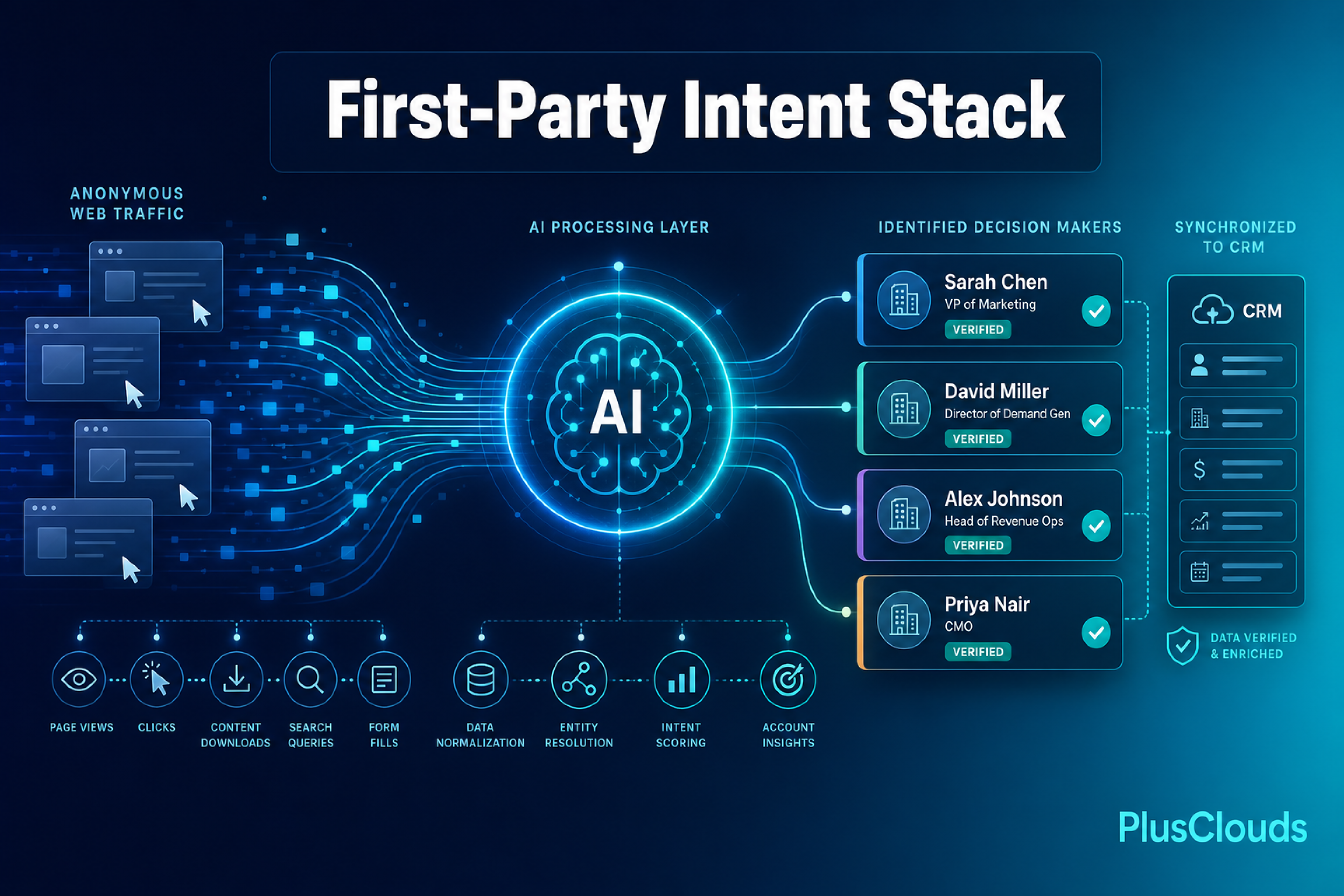
Most demand-generation teams are sitting on a gold mine they cannot see. Visitors land on your pricing page, read three case studies, and disappear. Your CRM logs nothing. Your SDRs never know. And somewhere in that anonymous traffic is the VP of Operations at a 400-person SaaS company who is actively evaluating your category right now.
That is the core problem with B2B buying in 2025: the research happens in private, the signals are scattered across a dozen tools, and the connection between "someone visited our site" and "an SDR sent a relevant email" almost never closes automatically. This guide walks you through building a first-party intent stack that resolves anonymous website activity into verified decision-maker contacts, scores them against firmographic and technographic context, and routes them into your CRM and outbound sequences without anyone touching a spreadsheet.
Key Takeaways
- B2B buyers complete roughly 70% of their evaluation before contacting a vendor, making first-party intent signals your earliest reliable window into active demand.
- First-party intent signals (website visits, content downloads, email engagement) are more timely and accurate than third-party intent subscriptions.
- Composite intent scoring, combining web activity, hiring triggers, funding events, and technographic data, produces a prioritized, actionable account list every day.
- LeadOcean by PlusClouds connects visitor identification to verified decision-maker contacts and writes them directly to HubSpot or Salesforce with intent context attached.
- Automated routing thresholds (60 points for SDR, 100 points for AE) eliminate manual review queues and ensure outreach happens while accounts are still in active research mode.
Table of Contents
- Why 70% of the B2B Buyer Journey Is Invisible to Your CRM (and What to Do About It)
- The Three Layers of B2B Intelligence: Firmographic, Technographic, and Intent
- First-Party Intent Signals You Already Have (But Are Not Acting On)
- How to Connect Website Visitor Identification to LeadOcean's 1.8B Company Database
- Stacking Signals: Combining Hiring Triggers, Funding Events, and Web Activity into a Composite Score
- Routing High-Intent Accounts into HubSpot and Salesforce Without Manual Steps
- Building the Signal-to-Sequence Playbook: What Happens the Moment an Intent Threshold Is Hit
- Measuring Intent Data ROI: Which Metrics Actually Prove the System Is Working
- Building the Stack Is Simpler Than It Looks
Why 70% of the B2B Buyer Journey Is Invisible to Your CRM (and What to Do About It)
The 70% figure is not a guess. Research from Gartner and widely cited demand-gen benchmarks consistently show that B2B buyers complete the majority of their evaluation before they ever contact a vendor. They read comparison articles, watch competitor demos, ask peers in Slack communities, and consume your content anonymously. Your CRM only captures the final 30%: the form fills, the demo requests, the inbound calls.
This creates a structural problem. Your SDRs are calling cold on accounts that have already made up their minds, while the accounts that are actively in-market right now go untouched because nobody knew they were there.
The fix is not buying more third-party intent data subscriptions and hoping the signals are fresh. The fix is building a system that starts with what you already own, your own website, your own content, your own product analytics, and then enriches those signals with external context to produce a prioritized, actionable list every single day.
The Three Layers of B2B Intelligence: Firmographic, Technographic, and Intent
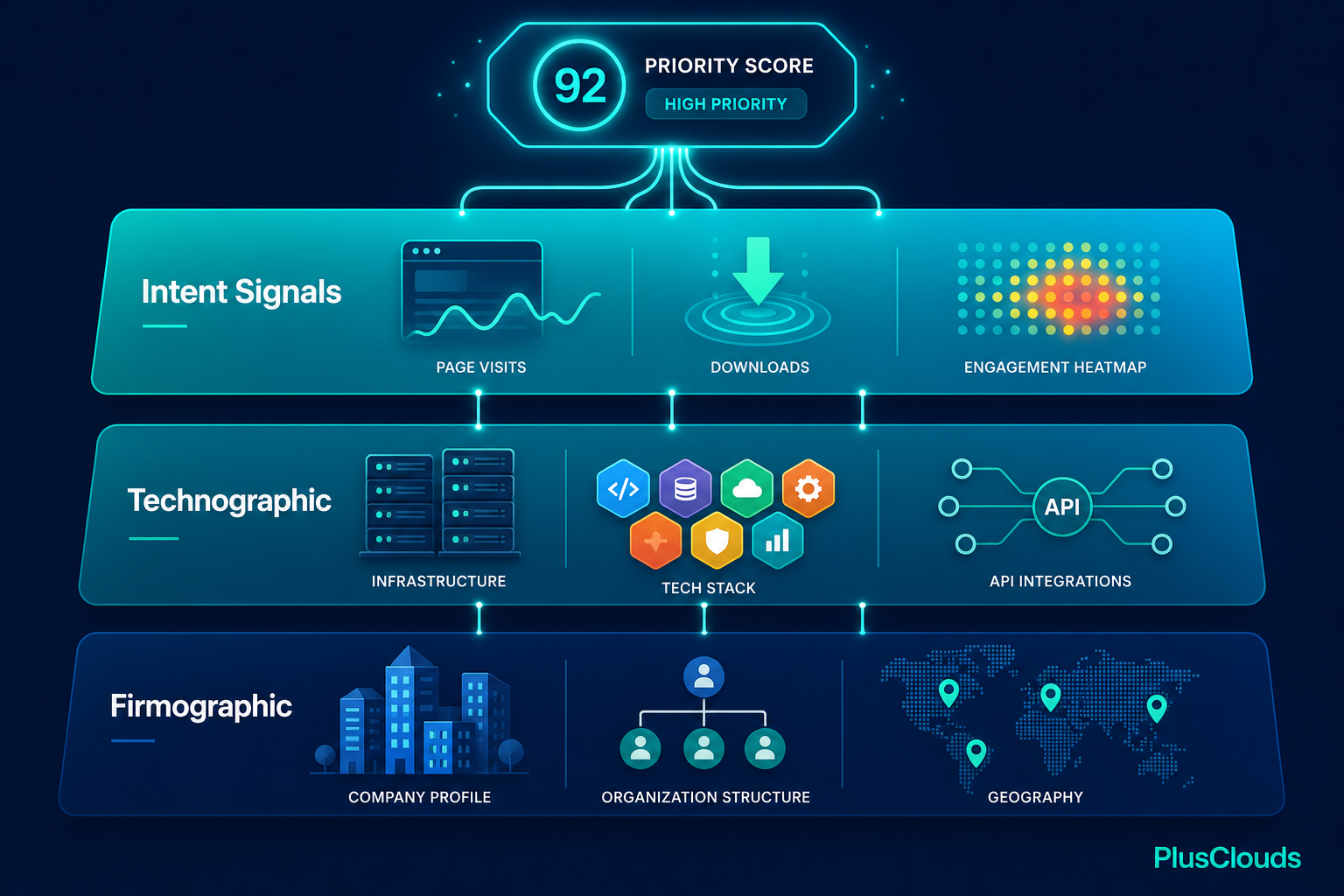
Before building anything, it helps to be precise about what kind of data you are stacking. There are three distinct layers, and conflating them is how teams end up with dashboards full of numbers that do not translate into booked meetings.
Firmographic data is the baseline: company size, industry, revenue range, headcount, geography. It tells you whether an account fits your Ideal Customer Profile (ICP). It does not tell you whether they are ready to buy.
Technographic data tells you what software and infrastructure an account already runs. If you sell a data integration tool, knowing that a prospect just adopted Snowflake is more useful than knowing their employee count. Tools like BuiltWith, Clearbit, and HG Insights surface this layer. LeadOcean by PlusClouds pulls technographic signals as part of its AI Match Engine, which means you can filter its 1.8 billion company database not just by firmographics but by the tech stack an account has deployed.
Intent data is the third layer, and it is the one most teams get wrong. Intent signals fall into two buckets: third-party (someone searched for a keyword on a publisher network you subscribe to) and first-party (someone visited your pricing page, downloaded your ROI calculator, or watched 80% of your product demo video). First-party signals are more reliable, more timely, and free. Third-party signals add breadth but degrade fast. The stack you want prioritizes first-party intent signals and uses third-party signals to confirm or amplify, not to lead.
First-Party Intent Signals You Already Have (But Are Not Acting On)
Most teams dramatically underestimate how much intent signal they are already generating and ignoring. Here is what is sitting in your existing tools right now:
- Website session data: Pages visited, time on page, scroll depth, return visits within a 30-day window. A company that hits your pricing page three times in a week is not browsing. They are evaluating.
- Content engagement: Which accounts downloaded a specific whitepaper, completed a product tour, or clicked through a comparison guide. Marketing automation platforms like HubSpot track this at the contact level, but most teams never aggregate it at the account level.
- Email engagement patterns: Click-through rates on nurture sequences, re-engagement with old sequences, forwarded emails (which often signal internal sharing with a buying committee).
- Product usage signals (for PLG companies): Free trial activations, feature adoption depth, seat expansion within a trial account, and failed upgrade attempts are all strong buying signals.
- Chat and support interactions: A prospect who opens a live chat and asks about your enterprise tier or SSO support is raising their hand. Most CRMs do not capture this.
- Ad engagement: Accounts that click your LinkedIn ads repeatedly but never convert are in-market and unconvinced. That is a retargeting and outreach opportunity, not a dead end.
The reason these signals go unused is not that teams do not know they exist. It is that no single tool aggregates them into a unified account-level score, and no automated workflow routes that score to an SDR. That is what the rest of this article builds.
How to Connect Website Visitor Identification to LeadOcean's 1.8B Company Database
Website visitor identification tools, including Clearbit Reveal, RB2B, Koala, and similar products, resolve anonymous IP traffic to company names using IP-to-company databases. The match rate varies (typically 20-40% of B2B traffic resolves cleanly), but even at 25%, you are uncovering hundreds of companies per month that your CRM has never seen.
The raw output of a visitor identification tool is a company name, sometimes an industry, and a rough location. That is not enough to act on. You need to know who at that company to contact, what their role is, and whether they fit your ICP before an SDR wastes time on them.
This is where connecting visitor identification to a verified contact database changes everything. The workflow looks like this:
- A visitor identification tool fires a webhook when a target account hits a high-value page (pricing, comparison, case studies).
- The webhook passes the company domain to LeadOcean's AI Match Engine via API.
- LeadOcean searches its database and returns verified contacts matching your ICP filters: job title, seniority level, department, and direct contact information.
- Those contacts are written to your CRM with the triggering intent event attached as a custom property.
The result is that an anonymous website visit becomes a named decision-maker contact in your CRM within minutes, with context about why they appeared and what page they were on. For teams running account-based marketing (ABM) plays, this is the difference between chasing accounts that look right on paper and reaching B2B in-market accounts that are demonstrably active. If you want to understand the broader signal-detection approach that powers this kind of workflow, the dark funnel prospecting guide covers the underlying logic in detail.
Stacking Signals: Combining Hiring Triggers, Funding Events, and Web Activity into a Composite Score
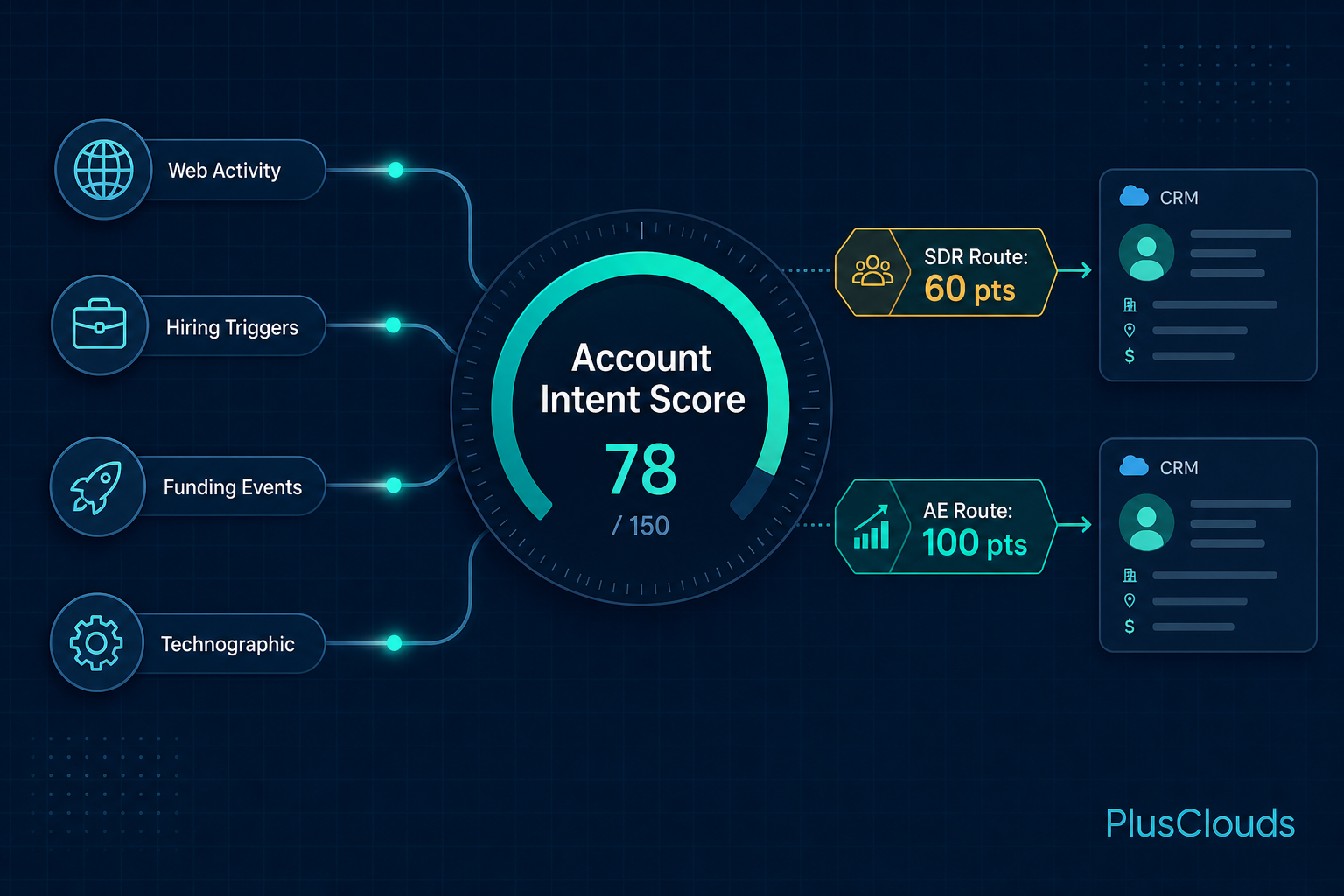
A single signal is a hypothesis. Multiple signals from the same account in the same window are a buying signal worth acting on.
Composite scoring is the practice of assigning point values to individual signals and summing them at the account level over a rolling time window (usually 30 days). Here is a simple example of what a scoring model might look like:
Account Intent Score (rolling 30 days):

+ 20 pts  Pricing page visit (any session)
+ 15 pts  Case study download
+ 10 pts  Return visit (2+ sessions in 30 days)
+ 25 pts  Job posting for a role your product replaces or integrates with
+ 30 pts  Series B/C funding event in last 90 days
+ 20 pts  Technographic: recently adopted a complementary tool
+ 15 pts  Email click on nurture sequence
+ 40 pts  Direct competitor comparison page visit

Threshold for SDR routing: 60 pts
Threshold for AE routing: 100 pts
The hiring trigger and funding event signals come from external data sources: LinkedIn job postings, Crunchbase, or purpose-built tools like Bombora or Apollo. The web activity signals come from your visitor identification layer and your marketing automation platform. LeadOcean's buying-signal detection layer can surface the external triggers automatically, so your scoring model does not require manual data pulls from five different tabs.
The key design decision is the threshold. Set it too low and SDRs get flooded with low-quality alerts. Set it too high and you miss accounts that are genuinely ready. Start conservative (60-70 points for SDR routing), measure conversion rates from routed accounts over 90 days, and adjust.
Routing High-Intent Accounts into HubSpot and Salesforce Without Manual Steps
The scoring model is only useful if it triggers action automatically. Manual review queues are where intent data goes to die. By the time someone checks the queue, reviews the account, and assigns it to an SDR, the buying window may have closed.
The automation layer connects your scoring engine to your CRM and your SDR workflow. Here is how the routing logic works in practice:
IF account_intent_score >= 60
AND account.owner IS NULL (not already being worked)
AND account.ICP_fit = "Strong"
THEN:
  - Create or update Account record in HubSpot/Salesforce
  - Attach intent_event_log to Account timeline
  - Assign to SDR based on territory rules
  - Enroll in Intent-Triggered Sequence (Sequence ID: IT-001)
  - Notify SDR via Slack: "High-intent account: [Company] hit pricing page 3x. Score: 82. Contact: [Name, Title]"
LeadOcean's native HubSpot and Salesforce integrations handle the CRM write without custom development. The contact record arrives with verified email, phone where available, LinkedIn URL, and the triggering intent signals attached. The SDR's first touchpoint is informed, not cold.
For teams already running outbound sequences, the signal-led outbound sequence playbook covers exactly how to structure the messaging once an account hits a threshold. The principle is the same: the signal tells you who to contact and why now, and the sequence delivers that context in a way that feels relevant rather than intrusive.
Building the Signal-to-Sequence Playbook: What Happens the Moment an Intent Threshold Is Hit
Routing an account to an SDR is step one. What the SDR does in the next 24 hours determines whether the intent signal converts into pipeline.
The signal-to-sequence playbook defines exactly what happens at each threshold level, so SDRs are not making judgment calls under pressure.
Tier 1 (60-79 points): Automated nurture with SDR visibility
- Account enters an automated email sequence personalized with the triggering signal ("I noticed [Company] has been exploring [topic] recently...")
- SDR receives a low-priority Slack notification for awareness
- No manual action required unless the account responds or the score increases
Tier 2 (80-99 points): SDR-assisted outreach
- SDR receives a priority alert with full account context
- SDR reviews and personalizes the first email before sending (template pre-populated with intent context)
- LinkedIn connection request sent within 24 hours
- SDR logs a call attempt within 48 hours
Tier 3 (100+ points): Immediate SDR and AE collaboration
- SDR and AE are both notified simultaneously
- Account is fast-tracked to a discovery call invitation
- Custom research brief generated (company news, funding, hiring trends, tech stack)
- AE approves and personalizes outreach before SDR sends
Eaglet by PlusClouds handles the automated outreach execution in Tiers 1 and 2, including multi-channel sequencing across email and LinkedIn, reply detection, and automatic removal from sequences when a contact responds. The combination of LeadOcean's contact verification and Eaglet's outreach automation means the entire Tier 1 workflow runs without SDR involvement, freeing human attention for the accounts that genuinely need it.
For a deeper look at how to build personalized outreach at scale using signal context, the signal-first outbound guide covers sequencing strategy and personalization mechanics in detail.
Measuring Intent Data ROI: Which Metrics Actually Prove the System Is Working
The wrong way to measure intent data ROI is to count how many intent signals you generated. Signals are inputs. What matters is what they produced downstream.
These are the metrics that actually tell you whether the system is working:
Pipeline coverage rate from intent-routed accounts. What percentage of accounts routed via intent signals converted to an open opportunity within 90 days? Compare this to your baseline conversion rate from cold outbound. If intent-routed accounts convert at 2x or better, the system is working.
Time-to-first-contact. How quickly does an SDR reach out after an account hits a threshold? The goal is under four hours for Tier 2 and Tier 3 accounts. Every hour of delay reduces the probability that the outreach lands while the account is still in active research mode.
Sequence reply rates by intent tier. Tier 3 accounts should reply at meaningfully higher rates than Tier 1. If they do not, your scoring model is not differentiating signal quality correctly. Adjust weights and thresholds based on actual reply data.
Contact match rate. What percentage of visitor-identified companies resolved to at least one verified ICP contact in LeadOcean? Track this monthly. A declining match rate may indicate your ICP filters are too narrow or your visitor identification tool is degrading.
Revenue influenced by intent-sourced pipeline. Closed-won deals where the first touch came from an intent signal, expressed as a percentage of total revenue. This is the number that justifies the budget.
Run a 90-day cohort analysis comparing intent-routed accounts against accounts sourced through traditional outbound or inbound. The conversion rate difference will be the clearest argument for expanding the program, and the clearest indicator of where the scoring model still needs tuning.
Building the Stack Is Simpler Than It Looks
The intent data problem sounds complex, and the vendor landscape does not help. There are dozens of tools claiming to solve pieces of it, and most RevOps teams end up with a fragmented mess of subscriptions that do not talk to each other.
The architecture described here is deliberately minimal. You need a visitor identification tool, a verified contact database with buying-signal detection, a composite scoring layer (which can live in HubSpot or Salesforce as a calculated property), and an outreach automation platform. Four components, one workflow.
LeadOcean by PlusClouds covers the contact database, the AI Match Engine, the buying-signal detection, and the CRM integration in a single platform. Eaglet handles the outreach automation. The visitor identification tool of your choice connects via webhook. The scoring logic lives in your CRM.
If your team is already running outbound sequences but struggling to prioritize which accounts to work, or if you are buying third-party intent data that never seems to translate into pipeline, this stack is worth building. Start with the first-party signals you already have, connect them to verified contacts, and let the composite score do the prioritization. The accounts that are ready to buy will surface themselves. Your job is to make sure an SDR reaches them before your competitor does.
To see how LeadOcean's AI Match Engine and buying-signal detection fit into this workflow, explore the platform at plusclouds.com/us/leadocean. If you want to layer in automated multi-channel outreach once the routing is in place, Eaglet is the natural next step.