Your enterprise sales pipeline looks healthy. Qualified leads, warm introductions, a product that solves a real problem. Then the procurement team sends over their vendor security questionnaire, and the deal goes quiet. Two weeks later, a polite email arrives: "We require SOC 2 Type II or ISO 27001 certification from all cloud-hosted vendors. Please reach out when you have completed your audit."
Enterprise procurement did not slow down while SaaS companies debated compliance budgets. It moved the requirement into the contract. According to research compiled by ITU Online, SOC 2 and ISO 27001 have become the two dominant security frameworks for cloud service providers, with enterprise buyers treating them not as differentiators but as baseline qualifications. If you cannot produce the report, you do not make the shortlist.
This guide is for CTOs, IT security leads, and compliance officers at SaaS companies and cloud-hosted B2B businesses who are staring down that requirement and need to choose a path. It covers which framework fits which situation, which controls satisfy both, and how to use your cloud provider's own certifications to cut months off your audit preparation.
Key Takeaways
- SOC 2 Type II is the baseline requirement for North American enterprise sales; ISO 27001 certification is the standard for European buyers and regulated industries.
- 89% of enterprise buyers require SOC 2 before signing contracts with cloud-hosted vendors; ISO 27001 adoption accelerated in 2025 alongside a 29% rise in multi-framework alignment.
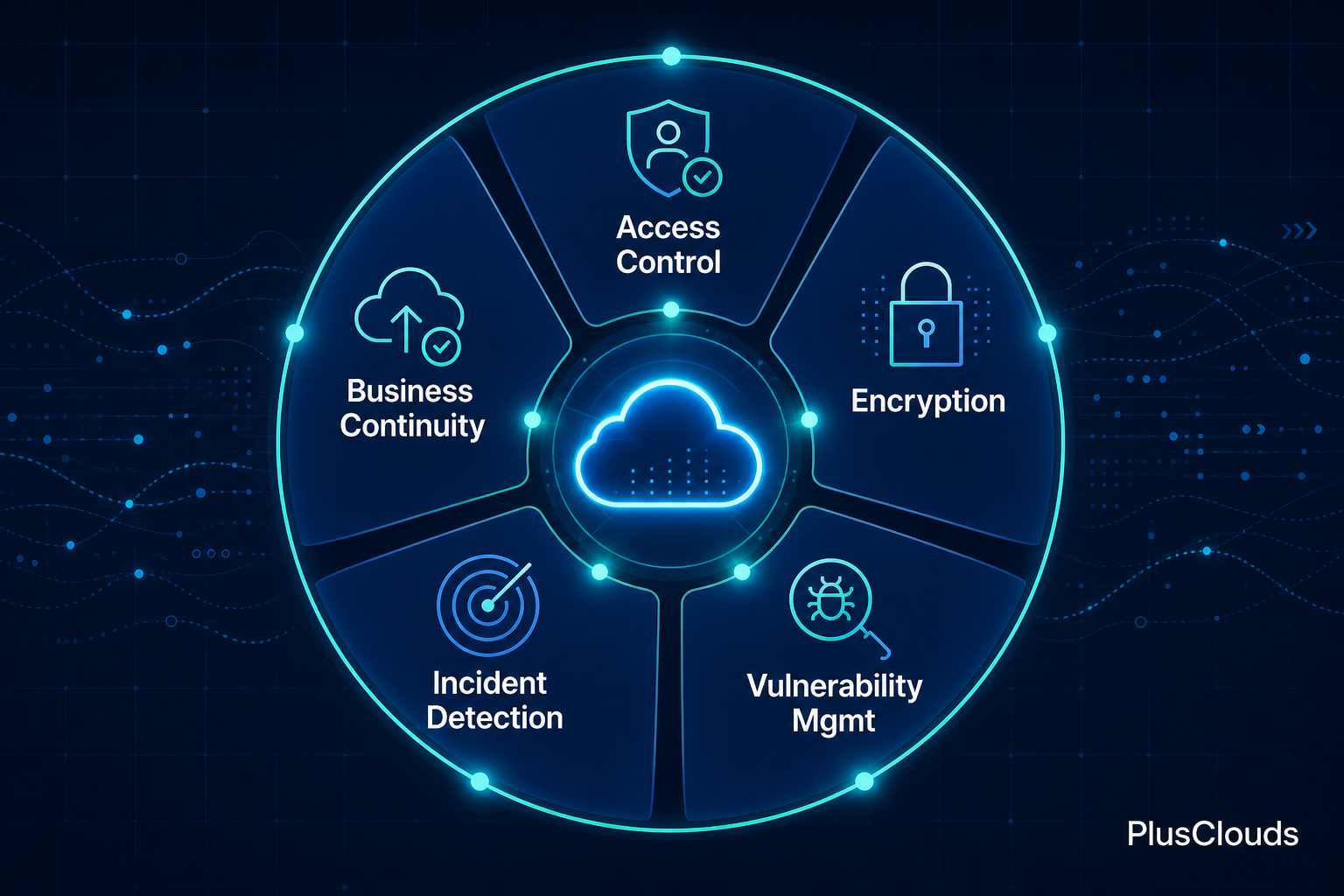
- Both frameworks share a core set of five infrastructure controls: least-privilege access, encryption in transit and at rest, centralized tamper-resistant logging, vulnerability management, and tested incident response.
- A cloud provider certified under ISO 27001 and SOC 2 can supply inherited evidence for physical, environmental, and network infrastructure controls, removing months of evidence collection work.
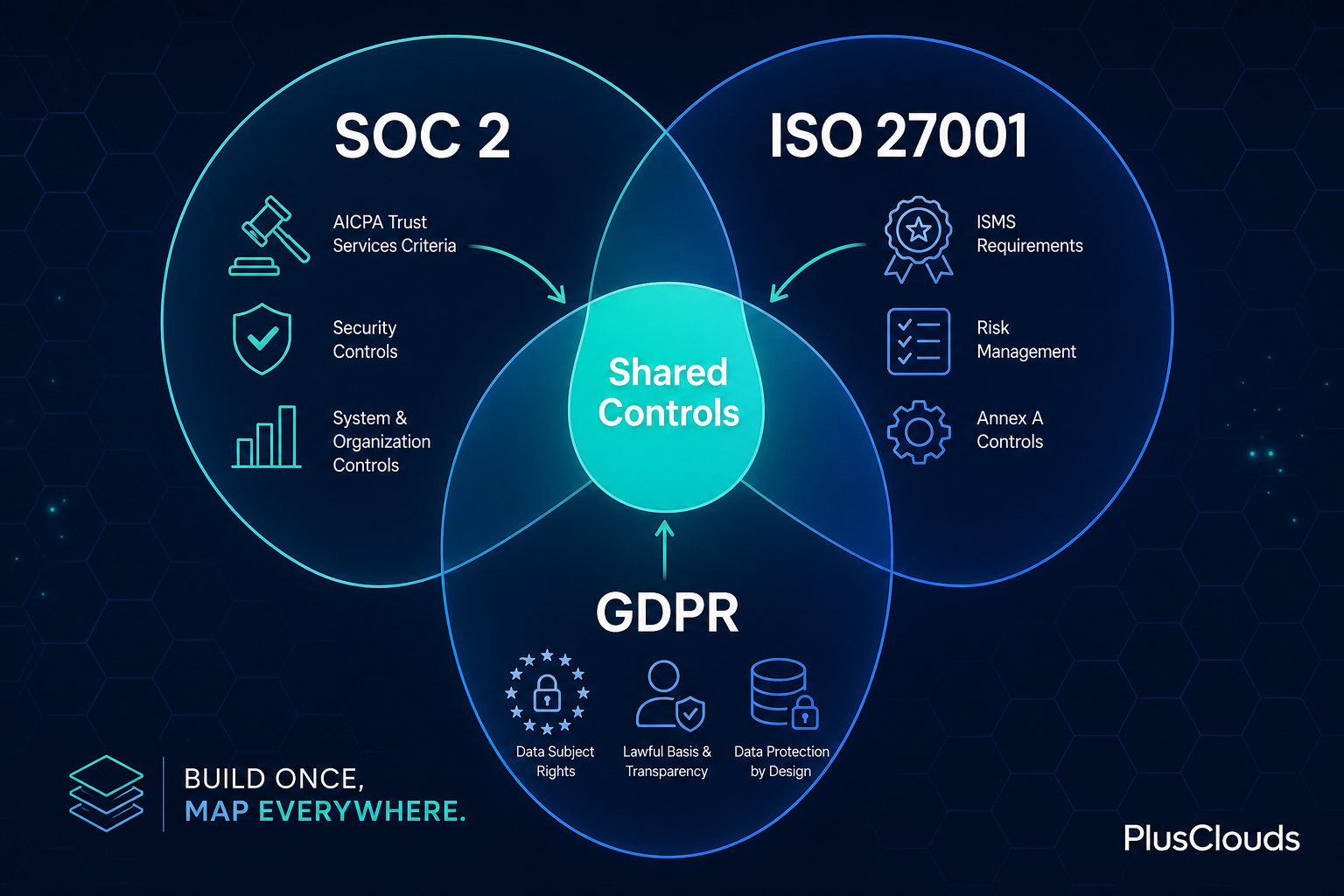
- A unified control framework mapped to SOC 2, ISO 27001, and GDPR simultaneously is more efficient than running three separate compliance programs.
Table of Contents
- Why Enterprise Buyers Now Treat SOC 2 and ISO 27001 as Baseline Requirements
- SOC 2 vs ISO 27001: What Each Framework Tests and Who Asks for Which
- The Five Infrastructure Controls Every Cloud Business Must Have for Both Frameworks
- How to Use Your Cloud Provider's Certifications as Inherited Compliance Evidence
- Firewall, WAF, and DDoS Protection: Mapping Perimeter Controls to Trust Services Criteria
- Backup, RTO, and RPO: Turning Automated Recovery Into SOC 2 Availability Evidence
- Network Segmentation as a Compliance Control: Public, Private, DMZ, and VPN Zones
- Multi-Framework Alignment: Running SOC 2, ISO 27001, and GDPR Without Rebuilding Controls
- Audit Readiness Checklist: What Your Cloud Infrastructure Must Document Before Day One
- Choosing Your Compliance Path and Building on Pre-Certified Cloud Infrastructure
Why Enterprise Buyers Now Treat SOC 2 and ISO 27001 as Baseline Requirements
Three years ago, a well-written security policy document and a signed data processing agreement were enough to get most enterprise deals across the line. That window has closed. Security review processes that once lived in IT departments have moved into procurement, legal, and sometimes the C-suite. The questionnaire arrives before the contract, not after.
The driver is liability. Enterprise buyers have watched enough breach headlines to understand that their vendors' security posture is now their own risk surface. A SaaS company that processes payroll data, customer records, or financial transactions sits inside the buyer's compliance perimeter. If that vendor gets breached, the buyer's auditors ask why they were approved in the first place.
The result is a clear market dynamic: enterprise buyers deprioritize or drop vendors that cannot produce the report. According to Venn's SOC 2 compliance research, 89% of enterprise buyers require SOC 2 before signing contracts with cloud-hosted vendors. ISO 27001 adoption is accelerating in parallel, particularly for deals involving European customers or regulated industries. Multi-framework alignment, meaning companies pursuing SOC 2 and ISO 27001 simultaneously, rose 29% in 2025.
If you are targeting enterprise accounts that are likely to carry these requirements, LeadOcean by PlusClouds surfaces compliance-driven buying signals, including companies actively researching SOC 2 or ISO 27001 vendors, so your sales team knows which deals are worth the certification investment before the questionnaire arrives.
The compliance investment is also not purely defensive. Completing a SOC 2 Type II audit or achieving ISO 27001 certification forces the internal documentation, access control reviews, and incident response procedures that mature engineering teams should have anyway. The audit is the accountability mechanism. Most companies do not implement the controls until someone external is checking.
SOC 2 vs ISO 27001: What Each Framework Tests and Who Asks for Which
SOC 2 and ISO 27001 are not competing standards. They test different things, originate from different bodies, and satisfy different audiences. Choosing between them, or deciding to pursue both, depends on your customer base, your geographic footprint, and your existing internal processes.
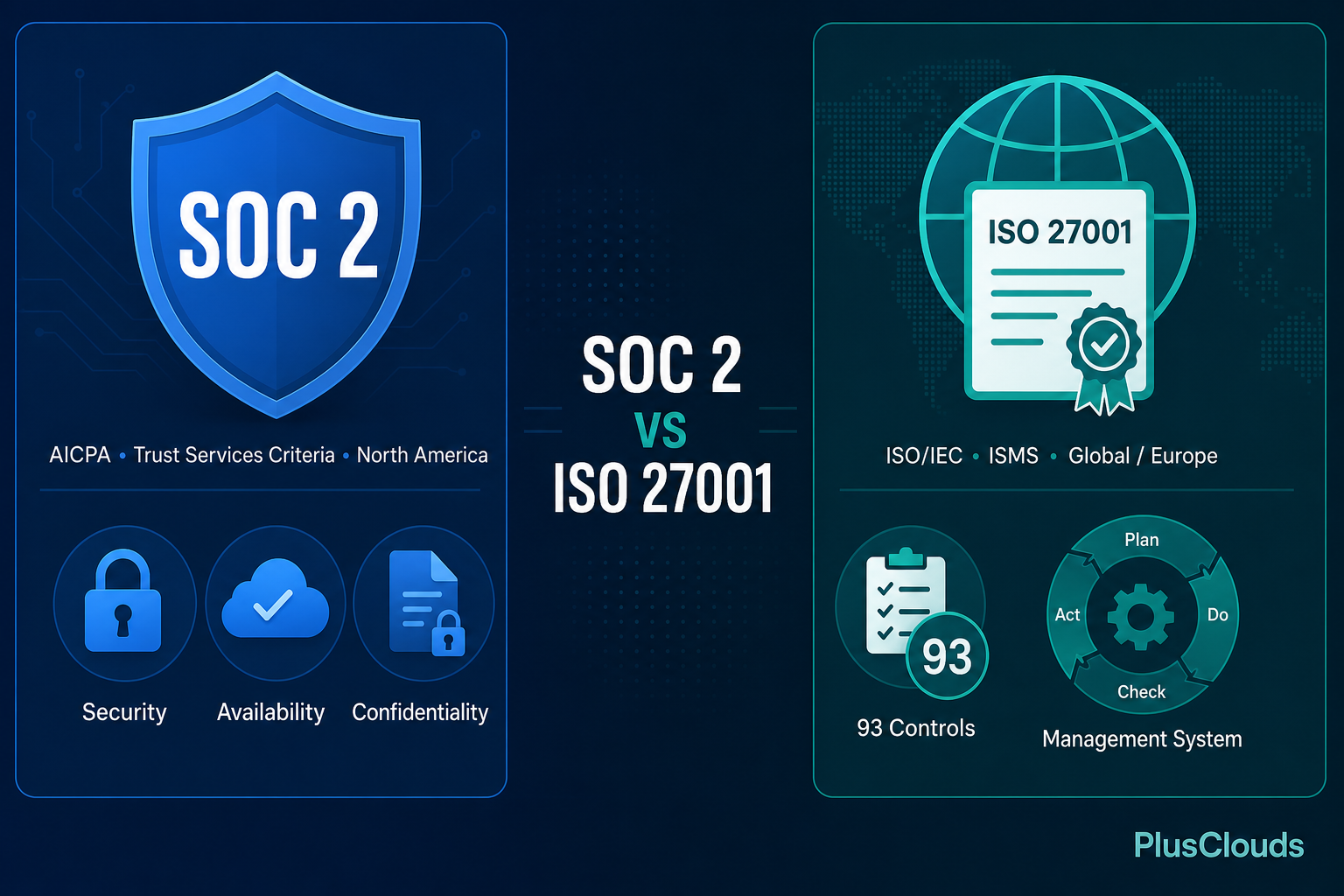
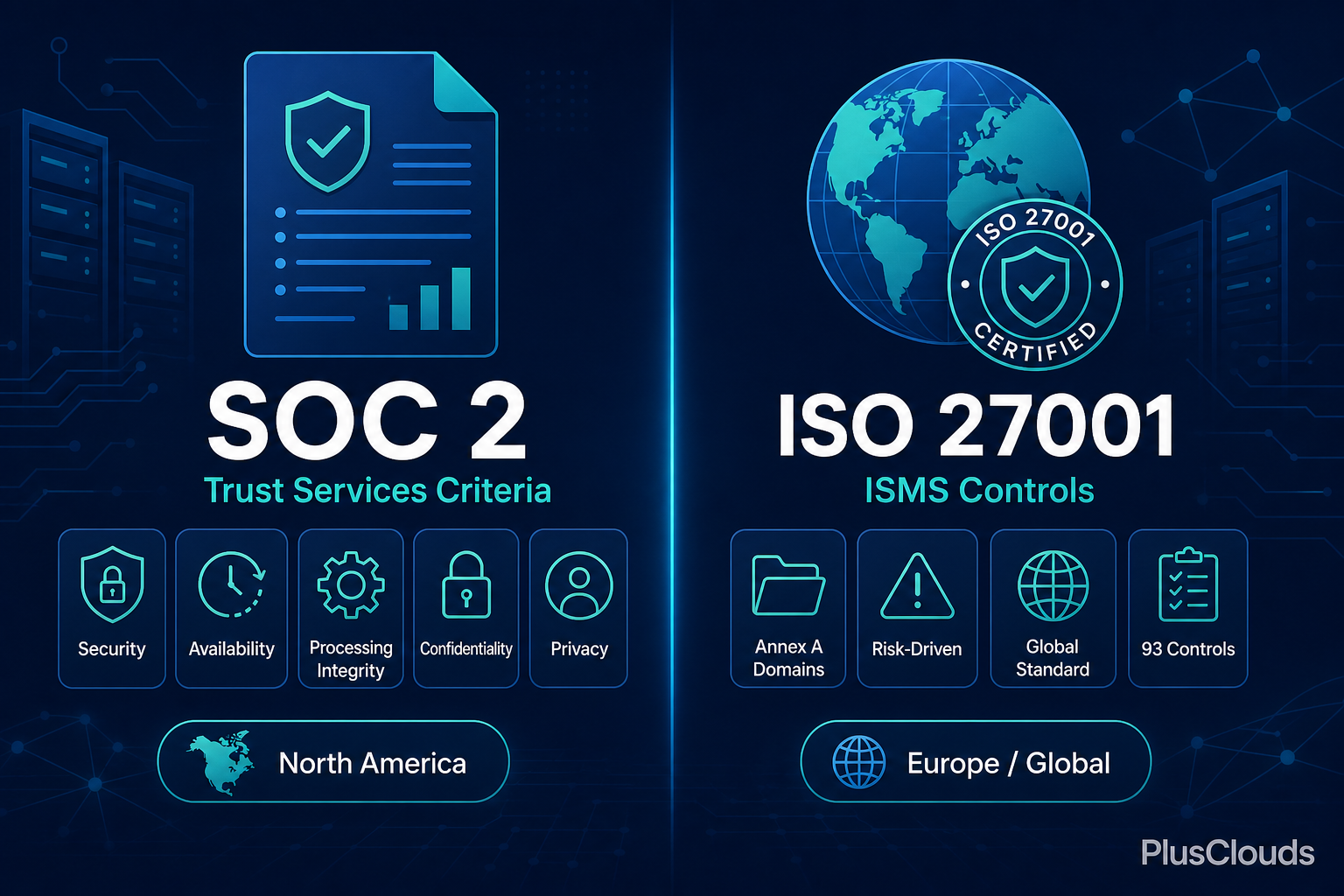
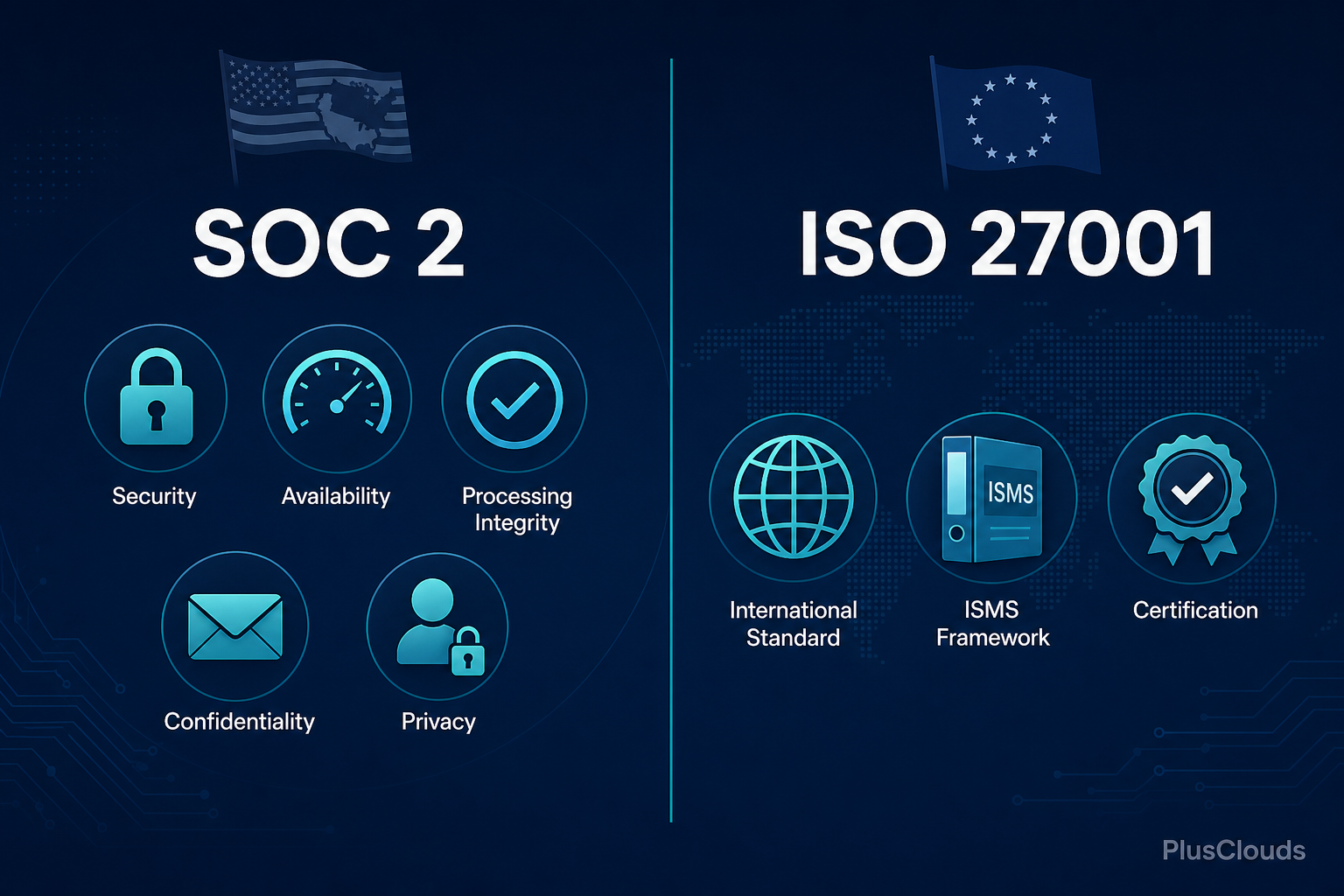
SOC 2 is a framework developed by the AICPA (American Institute of Certified Public Accountants). It defines five Trust Services Criteria: Security, Availability, Processing Integrity, Confidentiality, and Privacy. Every SOC 2 audit covers Security (also called the Common Criteria). The other four are optional, selected based on what your service promises to customers. A SOC 2 Type I report describes your controls at a point in time. A SOC 2 Type II report covers a defined observation period, typically six to twelve months, and tests whether those controls actually operated as described. Enterprise buyers want Type II. Type I is a starting point, not a finish line.
ISO 27001 is an international standard published by the International Organization for Standardization. It specifies requirements for an Information Security Management System (ISMS), a documented, risk-driven framework covering 93 controls across four domains in the ISO 27001:2022 revision. Unlike SOC 2, ISO 27001 certification is issued by an accredited third-party certification body and is recognized globally. European enterprise buyers, government contractors, and companies operating under GDPR often require ISO 27001 specifically because it maps cleanly to European regulatory expectations.
The practical difference: SOC 2 is a report produced by an independent auditor describing what your controls do. ISO 27001 is a certification confirming that your management system for information security meets an international standard. SOC 2 is the default ask in North American enterprise sales. ISO 27001 is the default ask in European procurement and regulated industries worldwide.
Who asks for which:
- North American SaaS buyers, financial services, healthcare IT vendors: SOC 2 Type II, with Security and Availability criteria at minimum
- European enterprise buyers, government contracts, global supply chains: ISO 27001 certification, often alongside GDPR compliance evidence
- Enterprise deals crossing both markets: Both, with controls mapped to avoid duplicating the work
The good news is that the control overlap between the two frameworks is substantial. A company that builds its security program around the SOC 2 Common Criteria and then maps those controls to ISO 27001 Annex A can achieve both certifications without rebuilding from scratch.
The Five Infrastructure Controls Every Cloud Business Must Have for Both Frameworks
Both SOC 2 and ISO 27001 converge on a core set of infrastructure controls. These are not optional additions. They are the foundation that auditors check first and that your cloud environment must document before any other evidence collection begins.
Access control with least privilege enforcement. Every system, service account, and user must have only the permissions required for their specific function. Auditors will pull IAM role assignments, SSH key inventories, and admin access logs. Undocumented admin accounts or overly permissive service roles fail this check immediately.
Encryption in transit and at rest. TLS 1.2 or higher for all data in transit. AES-256 or equivalent for data at rest. Key management must be documented, with rotation schedules and access logs for the key management system itself.
Logging and monitoring with retention. Audit logs for all privileged access, configuration changes, and authentication events. Logs must be tamper-resistant, centrally stored, and retained for the period specified in your policy (typically 12 months minimum for SOC 2 Type II observation periods).
Vulnerability management and patching. A documented process for identifying, prioritizing, and remediating vulnerabilities. Auditors will ask for patch logs, scan results, and evidence that critical patches were applied within your stated SLA.
Incident response with documented procedures. A written incident response plan, evidence that it has been tested (tabletop exercises or actual incident records), and documented escalation paths. SOC 2 CC7.3 through CC7.5 and ISO 27001 Annex A 5.24 through 5.28 both require this.
None of these controls can be satisfied with a policy document alone. Each requires infrastructure-level evidence: logs, configuration exports, access reports, and audit trails that an independent assessor can verify.
How to Use Your Cloud Provider's Certifications as Inherited Compliance Evidence
The shared-responsibility model is the most misunderstood concept in cloud compliance. Most cloud customers understand that the provider secures the physical infrastructure and they secure what runs on it. Fewer understand that the provider's certifications can be used directly as inherited evidence in their own audits.
A provider certified under ISO 27001, SOC 2, and GDPR collapses your inherited-control documentation from three separate requests into one. Instead of commissioning your own physical security assessments, environmental controls documentation, and data center redundancy reports, you obtain the provider's current certification reports and reference them in your own audit scope. The auditor accepts the provider's evidence for the physical and environmental layers. You focus your evidence collection on the application and operational layers you actually control.
Here is what that looks like in practice. ISO 27001 Annex A 7.1 through 7.6 covers physical security controls: perimeter security, access controls to physical facilities, environmental monitoring, and equipment protection. If your cloud provider holds a current ISO 27001 certificate covering their data centers, those controls are satisfied by reference. You document the inherited control, attach the provider's certificate, and move on.
The same logic applies to SOC 2. The Common Criteria CC6.4 covers physical access restrictions to data center facilities. A SOC 2 Type II report from your provider covering that control means you do not need to independently audit the cage locks and badge readers. You inherit the finding.
PlusClouds Cloud Servers run on infrastructure that holds ISO 27001, SOC 2, and GDPR compliance, hosted in Tier 3 data centers with N+1 redundancy and a 40 Gbps backbone. For a SaaS company preparing for its first SOC 2 Type II audit, that means the physical security, environmental controls, and network infrastructure sections of your audit scope arrive pre-evidenced. Your auditor will still test your application-layer controls, but the foundation is already documented.
Request your provider's current certification reports, their most recent SOC 2 Type II report (ask specifically for the bridge letter if the report is more than six months old), and their data center compliance documentation. Keep these in your evidence repository with the date retrieved and the coverage period.
Firewall, WAF, and DDoS Protection: Mapping Perimeter Controls to Trust Services Criteria
SOC 2 CC6.6 requires that you protect against threats from outside your logical access boundaries. ISO 27001 Annex A 8.20 through 8.22 covers network security, including the use of firewalls, network filtering, and segregation of networks. Both frameworks require documented evidence that your perimeter defenses exist, are configured correctly, and are actively monitored.
A stateful firewall satisfies the baseline requirement: traffic filtering based on connection state, with rules documented and change-managed. Auditors will ask for your firewall ruleset, the change log for rule modifications, and evidence that rule reviews happen on a defined schedule.
A Web Application Firewall (WAF) covering the OWASP Top 10 satisfies a separate but related requirement. CC6.8 in the SOC 2 Common Criteria covers protection against malicious software and unauthorized code. A WAF that blocks SQL injection, cross-site scripting (XSS), and remote code execution attempts provides documented evidence for this criterion. Export your WAF event logs for the audit period. High-volume blocked request logs are evidence of active protection, not a cause for concern.
DDoS mitigation addresses CC9.2 (risk monitoring) and the Availability criteria A1.1 (capacity and performance monitoring). Document your DDoS protection tier, the threshold at which mitigation activates, and any incidents during the observation period along with their resolution times.
PlusClouds Cloud Security provides a stateful firewall, a WAF with OWASP Top 10 coverage, and always-on DDoS mitigation at 1 Tbps+, all under the same ISO 27001 and SOC 2 certified infrastructure. For compliance purposes, the security stack and the certification evidence travel together. You are not assembling controls from three separate vendors and then trying to explain the gaps to your auditor.
For a fuller treatment of how firewall and WAF controls map to specific compliance requirements, the PCI DSS 4.0.1 cloud compliance guide covers overlapping control territory in detail, particularly for businesses that carry both payment and security certification obligations.
Backup, RTO, and RPO: Turning Automated Recovery Into SOC 2 Availability Evidence
The Availability criteria in SOC 2, specifically A1.2 and A1.3, require that you have the environmental protections, backup procedures, and recovery processes in place to meet your availability commitments to customers. ISO 27001 Annex A 8.13 covers information backup, and 5.30 addresses ICT readiness for business continuity.
Both frameworks require more than a backup job that runs nightly. They require documented Recovery Time Objectives (RTO) and Recovery Point Objectives (RPO), evidence that backups are tested, and logs showing that recovery procedures work within the committed timeframes.
The evidence package for an Availability audit includes:
- Backup job logs for the full observation period, showing successful completion and any failures with remediation records
- Documented RTO and RPO targets, tied to your customer-facing SLA or internal policy
- Recovery test records: at minimum one documented restore test per year, with the date, the data restored, and the time to recovery
- Monitoring alerts showing that backup failures trigger notifications to the responsible team
Automated backup removes the human-error risk from this evidence chain. A system that runs on a defined schedule, logs every job outcome, and retains recovery point history gives you a clean audit trail without manual intervention.
PlusClouds Automated Backup provides automated backup and recovery with explicit RPO and RTO targets, SLA tracking, and remote restore capability. For SOC 2 A1.2 and A1.3 evidence, the job logs and recovery records are available directly from the platform. No manual log aggregation, no reconstructed timelines. The audit trail is the system output.
For teams building a broader ransomware-resistant recovery architecture alongside their compliance program, the 3-2-1-1 backup rule guide covers the full recovery design in detail.
Network Segmentation as a Compliance Control: Public, Private, DMZ, and VPN Zones
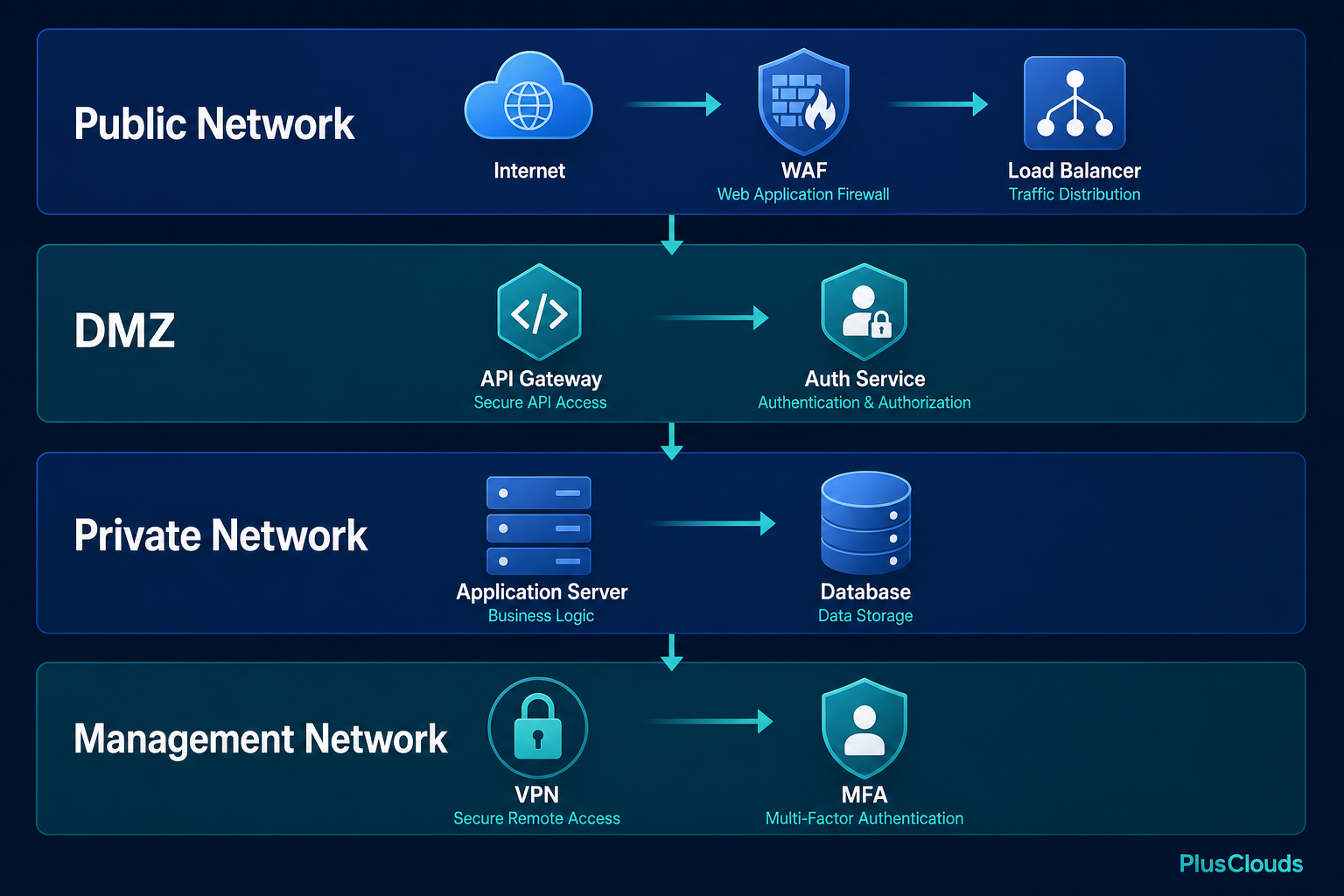
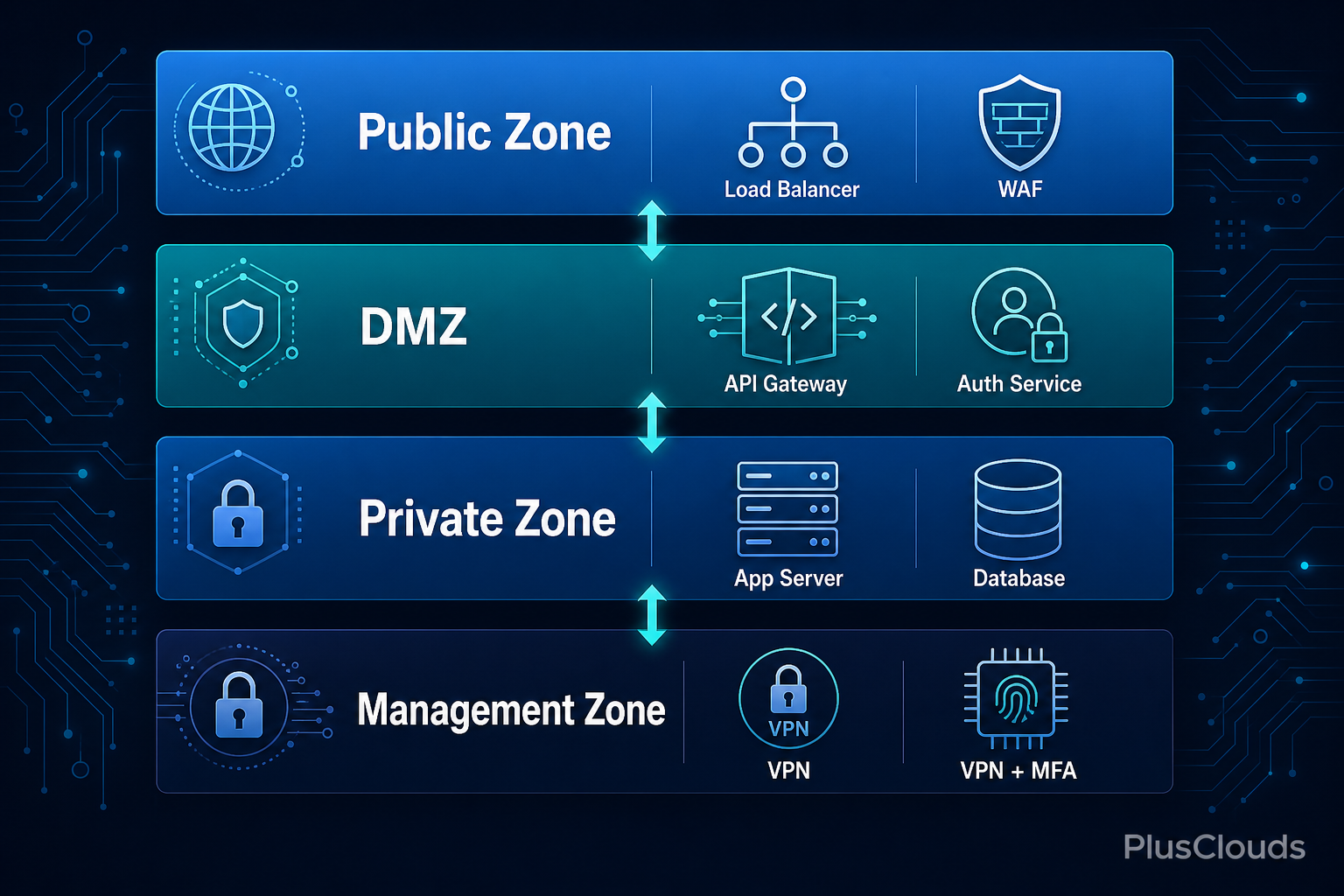
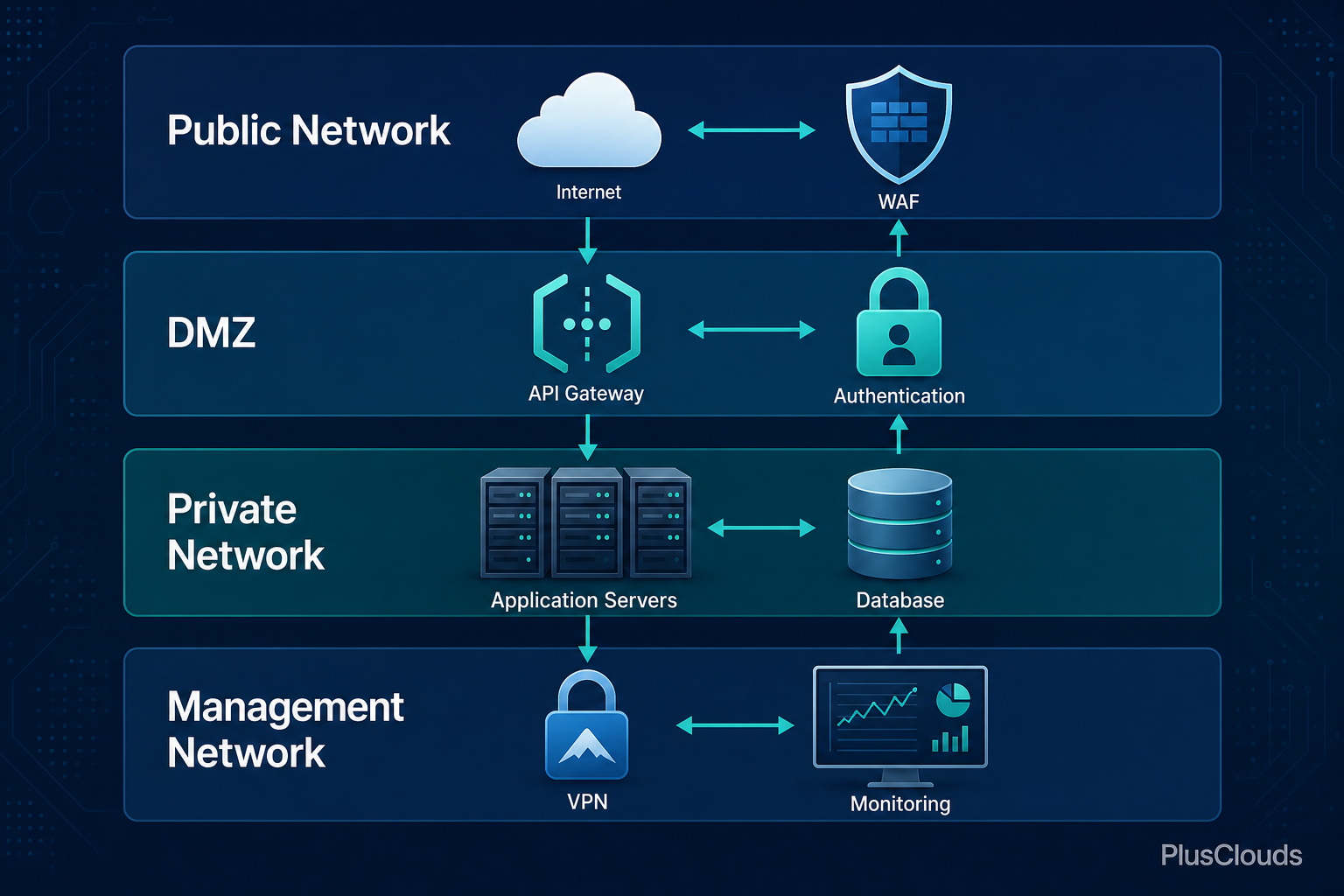
Network segmentation is not a nice architectural touch. It is a control requirement in both frameworks. SOC 2 CC6.1 requires logical access controls that restrict access to information assets. CC6.7 covers the transmission of data over public networks. ISO 27001 Annex A 8.22 requires that groups of information services, users, and systems be segregated on networks.
The practical implementation for a cloud-hosted SaaS product involves at minimum three network zones:
Public network: internet-facing load balancers and WAF endpoints. Nothing else. No database access, no admin interfaces, no internal APIs.
Private network: application servers, databases, and internal services. No direct internet access. All inbound traffic arrives from the public zone through controlled ingress points.
Management network: administrative access, monitoring agents, and configuration management. Accessible only via VPN with multi-factor authentication (MFA). Auditors will look specifically at whether your database administration access and your production application access are separated from each other.
A DMZ (demilitarized zone) sits between the public and private networks, hosting services that need controlled access from both sides: API gateways, authentication services, and integration endpoints. VPN access to the management network should be logged at the connection level, with user, timestamp, and source IP recorded for every session.
PlusClouds Networking and Load Balancers provides five network types, public, private, VPN, management, and DMZ, deployable from a single control plane. For compliance documentation, the network topology can be exported and attached directly to your audit evidence package as the network architecture diagram required by both frameworks.
The segmentation design also satisfies the isolation requirements relevant to multi-tenant environments. For teams evaluating whether their workload isolation model meets security audit requirements, the multi-tenant cloud vs. single-tenant bare metal guide covers the isolation architecture decision in depth.
Multi-Framework Alignment: Running SOC 2, ISO 27001, and GDPR Without Rebuilding Controls
The most common mistake companies make when pursuing multiple certifications is treating each framework as a separate project. Separate control libraries, separate evidence collection processes, separate auditor relationships. The result is three times the work and three times the ongoing maintenance burden.
The correct approach is a unified control framework with framework-specific mappings. You build one set of controls, one evidence repository, and one monitoring program. Then you map each control to the relevant criteria in SOC 2, ISO 27001, and GDPR. When an auditor asks for evidence, you pull from the same repository regardless of which framework they are assessing.
Here is a practical mapping example for access control:
Control: Multi-factor authentication required for all privileged access
Evidence: MFA enrollment logs, authentication event logs, exception records

SOC 2 mapping:  CC6.1 (logical access controls)
                CC6.3 (access removal upon termination)
ISO 27001 mapping: Annex A 5.15 (access control)
                   Annex A 8.5 (secure authentication)
GDPR mapping:   Article 32 (security of processing)
                Recital 83 (pseudonymisation and encryption)
One control, one evidence artifact, three framework citations. This is the efficiency gain from a unified approach.
GDPR alignment sits naturally alongside ISO 27001 because ISO 27001:2022 explicitly incorporates privacy controls through its relationship with ISO 27701 (the privacy information management extension). Companies pursuing ISO 27001 certification that also need GDPR documentation can extend their ISMS to cover personal data processing records, data subject rights procedures, and breach notification workflows without building a separate compliance program.
For businesses with data residency requirements layered on top of these certification obligations, the data sovereignty guide covers how to keep workloads within national borders while maintaining the performance and availability commitments your SOC 2 Availability criteria require.
Audit Readiness Checklist: What Your Cloud Infrastructure Must Document Before Day One
Auditors do not reward effort. They reward evidence. The following checklist covers the infrastructure documentation your team must have in place before your observation period begins for SOC 2 Type II or before your ISO 27001 Stage 2 audit.
Access and Identity
- Current IAM role inventory with business justification for each elevated permission
- MFA enrollment confirmation for all accounts with privileged or administrative access
- Access review records from the past 12 months (quarterly reviews are the standard)
- Terminated employee access removal logs with timestamps
Network and Perimeter
- Network architecture diagram showing all zones (public, private, DMZ, management, VPN)
- Firewall ruleset export with change log for the observation period
- WAF configuration and blocked request logs
- DDoS protection configuration and any incident records
Encryption
- Data classification policy identifying what data is in scope
- Encryption configuration for all databases and storage volumes
- TLS certificate inventory with expiration monitoring evidence
- Key management documentation including rotation schedule and access logs
Backup and Recovery
- Backup job logs for the full observation period
- Documented RTO and RPO with the policy document that sets them
- Recovery test records (date, scope, outcome, time to recovery)
- Backup failure alerts and remediation records
Monitoring and Incident Response
- SIEM or log aggregation configuration showing what is captured and retained
- Incident response plan (version-controlled, with last review date)
- Incident records for the observation period, including near-misses
- Vulnerability scan results and patch remediation records
Vendor and Provider Evidence
- Current ISO 27001 certificate from your cloud provider (with coverage scope)
- SOC 2 Type II report from your cloud provider (request bridge letter if older than six months)
- Data processing agreements with all sub-processors
- Third-party penetration test report from the past 12 months
Missing any of these before your observation period starts means you are collecting evidence retroactively. Auditors can tell. Retroactive evidence is a finding.
Choosing Your Compliance Path and Building on Pre-Certified Cloud Infrastructure
The ISO 27001 vs SOC 2 decision is not permanent. Most companies that reach Series B or begin selling into regulated enterprise markets end up pursuing both. The practical question for 2026 is which one to complete first, and the answer depends on where your next 10 deals are coming from. North American enterprise buyers: start with SOC 2 Type II. European buyers or regulated industries: start with ISO 27001. Both markets simultaneously: build the unified control framework from the beginning and run parallel audits.
The infrastructure layer is the one part of this you should not be building from scratch. Start with the infrastructure layer. PlusClouds Cloud Servers carry ISO 27001, SOC 2, and GDPR compliance out of the box, which means the physical and environmental controls in your audit scope are already satisfied on day one. Add Cloud Security for your firewall, WAF, and DDoS evidence artifacts, and Automated Backup for the availability logs your SOC 2 A1.2 and A1.3 controls require. The certification work that remains is yours to own. The foundation does not have to be.