The letter from your national regulator arrives on a Tuesday. It asks for your backup recovery test results, your incident response logs from a specific date, and evidence that your cloud providers were risk-assessed. You have 15 business days. If you cannot produce these documents, you are not just facing a fine. You are facing the kind of public enforcement action that boards and customers both notice.
This is not hypothetical. In February 2026, Germany issued its first NIS2 fine of EUR 850,000, and France opened investigations into 14 entities in the same quarter. The scope of the directive expanded from roughly 10,000 entities under NIS1 to approximately 160,000 under NIS2, which means a huge number of mid-sized European companies are dealing with formal infrastructure compliance for the very first time. Many of them are discovering that the hard part is not writing policies. The hard part is producing evidence from their cloud infrastructure that the policies actually work.
This guide walks you through the infrastructure-side checklist that NIS2 and DORA auditors will actually ask about: backups and recovery objectives, network controls, third-party risk, and incident reporting timelines. By the end, you will know what to fix first and what evidence you need to have on hand before the auditor arrives.
Key takeaways:
- NIS2 covers roughly 160,000 EU entities across 18 sectors; DORA covers the financial sector and its ICT third-party providers. Financial entities usually need to satisfy both, and DORA is generally the stricter standard.
- The first fines went to organizations that could not demonstrate controls, not to those with weak posture. Test evidence, logs, and documentation are what close the gap.
- Auditors expect measured and tested RPO/RTO targets, restore-tested and immutable backups, real network segmentation with firewall and WAF logs, audited cloud providers, and centralized logs capable of supporting a 24-hour early warning.
- A 30-day remediation roadmap can close the highest-risk gaps and produce evidence of a functioning improvement program.
Table of Contents
- NIS2 and DORA in 2026: Who Is In Scope and What the First Fines Tell Us
- The Four Infrastructure Requirements Both Regulations Share (and Where They Diverge)
- Backup and Recovery Under NIS2 and DORA: Why RPO/RTO Must Be Measured, Tested, and Documented
- Firewall, WAF, and Network Segmentation Requirements: What Demonstrable Control Actually Means
- Supply Chain and Third-Party ICT Risk: How to Audit Your Cloud Providers
- Incident Reporting in 24/72 Hours: What Your Infrastructure Must Log and How to Retrieve It
- How PlusClouds' Security Stack Supports Your Compliance Evidence File
- The 30-Day Remediation Roadmap: Prioritizing Quick Wins vs. Deep Architectural Changes
- Before the Auditor Arrives
NIS2 and DORA in 2026: Who Is In Scope and What the First Fines Tell Us
NIS2 (the Network and Information Security Directive 2) applies to essential and important entities across 18 sectors, including energy, finance, healthcare, transport, water, and digital infrastructure. If your organization has 50 or more employees or exceeds EUR 10 million in turnover and operates in a listed sector, you are almost certainly in scope. DORA (the Digital Operational Resilience Act) applies specifically to the financial sector: banks, insurers, investment firms, and critically, their ICT third-party providers.
The two regulations overlap heavily but are not interchangeable:
- NIS2 is a cybersecurity directive focused on risk management, incident reporting, and supply chain security. Enforcement is national, with fines that can reach EUR 10 million or 2% of global turnover for essential entities.
- DORA is a regulation (directly applicable, no national transposition needed) focused on operational resilience of the financial sector, with detailed requirements on ICT risk management, resilience testing, and third-party oversight.
The early enforcement actions tell you something important about auditor priorities. The first fines are not going to companies that lacked a perfect security posture. They are going to companies that could not demonstrate the controls they claimed to have. Documentation, logging, and test evidence are where the gap between "we do that" and "we can prove that" becomes expensive.
The Four Infrastructure Requirements Both Regulations Share (and Where They Diverge)
Strip away the legal language and both regulations demand four things from your infrastructure:
- Backup and recovery capability with defined and tested recovery objectives.
- Network security controls, including segmentation, firewalls, and protection against common attack classes.
- Third-party ICT risk management, meaning you must assess and monitor your cloud providers.
- Incident detection and reporting within strict regulatory timelines.
Where they diverge matters for planning. DORA requires formal resilience testing programs, including threat-led penetration testing for significant entities, and imposes contractual requirements on ICT third-party providers. NIS2 is broader in sector coverage but gives member states more latitude in how requirements are enforced. If you operate in finance, you likely need to satisfy both, and the good news is that DORA's requirements are generally the stricter of the two. Build to DORA's standard and you are most of the way to NIS2 compliance.
A practical note on evidence: both frameworks reward continuous, automated evidence collection over point-in-time audits. A guide to continuous compliance for DORA and NIS2 makes the point well: auditors increasingly want to see that controls were operating all year, not that you scrambled before the review.
Backup and Recovery Under NIS2 and DORA: Why RPO/RTO Must Be Measured, Tested, and Documented
This is the section where most organizations lose points, and it is worth being precise about terminology.
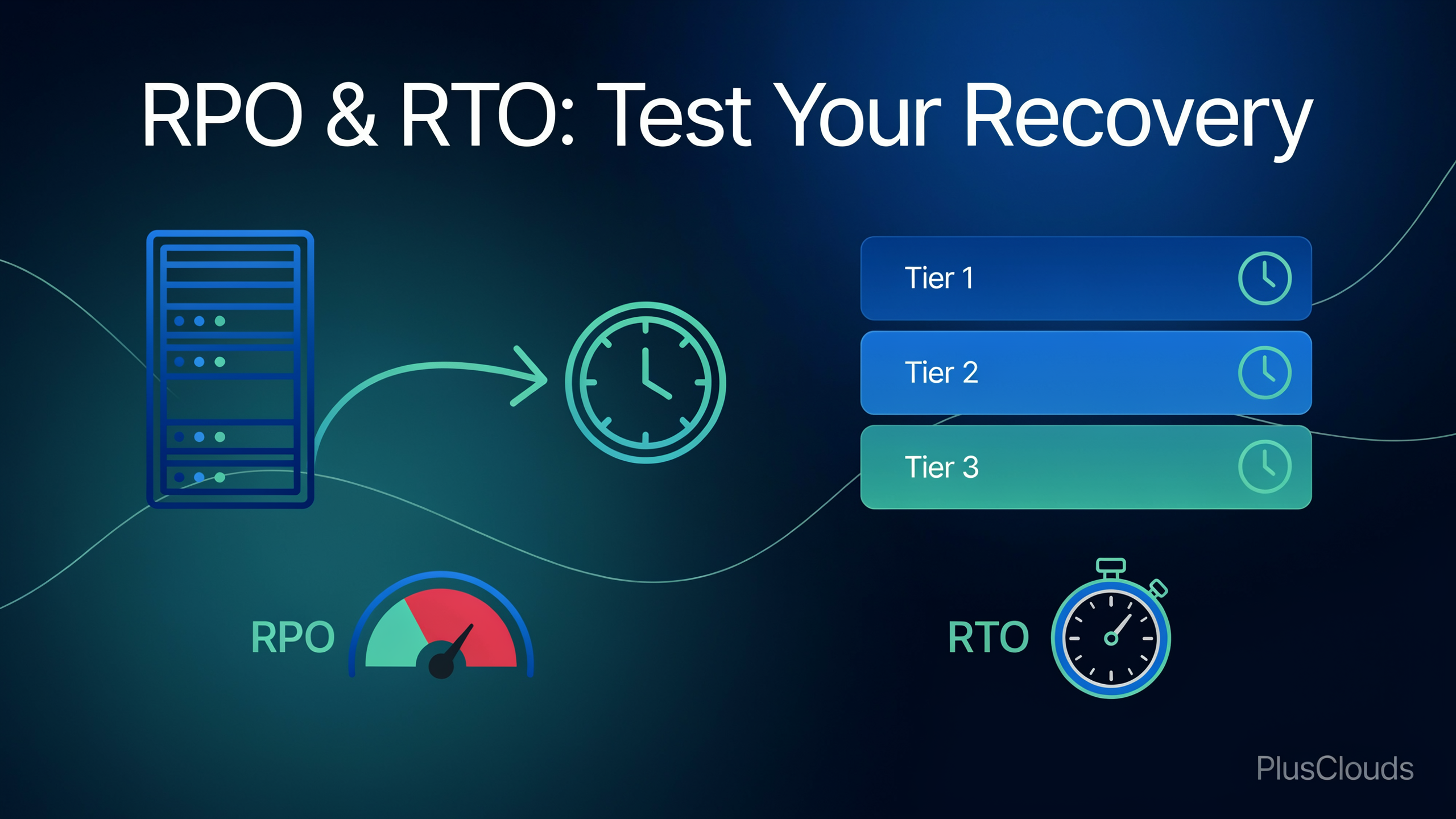
RPO (Recovery Point Objective) is the maximum acceptable amount of data loss, measured in time. If your RPO is one hour, your backups must capture data at least hourly, and you must be able to prove it.
RTO (Recovery Time Objective) is the maximum acceptable time to restore service after an incident. If your RTO is four hours, a full restore must complete within four hours, and you must be able to prove that too.
Both regulations require you to define these objectives based on business criticality, and both require you to test whether you actually meet them. DORA's Articles 11 and 12 go further, requiring documented backup policies, restoration and recovery procedures, and periodic testing of those procedures. We covered the full DORA Article 11 & 12 backup and recovery requirements in a separate guide, including the documentation format supervisors expect.
Your backup checklist:
- Classify workloads by criticality and assign RPO/RTO targets to each tier. Your customer-facing database and your internal wiki do not need the same targets.
- Automate backups so schedules are enforced by the platform, not by a runbook someone remembers to follow. Solutions like PlusClouds' Automated Backup let you set explicit RPO/RTO targets per workload and track them against SLA, which is exactly the evidence format auditors want.
- Run restore tests, not just backup tests. A backup that has never been restored is a hope, not a control. Schedule quarterly restore tests for critical systems and keep the test reports.
- Keep at least one backup copy offline or immutable to survive ransomware. The 3-2-1-1 backup rule is the standard architecture here, and it maps cleanly to NIS2's resilience expectations.
- Document everything. Backup policy, schedule, retention, test dates, and results. If it is not written down, it did not happen as far as the auditor is concerned.
Firewall, WAF, and Network Segmentation Requirements: What Demonstrable Control Actually Means
NIS2 Article 21 lists network security among the minimum measures, and DORA requires protection of ICT systems against all relevant threats. In practice, auditors look for three things: a stateful firewall at your perimeter and between network zones, a web application firewall (WAF) protecting internet-facing applications, and segmentation that prevents lateral movement.
What "demonstrable" means here is concrete:
- Firewall rules are documented and reviewed. Every rule has an owner and a justification. Rules that grant broad access (any-any rules) are flagged and remediated.
- Segmentation is real, not nominal. Your production environment, management network, and any DMZ-hosted services are separated. If a compromised web server can reach your database management interface directly, you have a segmentation gap.
- WAF coverage addresses the OWASP Top 10, and you can show the WAF blocked real attacks. Logs of blocked SQL injection or cross-site scripting attempts are excellent evidence.
- DDoS protection is in place and tested. Availability is a compliance requirement, not just a performance concern. Multi-vector attacks hitting layers 3, 4, and 7 simultaneously are now routine, and we break down how to defend against them in our multi-vector DDoS guide.
If you are building this on your own infrastructure, PlusClouds' Networking & Load Balancers provide five distinct network types (public, private, VPN, management, and DMZ) deployable from a single control plane, which gives you the segmentation structure without hand-building VLANs. The Cloud Security layer adds the stateful firewall and WAF with OWASP Top 10 coverage plus always-on DDoS mitigation above 1 Tbps.
For a deeper treatment of how these controls map to a specific regulatory framework, our PCI DSS 4.0.1 compliance guide covers the same firewall, WAF, and segmentation controls in detail, and the mapping logic transfers directly to NIS2 and DORA.
Supply Chain and Third-Party ICT Risk: How to Audit Your Cloud Providers
Under both regulations, your compliance posture extends to your providers. DORA is especially strict: financial entities must have contractual provisions covering audit rights, exit strategies, and service levels with critical ICT providers, and must maintain a register of ICT third-party arrangements.
Your provider audit checklist:
- Certifications. ISO 27001 and SOC 2 are the baseline. Ask for the actual certificates and the latest audit reports, not just a logo on a website.
- Data location. GDPR and, increasingly, national sovereignty requirements mean you should know exactly where your data resides. Our guide on data sovereignty in 2026 covers how to keep workloads inside national borders without sacrificing performance.
- Incident notification terms. Your provider must commit to notifying you fast enough that you can meet your own regulatory reporting deadlines. A provider that takes 48 hours to tell you about a breach makes your 24-hour NIS2 early warning impossible.
- Sub-processor transparency. Who does your provider rely on? You inherit that risk.
- Exit provisions. Can you get your data out in a usable format if the relationship ends?
Physical infrastructure matters too. The tier and redundancy design of your provider's data centers directly affect your availability commitments. PlusClouds operates Tier 3 data centers with N+1 redundancy and a 40 Gbps backbone in the EU, which is the kind of facility-level detail you can put directly into your third-party risk register.
Incident Reporting in 24/72 Hours: What Your Infrastructure Must Log and How to Retrieve It
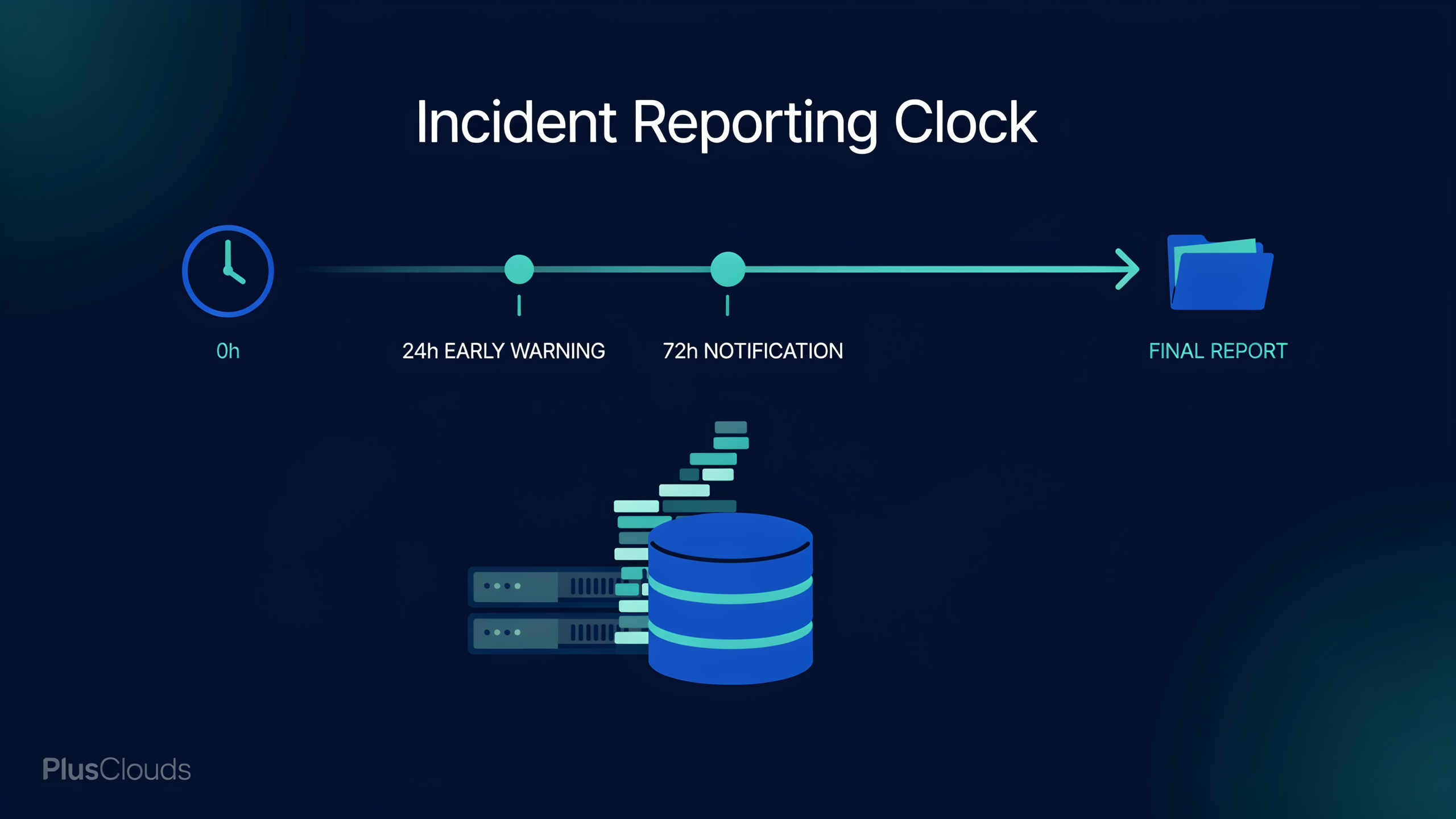
NIS2's reporting timeline is unforgiving. You must submit an early warning within 24 hours of becoming aware of a significant incident, an incident notification within 72 hours, and a final report within one month. DORA has a similar structure for major ICT incidents.
The 24-hour clock is the problem. To file a meaningful early warning, you need to know what happened, what systems were affected, and whether the incident is ongoing. That means your infrastructure must already be logging the right things:
- Authentication and access logs across all critical systems, centralized (not scattered across individual servers).
- Network flow and firewall logs showing what traffic was allowed, denied, and from where.
- Application and WAF logs for internet-facing services.
- Backup and restore logs, because a ransomware incident response starts with knowing your last clean restore point.
Then, critically, you need to be able to retrieve and correlate these logs quickly. A log store spread across 40 servers with no central collection point will cost you hours you do not have. Centralize logs, set retention to at least the regulatory reporting window plus margin (six months is a safe floor), and rehearse the retrieval. Some teams run a tabletop exercise specifically for the 24-hour report: inject a scenario, and see how long it takes to assemble the facts. If the answer is more than four hours, fix that before an attacker tests it for real.
How PlusClouds' Security Stack Supports Your Compliance Evidence File
Everything above reduces to one practical problem: producing evidence. This is where your infrastructure choice either helps or hurts.
PlusClouds' platform was built around controls that map directly to what NIS2 and DORA auditors request. The Cloud Security stack holds ISO 27001, SOC 2, and GDPR compliance certifications, so when your auditor asks for your provider's third-party risk assessment, you hand over current certificates rather than a spreadsheet of promises. The stateful firewall and WAF generate the block logs that serve as evidence of active network controls. Automated Backup produces timestamped, SLA-tracked backup and restore records with explicit RPO/RTO targets, which is the exact artifact DORA Article 12 testing requires. And the Tier 3 data center documentation covers the physical and availability controls that round out the file.
For organizations with stricter isolation requirements, particularly financial entities and healthcare providers, our comparison of multi-tenant cloud versus single-tenant bare metal walks through when dedicated infrastructure is worth the trade-off. And if you want to understand what those certifications actually guarantee, our breakdown of ISO 27001 versus SOC 2 explains how to read them as evidence rather than marketing.
The 30-Day Remediation Roadmap: Prioritizing Quick Wins vs. Deep Architectural Changes
You cannot fix everything in 30 days, and you do not need to. You need to close the highest-risk gaps and produce evidence of a functioning improvement program. Here is how we would sequence it.
Week 1: Inventory and gap assessment.
- List every system, its data classification, and its criticality tier.
- Assign RPO/RTO targets per tier.
- Map every cloud and ICT provider against the third-party checklist above.
- Identify which logs exist, where they live, and whether they are centralized.
Week 2: Quick wins.
- Turn on automated backups for all critical workloads with explicit RPO/RTO settings.
- Centralize logging for authentication, firewall, and application events.
- Close any any-any firewall rules and document the rest.
- Verify WAF coverage on all internet-facing applications.
Week 3: Test and document.
- Run your first restore test on your most critical system. Record the actual recovery time against your RTO.
- Run a 24-hour incident reporting tabletop exercise.
- Draft or update your backup policy, incident response plan, and third-party risk register.
Week 4: Architectural gaps and the road ahead.
- If segmentation is inadequate, design the target network zones (this is a deep change; start the plan now, execute over the next quarter).
- If a critical provider fails the third-party audit, begin migration planning.
- Schedule quarterly restore tests and annual full resilience tests in the calendar so they actually happen.
The distinction between quick wins and deep changes matters because auditors respond well to documented, in-progress remediation. A gap you identified, scheduled, and are actively closing is a finding. A gap you did not know about is a failure of governance.
Before the Auditor Arrives
NIS2 and DORA have moved European infrastructure compliance from a paperwork exercise to a technical evidence exercise. The organizations that struggle are not the ones with weak security; they are the ones with unmeasured recovery objectives, untested restores, scattered logs, and unaudited providers. Every item on the checklist above produces an artifact you can hand to an auditor, and most of them also make your infrastructure genuinely more resilient.
If you are rebuilding any part of this stack, running these workloads on infrastructure where the compliance evidence comes built in saves months of assembly. PlusClouds' Cloud Servers deploy in 60 seconds on AMD EPYC and NVMe hardware with a 99.98% uptime SLA and zero egress fees, backed by the security and backup stack described above. Take the 30-day roadmap, start with your backup and logging gaps this week, and if you want a platform that already speaks the auditor's language, get started with PlusClouds and build your compliance evidence file as you go.