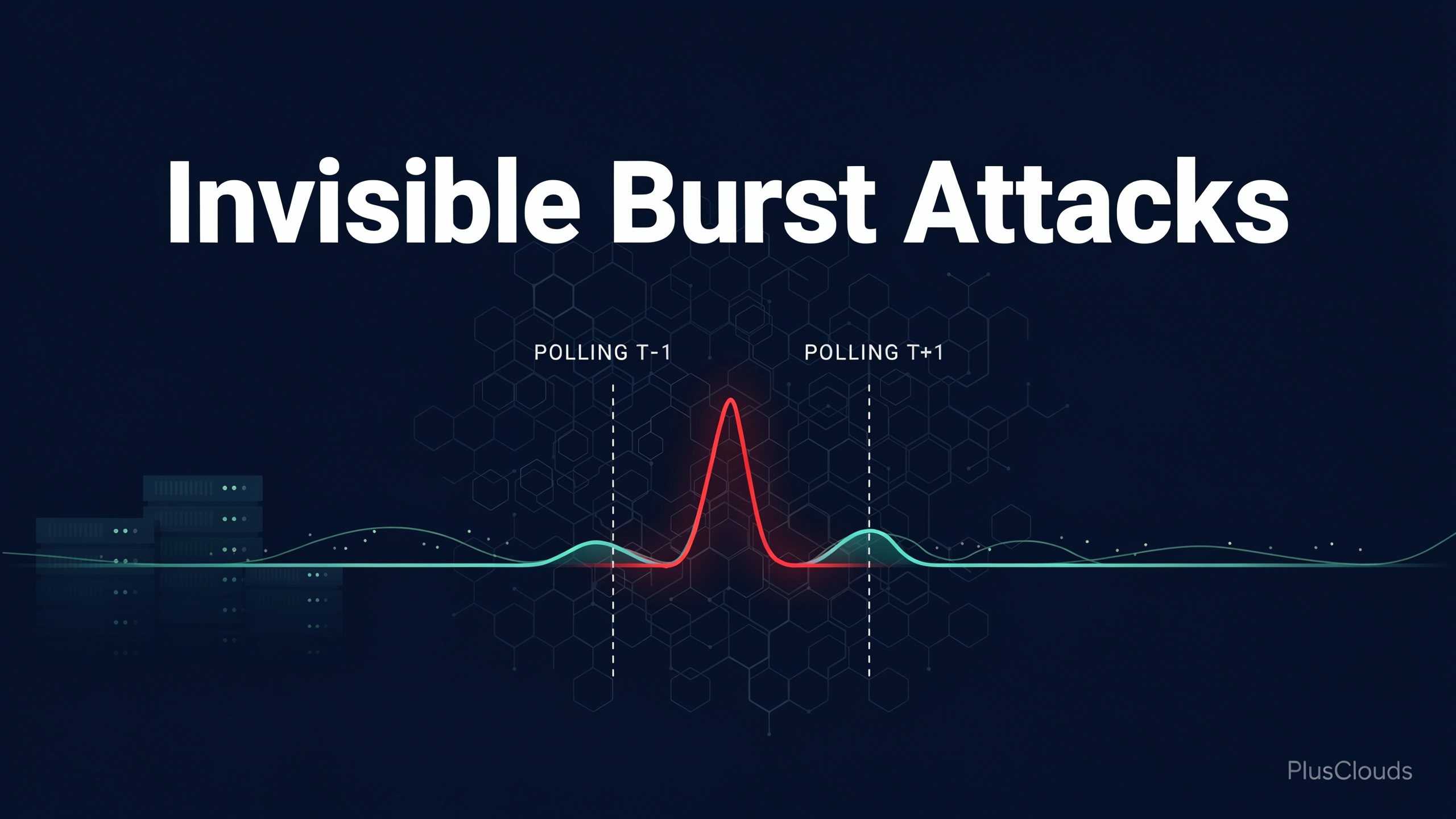
Your monitoring polls every 60 seconds. Your DDoS protection provider promises coverage "when attacks cross a threshold." And somewhere in the gap between those two numbers sits the most common attack on the internet right now: a burst of malicious traffic that starts and finishes in under a minute, peaks well below 1 Gbps, and does exactly enough damage to take your application down or slip past your defences unnoticed.
Key takeaways
- 96.1% of DDoS attacks in H1 2026 measured under 1 Gbps, and most last under 60 seconds.
- Reactive, threshold-triggered mitigation is structurally blind to short burst attacks: the attack ends before scrubbing engages.
- Multi-vector bursts and reconnaissance probes exploit thresholds, mapping your defenses before the real attack.
- Always-on inline mitigation, a stateful L3/L4 firewall, and a WAF with OWASP Top 10 coverage are the effective defense stack.
Here's the uncomfortable math. In the first half of 2026, 96.1% of DDoS attacks measured under 1 Gbps, according to State of DDoS research from Flowtriq. Yet overall attack volume grew 168% year over year in Q1 2026, with forecasts pointing to roughly 58 million mitigations by year end (Stormwall, Q1 2026). Those two facts together tell a clear story: attackers have shifted away from headline-grabbing terabit floods and toward small, fast, surgical bursts that exploit the blind spots in how most infrastructure is actually monitored and protected.
This guide walks through what sub-gigabit and short-burst DDoS attacks actually look like, why conventional on-demand mitigation misses them, and the concrete configuration changes that close the gap. By the end, you'll know whether your current setup would survive a 40-second attack, and what to do about it if the honest answer is no.
Table of Contents
- Why Most DDoS Guides Miss the Real Threat in 2026
- The Long Tail: Why 96% of Attacks Are Under 1 Gbps (and Still Devastating)
- How Short-Burst DDoS Works: The 60-Second Attack Your Monitoring Won't Catch
- Multi-Vector Campaigns: When Attackers Hit L3, L4, and L7 Simultaneously
- Reconnaissance DDoS: The Probe Before the Kill Shot
- What 'Always-On' Mitigation Actually Means vs. Reactive Scrubbing
- How PlusClouds 1 Tbps+ DDoS Mitigation and WAF Handle the Long Tail
- Configuration Checklist: Hardening Your Cloud Network Against Burst Attacks
- Key Takeaways and Next Steps
Why Most DDoS Guides Miss the Real Threat in 2026
Most DDoS content written in the last five years follows the same template: volumetric attacks are getting bigger, here's a chart of record-breaking Tbps figures, make sure your provider has scrubbing capacity. That advice was correct for the threat of 2019. It's dangerously incomplete for 2026.
The reason is economic. Launching a DDoS attack has never been cheaper. Booter and stresser services rent for the price of a coffee, and botnets built from compromised IoT devices and hijacked cloud instances give attackers massive distributed capacity on demand. When the cost of an attack approaches zero, attackers stop optimizing for raw volume and start optimizing for effectiveness per attack.
A 900 Gbps flood against a well-protected target gets scrubbed in minutes and accomplishes nothing. A 600 Mbps burst lasting 35 seconds that lands between two monitoring polls can crash a payment API, exhaust a connection pool, or simply probe the target's defences without triggering anything. The second attack costs the same to launch and often does more damage.
There's also a detection asymmetry at play. Cloud providers and hosting companies typically advertise DDoS protection in terms of total mitigation capacity, "we can absorb 5 Tbps." Capacity matters when a big flood arrives. But capacity is not the same as reaction time, and reaction time is the entire game when the attack itself lasts less time than most mitigation systems take to notice it.
The result is a threat landscape where the dominant attack pattern is precisely the one that legacy, threshold-triggered defences were never designed to catch. If your protection only "activates" when traffic crosses a threshold and that activation takes 60 to 180 seconds of detection, routing, and scrubbing, you are structurally vulnerable to the majority of attacks happening today.
The Long Tail: Why 96% of Attacks Are Under 1 Gbps (and Still Devastating)
The 96.1% figure deserves a closer look, because it's easy to misread. It does not mean attacks got weaker. It means the distribution of attack sizes has a very long tail: millions of small attacks, a small number of enormous ones.
Think of it like earthquakes. The magnitude-9 events make the news, but the vast majority of seismic activity is made up of small quakes, and for any given building, the cumulative damage from repeated small shocks can exceed a single dramatic event. DDoS works the same way against infrastructure.
Why would an attacker bother with 500 Mbps? Several reasons:
- It's enough. A modern application with a 1 Gbps uplink, a modest connection pool, and a stateful firewall can be knocked over by a fraction of that if the traffic is well-crafted. Small attacks that target application weaknesses beat large attacks that target raw bandwidth.
- It evades thresholds. Many "DDoS protection" products only engage above a set bitrate. Attackers know this and deliberately stay under it.
- It evades monitoring. If your dashboards sample at 1-minute or 5-minute intervals, a 30-second burst may never appear as more than a brief blip, if it appears at all.
- It's cheap and repeatable. A small attack can be fired dozens of times per day from rotating sources, making attribution hard and fatigue real.
And the damage profile is not just availability. Application layer DDoS, where attackers exhaust server resources with seemingly legitimate requests, frequently operates at bandwidth levels that wouldn't register on a traffic graph at all. A few thousand requests per second hitting an expensive database query can degrade service with less than 50 Mbps of inbound traffic. Industry data consistently shows application layer attacks making up a large share of total DDoS activity precisely because they're cheap, hard to distinguish from real users, and devastatingly effective (SentinelOne's DDoS statistics roundup).
The takeaway: if your mental model of DDoS is "massive flood, obvious spike, provider saves the day," your model is about five years out of date.
How Short-Burst DDoS Works: The 60-Second Attack Your Monitoring Won't Catch
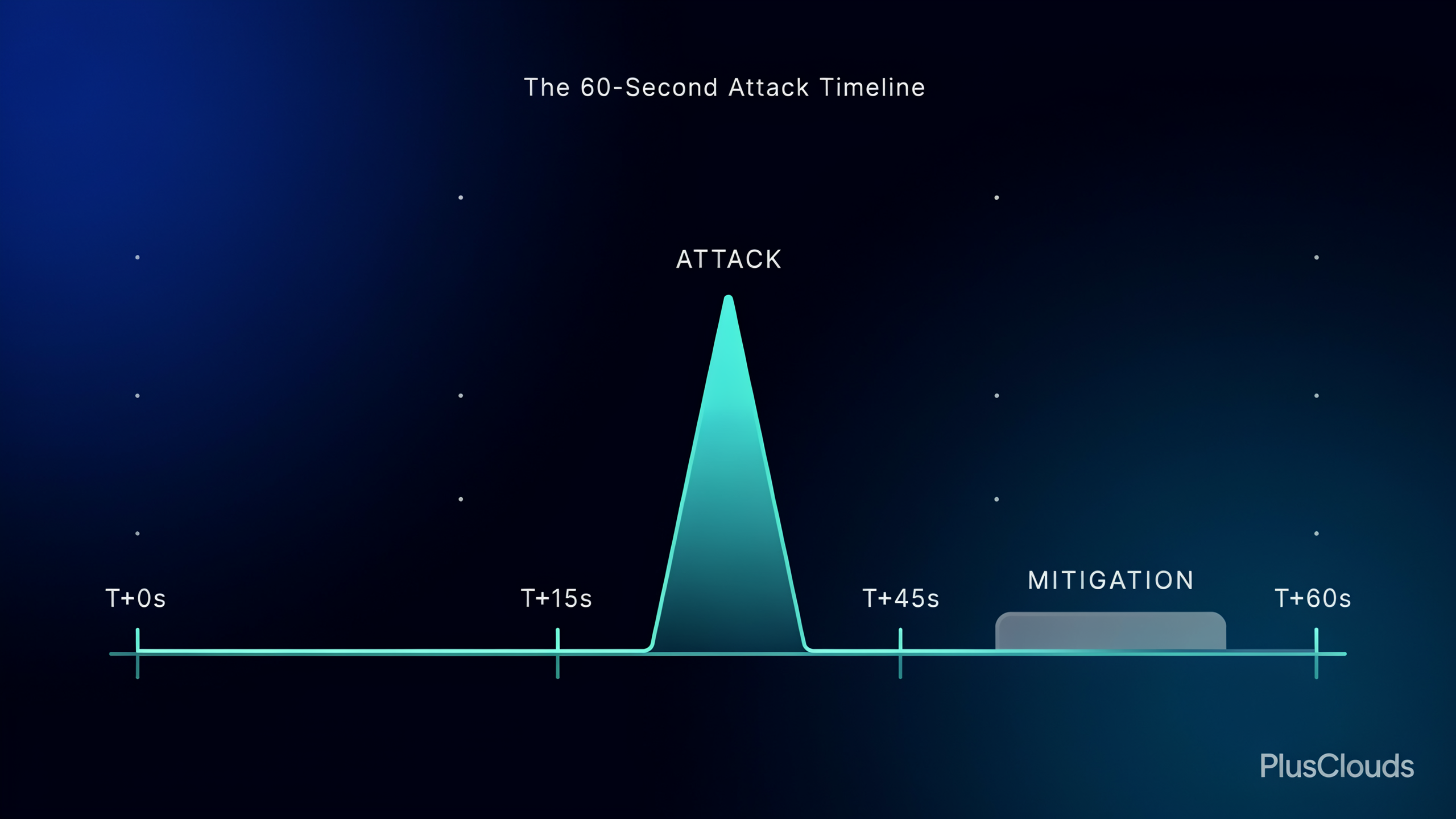
Let's make this concrete with a timeline, because the mechanics matter.
A short-burst attack typically unfolds like this:
- T+0s: Attack traffic starts. The attacker has pre-staged the botnet and fires a pre-compiled vector, often a UDP amplification flood (DNS, NTP, Memcached reflection) or a TCP SYN flood.
- T+5s to T+15s: Traffic peaks. A well-executed burst reaches full amplitude within seconds because amplification vectors require no handshake.
- T+20s to T+45s: Damage occurs. State tables fill, connection pools exhaust, load balancers hit concurrent-connection limits, upstream links saturate.
- T+30s to T+60s: Attack stops. The attacker withdraws before your mitigation pipeline, which typically involves detection, a routing change (BGP announcement shift or DNS change), traffic scrubbing, and re-injection, has completed even its first stage.
- T+60s to T+300s: Your mitigation "activates" against traffic that no longer exists. Your monitoring shows a brief anomaly. Repeat.
The killer detail is the polling interval. Most monitoring stacks, whether Prometheus scrape jobs, CloudWatch metrics, or your provider's traffic graphs, sample at 30 to 60 second intervals. A 25-second burst that begins 5 seconds after a poll can complete entirely between samples. In your metrics, it looks like nothing. In your logs, if you're retaining per-flow data, it looks like a firewall event storm. In your user complaints, it looks like "the site was down for a minute."
If your mitigation is reactive, meaning it triggers on detection of an anomaly and then requires time to reroute and scrub traffic, the attack is over before the mitigation engages. You pay for protection that, against this attack class, arrives after the funeral.
This is why the industry distinction between on-demand scrubbing and always-on mitigation has become the single most important question to ask a hosting or security provider. We'll come back to it.
Multi-Vector Campaigns: When Attackers Hit L3, L4, and L7 Simultaneously
Short bursts get more dangerous when they're combined. Modern attack tooling fires multiple vectors at once, and the interaction between them is what defeats layered-but-uncoordinated defences.
A typical multi-vector burst might include:
- Layer 3/4 volumetric component: A UDP amplification flood sized to saturate your uplink or force your provider's edge to drop legitimate traffic alongside attack traffic.
- Layer 4 state-exhaustion component: A SYN flood or ACK flood targeting your firewall's or load balancer's connection table, sized carefully to stay under volumetric detection thresholds.
- Layer 7 component: HTTP or HTTPS request floods targeting specific expensive endpoints, such as search, login, or checkout, designed to consume CPU and database connections. Because TLS requires handshake completion, these requests look like real users.
Each component alone might be survivable. Together, they create a failure cascade: the volumetric layer masks the state-exhaustion layer from your view, the state exhaustion prevents your autoscaling from responding in time, and the application layer ensures that even traffic that gets through consumes disproportionate resources.
We've covered the full mechanics of layered attacks in depth in Multi-Vector DDoS in 2026: How to Defend Your Cloud Infrastructure When Attackers Hit Layers 3, 4, and 7 Simultaneously, so I won't duplicate that here. The point relevant to this article is that multi-vector campaigns and short bursts compound each other: bursts make the attack hard to see, and multiple vectors make it hard to filter, because a single mitigation tuned for one vector leaves the others untouched.
Defending against this requires mitigation that inspects state at multiple layers simultaneously and does so continuously, not on activation. A stateful firewall that tracks connection legitimacy at L4, paired with a Web Application Firewall (WAF) that applies OWASP Top 10 rules and rate-based behavioural checks at L7, handles the parts of a multi-vector burst that raw bandwidth absorption never can.
Reconnaissance DDoS: The Probe Before the Kill Shot
Not every small attack is meant to take you down. Some of the most dangerous sub-gigabit traffic is reconnaissance, and almost nobody talks about it.
The pattern works like this. An attacker fires a series of small, short bursts at your infrastructure while carefully observing the response:
- Does rate limiting kick in? At what threshold?
- Does your provider start scrubbing? How fast?
- Do you fail over to a secondary region? How long does that take?
- Does your WAF block the probe, or does it pass through to the application?
- Does your origin IP leak when the attack hits a CDN edge?
Each probe is too small to trigger alerts and too brief to attract human attention. But collectively, they map your defensive posture with surgical precision. Then, hours or days later, the real attack arrives: sized just under your measured thresholds, timed for your peak traffic window or during a product launch, and aimed at the exact vector your probes revealed as weak.
This is the DDoS equivalent of a bank robber casing the building. And it explains a pattern many teams have experienced but rarely connected: an unexplained "weird traffic blip" on Tuesday, followed by a serious outage on Friday.
The defence against reconnaissance DDoS is consistency. If your mitigation behaves identically whether the attack is 50 Mbps or 50 Gbps, if there is no threshold below which you simply absorb and log, probes return no useful information. That is only achievable with always-on inspection, which brings us to the central distinction of this article.
What 'Always-On' Mitigation Actually Means vs. Reactive Scrubbing
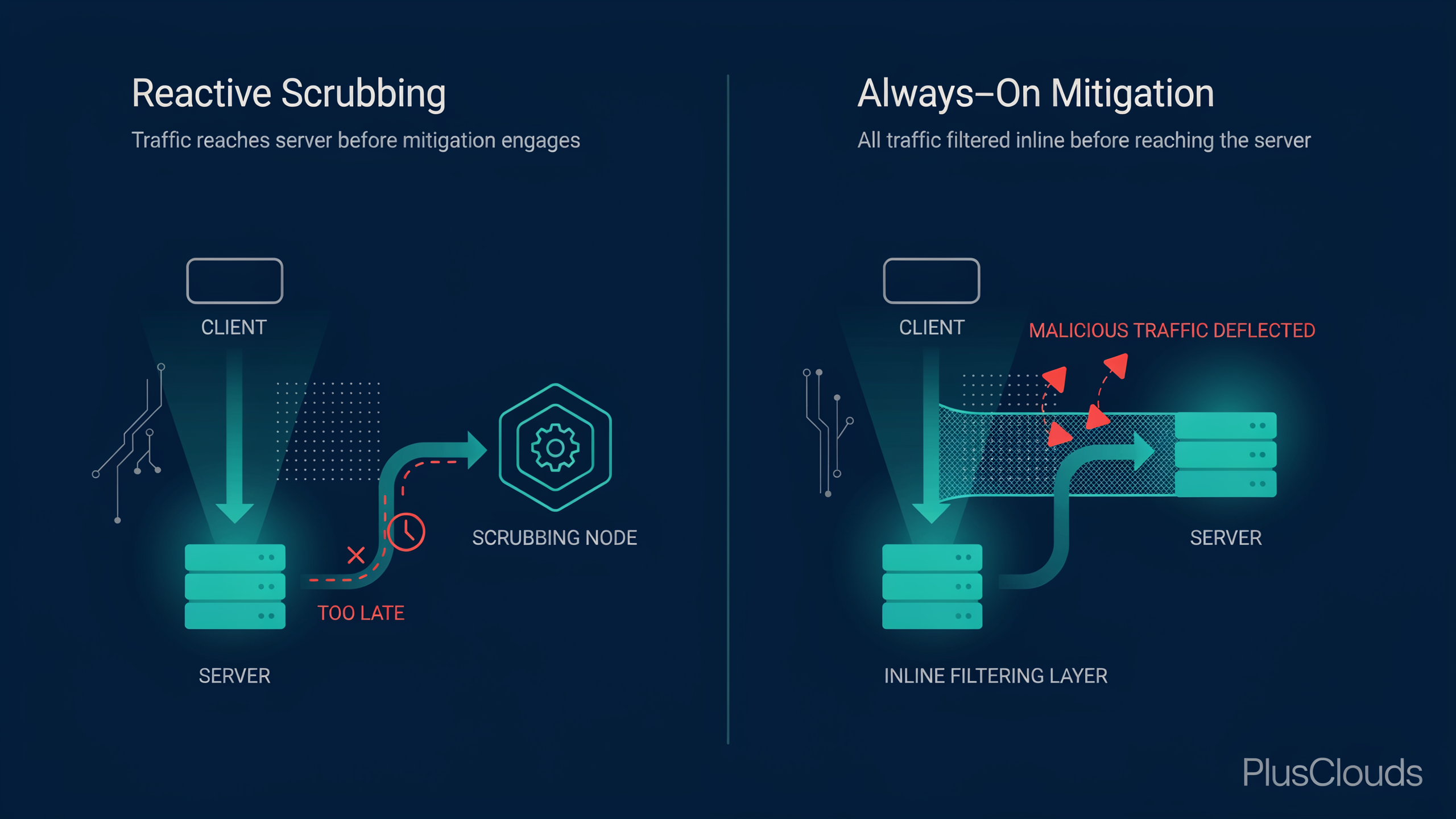
These terms get thrown around loosely, so let's define them precisely, because the difference is measured in downtime.
Reactive (on-demand) scrubbing works like this: your traffic flows normally until a detection system flags an anomaly. Then traffic is rerouted, usually via BGP, to a scrubbing centre, filtered, and sent back clean. Total time from detection to effective mitigation: typically 60 seconds to several minutes, depending on the provider and propagation. During that window, your infrastructure eats the attack raw. Against a 40-second burst, reactive scrubbing is architecturally incapable of helping. It's not a tuning problem; the attack ends before the defence begins.
Always-on mitigation routes all traffic through scrubbing and inspection infrastructure continuously, whether or not an attack is in progress. There is no activation step, no rerouting delay, no threshold to cross. Every packet, from the first malicious one to the last, passes through filtering. Against a short burst, the attack is mitigated in the first seconds because the defences were already in the path.
The tradeoff historically was cost and latency: always-on meant paying for constant scrubbing capacity and accepting a small routing overhead. That tradeoff has collapsed as mitigation capacity has become cheap at scale. Modern providers with terabit-scale scrubbing can offer always-on protection without meaningful latency penalty, which is why the 1 Tbps DDoS mitigation capacity tier has become the practical baseline for serious infrastructure in 2026.
When evaluating any provider, ask three questions:
- Is mitigation always in the traffic path, or does it activate on detection?
- What is the time from first malicious packet to first dropped malicious packet?
- Is application layer traffic (L7) inspected continuously, or only during declared attacks?
If the answer to question 1 is "activates," the answers to 2 and 3 don't matter much for burst attacks.
How PlusClouds 1 Tbps+ DDoS Mitigation and WAF Handle the Long Tail
This is where the architecture choices above become concrete. PlusClouds Cloud Security was designed around exactly the threat pattern this article describes: always-on, multi-layer, no activation delay.
The stack has three components working together:
- Always-on 1 Tbps+ DDoS mitigation. All inbound traffic passes through scrubbing capacity exceeding 1 Tbps continuously. There is no threshold to cross and no rerouting step, so a 30-second burst is filtered in the first seconds of its life, the same way a 300 Gbps flood would be. Sub-gigabit attacks get no free pass.
- Stateful firewall at L3/L4. Connection tracking identifies SYN floods, malformed packets, and state-exhaustion attempts in real time, which addresses the component of multi-vector bursts that volumetric filters miss.
- WAF with OWASP Top 10 coverage. At the application layer, the WAF inspects HTTP/HTTPS traffic for request floods, credential-stuffing bursts, and exploitation attempts, distinguishing attack traffic from legitimate users by behaviour rather than volume alone. This is what stops the 50 Mbps attack that degrades your checkout page.
The platform carries ISO 27001, SOC 2, and GDPR compliance, which matters if you're operating in regulated contexts (payments, health data, EU financial services). For a deeper look at how firewall, WAF, and segmentation controls fit into compliance requirements specifically, see PCI DSS 4.0.1 Compliance on Cloud Infrastructure.
It's worth noting how this connects to the rest of the platform. PlusClouds Networking & Load Balancers let you segment public, private, VPN, management, and DMZ networks from a single control plane, so the attack surface presented to the internet is deliberately minimal. And because Cloud Servers deploy in 60 seconds on AMD EPYC and NVMe with zero egress fees, rebuilding or horizontally scaling a targeted service during an incident doesn't carry the bandwidth-bill penalty it would on most hyperscalers.
Configuration Checklist: Hardening Your Cloud Network Against Burst Attacks
Architecture is half the battle. The other half is configuration. Here's a practical checklist, roughly in priority order:
1. Verify your mitigation is actually always-on. Read your provider's documentation, not their marketing page. Look for the words "always-on," "inline," or "in-path." If you find "on-demand," "triggered," or "auto-mitigation," you have reactive scrubbing.
2. Tighten your monitoring resolution. Default polling intervals hide bursts. Configure flow-based monitoring (NetFlow, sFlow, or IPFIX) with per-second or 10-second granularity on your edge, and alert on rate-of-change rather than absolute thresholds:
# Example: alert on sudden SYN rate spike, not absolute bandwidth
- alert: syn_flood_burst
  expr: rate(tcp_syn_packets_total[10s]) > 4 * rate(tcp_syn_packets_total[5m])
  for: 10s
3. Enable SYN cookies and connection rate limiting at the host level. On Linux:
# Enable SYN cookies (usually on by default on modern kernels, verify)
sysctl -w net.ipv4.tcp_syncookies=1

# Limit connection attempts per source
sysctl -w net.ipv4.tcp_max_syn_backlog=4096
4. Deploy rate limiting at the application edge. Use your load balancer or WAF to cap requests per second per source IP on expensive endpoints (login, search, checkout). A burst of 5,000 requests/second against your login page should hit a rate limiter, not your database.
5. Reduce time-to-live on idle connections. Long idle timeouts let attackers hold connections open cheaply. Set aggressive but realistic timeouts on your load balancer and application servers.
6. Never expose origin IPs. If you use a CDN or proxy, audit DNS history and misconfigured subdomains (a classic recon target) to ensure attackers can't bypass your edge and hit your origin directly.
7. Segment your network. Management interfaces, databases, and internal services should not be reachable from the public network at all. DMZ architecture isn't nostalgia; it's the reason an L7 burst against your web tier can't reach your data tier.
8. Test with a burst simulation. Run a controlled load test that mimics a short burst: 30 seconds of high-concurrency traffic against a staging environment. Measure how long your system takes to recover and whether your monitoring even registered it.
9. Keep an incident runbook. When a burst takes you down, the response is operational: who contacts the provider, who checks flow data, who communicates status. Write it down before you need it.
None of these steps is exotic. The gap between teams that survive burst attacks and teams that don't is almost entirely whether someone did the unglamorous configuration work.
Key Takeaways and Next Steps
Let's compress everything into what actually matters:
- The dominant DDoS threat in 2026 is small and fast, not large and slow. With 96% of attacks under 1 Gbps and most lasting under a minute, the attacks most likely to hit you are the ones your monitoring and reactive mitigation literally cannot see in time.
- Reactive scrubbing is structurally blind to short bursts. If mitigation activates on detection, the attack is over before protection engages. Always-on, inline mitigation is the only architecture that addresses this attack class.
- Multi-vector and reconnaissance attacks exploit thresholds. Defences that behave differently at different traffic levels hand attackers a map of your weaknesses.
- Layered, continuous inspection beats raw capacity. A stateful firewall plus a WAF at the application layer stops the small, surgical attacks that volumetric absorption never touches.
The good news is that this is a solvable problem, and solving it doesn't require a six-figure security stack or a dedicated SOC. It requires the right architecture from your infrastructure provider and a few hours of configuration discipline on your side.
If you're evaluating whether your current setup would survive a 40-second burst, start with the checklist above, and take an honest look at whether your mitigation is truly always-on. If you're looking for infrastructure where that protection is built in rather than bolted on, PlusClouds Cloud Security combines always-on 1 Tbps+ DDoS mitigation with a stateful firewall and OWASP-covering WAF, on top of cloud servers you can deploy in 60 seconds. Spin up a test environment, run your burst simulation against it, and see the difference for yourself.