Account-based marketing sounds simple on paper: pick the right companies, reach the right people, close bigger deals. In practice, most ABM programs stall before they ever reach the "close bigger deals" part. Teams spend weeks building target account lists in spreadsheets, hand-picking logos that feel right, and then wonder why pipeline velocity never improves. The problem is almost never the outreach. It is the list.
This guide walks you through a five-step process for building a target account list that is grounded in data, mapped to actual buying committees, and enriched with the intent signals that separate accounts ready to buy from accounts that will ghost you indefinitely.
Key takeaways:
- Most ABM failures are a data problem, not a messaging problem. The target account list is the foundation.
- A useful Ideal Customer Profile (ICP) must be specific enough to be exclusionary, covering firmographics, technographics, and growth signals.
- Buying committees of five to eight stakeholders, not individual contacts, are the real unit of targeting in B2B deals.
- Intent data lets you separate in-market accounts from ICP-fit accounts that are not yet in a buying cycle.
- Verified contact enrichment and bidirectional CRM sync (HubSpot or Salesforce) turn a research project into an operational ABM program.
Table of Contents
- Why Most Target Account Lists Fail and What ABM Data Shows in 2026
- Step 1: Define Your ICP with Firmographic and Technographic Precision
- Step 2: Use AI Prospecting to Identify Buying Committees, Not Just Companies
- Step 3: Layer Intent Data to Prioritize In-Market Accounts
- Step 4: Enrich Each Account with Verified Decision-Maker Contacts
- Step 5: Sync Your Target Account List Directly into HubSpot or Salesforce
- How to Measure ABM Pipeline Health Week Over Week
- Common ABM Pitfalls and How to Avoid Them
Why Most Target Account Lists Fail and What ABM Data Shows in 2026
The average B2B marketing team builds its target account list the same way it always has: sales leadership nominates familiar logos, marketing adds a few accounts from trade show badge scans, and someone exports a filtered list from LinkedIn. The result is a list that reflects gut feeling more than buying behavior.
The consequences are predictable. Sales reps work accounts that have no active need. Marketing spends budget on personalized content for companies that are not in a buying cycle. And because the list is static, it does not update when a target account goes through a merger, a funding round, or a leadership change that would make them suddenly very receptive.
Research into B2B lead generation trends for 2026 consistently points to the same root cause: most ABM failures are a data problem, not a messaging problem. Teams invest in creative and copywriting while underinvesting in the foundational work of identifying which accounts are actually worth pursuing and who inside those accounts makes the decision.
Two patterns separate high-performing ABM programs from the rest. First, they define their Ideal Customer Profile (ICP) with enough precision that account selection becomes systematic rather than political. Second, they treat the buying committee, not the company, as the fundamental unit of targeting. A company does not buy your software. A VP of Operations and a CFO and a Security Director buy your software, together, after a process that usually involves six to ten people according to analysis of B2B buying behavior.
Fix the list, and everything downstream gets easier.
Step 1: Define Your ICP with Firmographic and Technographic Precision
A useful ICP is specific enough to be exclusionary. If your ICP includes companies with "100 to 10,000 employees in the technology sector," you do not have an ICP. You have a vague preference.
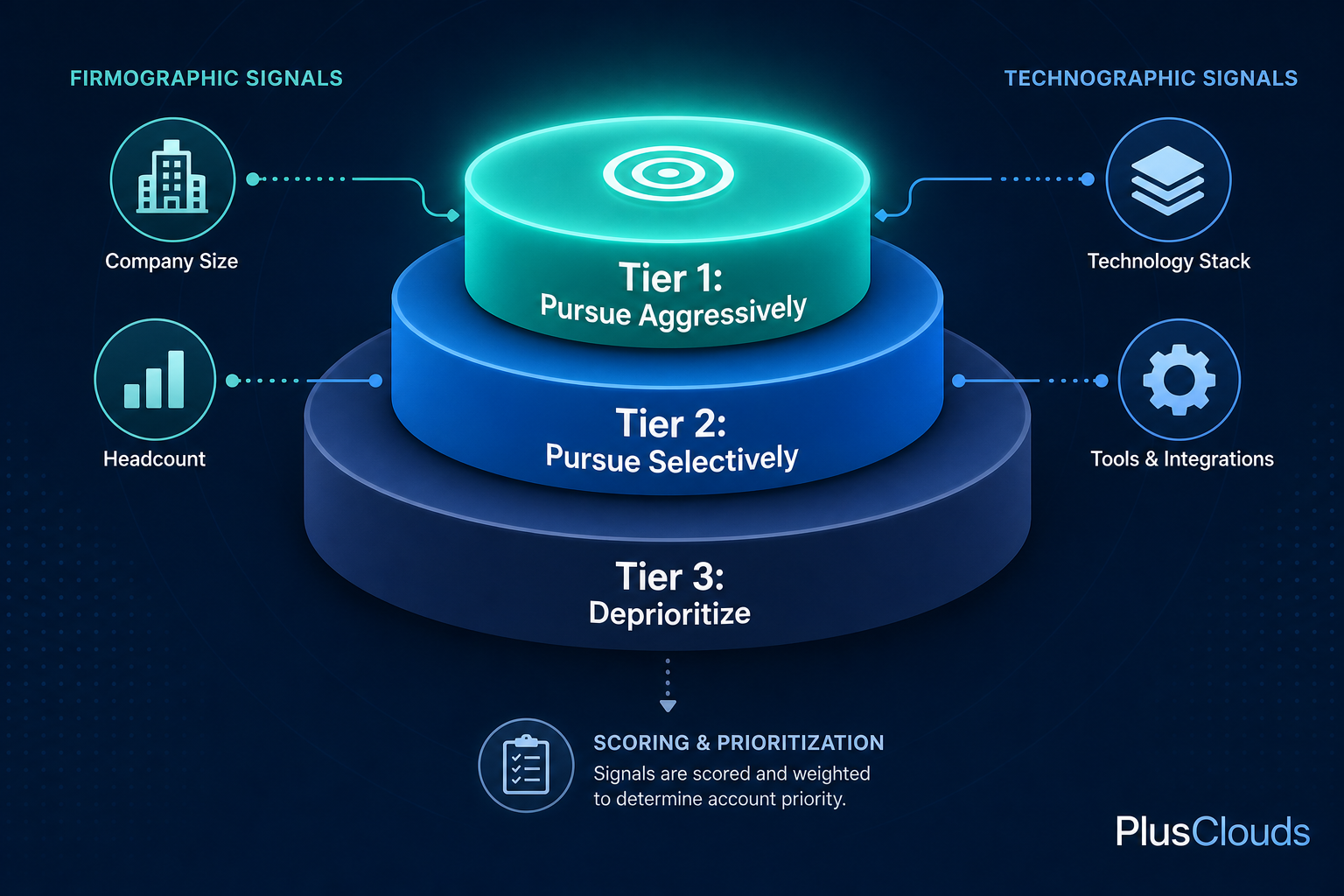
Start with firmographics: the structural attributes of companies that have already become your best customers. Pull your top 20 accounts by lifetime value, not by deal size alone, and look for patterns across these dimensions:
- Employee count (and which department is largest)
- Annual recurring revenue or revenue range
- Industry vertical and sub-vertical
- Geographic market and headquarters location
- Funding stage and investor profile for startups
- Growth trajectory (headcount growth over the past 12 months is a reliable proxy)
Then add technographics. The tools a company runs tell you a great deal about their buying readiness and their existing stack. A company running Salesforce, Marketo, and Snowflake has already made significant investments in revenue infrastructure. They understand the category, they have budget precedent, and they are far more likely to evaluate a complementary tool than a company running spreadsheets and a shared Gmail inbox.
Technographic data is available through providers that scrape job postings, review sites, and public-facing technology signals. The point is to add a layer of precision that firmographics alone cannot provide. An enterprise manufacturer with 5,000 employees looks very different from a SaaS company with 5,000 employees, even though they occupy the same firmographic bucket.
Document your ICP in a format your entire revenue team can use. A simple scoring rubric works well:
ICP Tier 1 (Score 8-10): Pursue aggressively
  - Industry: SaaS, FinTech, or MarTech
  - Employees: 200-2,000
  - HQ: North America or Western Europe
  - Stack includes: Salesforce or HubSpot
  - Headcount growth: >15% YoY

ICP Tier 2 (Score 5-7): Pursue selectively
  - Industry: Professional Services or Manufacturing
  - Employees: 500-5,000
  - Stack includes: legacy CRM (Dynamics, SAP)
  - Headcount growth: 5-15% YoY

ICP Tier 3 (Score <5): Deprioritize
This scoring model turns account selection from a debate into a process.
Step 2: Use AI Prospecting to Identify Buying Committees, Not Just Companies
Once you have a defined ICP, the natural instinct is to build a list of companies that match it. Resist stopping there. A company name on a list is not a pipeline opportunity. A mapped buying committee is.
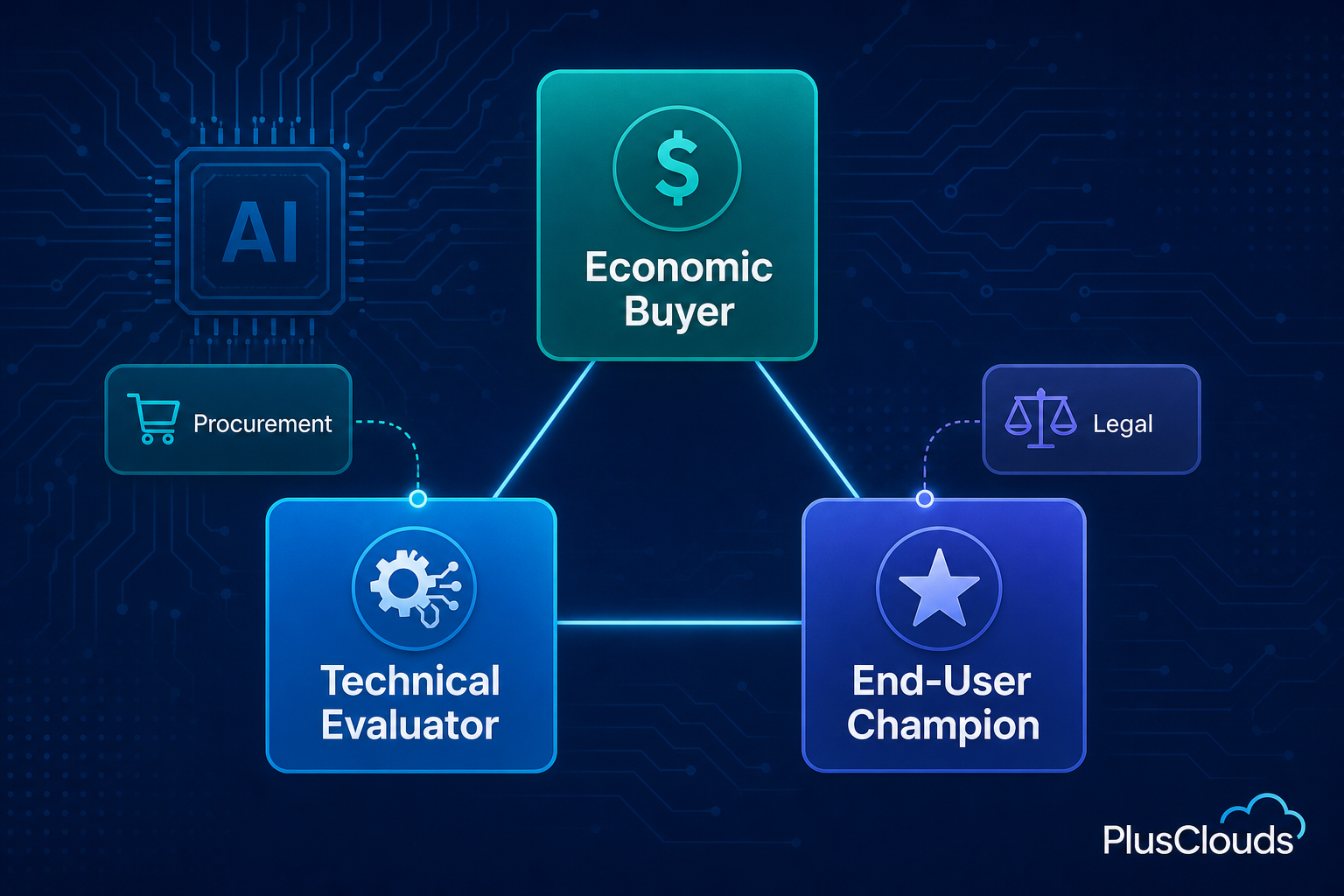
Buying committees in mid-market and enterprise deals typically include five to eight stakeholders across three functional roles: the economic buyer (controls budget), the technical evaluator (assesses fit and integration), and the end user champion (advocates internally based on day-to-day impact). In larger organizations, you will also encounter procurement gatekeepers and legal reviewers who enter the process late but can kill a deal quickly.
AI-powered prospecting tools have made buying committee mapping genuinely tractable at scale. Rather than manually researching org charts for each account, you can use platforms that ingest company data, job titles, reporting structures, and professional network signals to surface the likely members of a buying committee for a given product category.
LeadOcean by PlusClouds approaches this problem with an AI Match Engine that searches across more than 1.8 billion company records to identify not just target accounts but the specific decision-makers and influencers within each account who match your buyer persona criteria. Instead of getting a company name and a generic contact list, you get a mapped set of stakeholders with verified contact information, organized by their likely role in the buying process.
For each account on your list, aim to identify at minimum:
- One economic buyer (typically VP or C-suite, controls budget)
- One technical evaluator (Director of IT, RevOps, or Engineering)
- One end-user champion (the person who will live with the product daily)
Reaching all three simultaneously is what separates ABM from standard outbound prospecting.
Step 3: Layer Intent Data to Prioritize In-Market Accounts
A perfectly constructed ICP-matched account list still has a fundamental problem: not every company that fits your ICP is actively looking to buy right now. Sending personalized campaigns to accounts that are mid-contract with a competitor, or that just completed a similar purchase six months ago, wastes resources and burns goodwill.
Intent data solves this by surfacing behavioral signals that indicate active buying research. These signals come from multiple sources: third-party content consumption (which topics a company's employees are reading about across the web), search query patterns, review site visits on G2, Capterra, and TrustRadius, job postings that signal a new initiative, and technology install or uninstall events.
The practical output of layering intent data is a prioritized account list rather than a flat one. Instead of treating all 500 accounts in your ICP equally, you can identify the 50 that are demonstrably in-market this month and concentrate your highest-effort, highest-cost ABM tactics on them. The remaining 450 go into a lower-touch nurture track until their intent signals warm up.
Research into AI-driven B2B prospecting shows that combining firmographic fit with intent signals can increase conversion rates from target account to opportunity by a significant margin, because you are no longer creating demand from scratch. You are meeting buyers who are already in motion.
When evaluating intent data providers, look for coverage that includes both first-party signals (your own website behavior, content downloads, webinar attendance) and third-party signals (off-site research activity). First-party signals are higher quality but narrower. Third-party signals give you early warning before a prospect ever visits your site.
Step 4: Enrich Each Account with Verified Decision-Maker Contacts
Intent signals tell you who to call. Contact enrichment tells you how to reach them. These are different problems, and conflating them is a common source of frustration.
A target account with a mapped buying committee and strong intent signals is worthless if your contact data is stale. Email bounce rates above 10 to 15 percent damage your sender reputation and reduce deliverability across your entire domain. Phone numbers that roll to voicemail because the person left the company six months ago waste rep time and erode confidence in the list.
Contact verification needs to happen at two points: when you first add a contact to your list, and on a rolling basis as you run campaigns. People change jobs. Companies restructure. A CFO who was your economic buyer in January may have been replaced by March.
Verified contact enrichment should include:
- Work email (not personal Gmail or Yahoo addresses)
- Direct phone or mobile where available
- Current job title and department
- LinkedIn profile URL for social selling and ad targeting
- Seniority level to confirm they match your buyer persona
LeadOcean's database approach addresses this directly by maintaining verified, continuously updated contact records rather than relying on static data exports. For ABM programs where personalization is central to the strategy, contact accuracy is not a nice-to-have. A personalized email that opens with the wrong job title, or lands in the inbox of someone who left the company, signals to the rest of the buying committee that you did not do your homework.
If you are also running outreach sequences alongside your ABM campaigns, pairing enriched contact data with an AI outreach automation platform like Eaglet by PlusClouds lets you move from a verified contact list to a live sequence without the manual handoff that typically introduces delays and data errors.
Step 5: Sync Your Target Account List Directly into HubSpot or Salesforce
A target account list that lives in a spreadsheet is not an ABM program. It is a research project. The moment your list exists only in a static file, it starts degrading. Contacts change roles. New stakeholders join the buying committee. Intent signals shift. And your sales team cannot act on data they cannot see inside the tools they use every day.
Syncing your target account list directly into your CRM is what transforms research into an operational program. In HubSpot, this means creating a target account company list, associating the mapped contacts, and setting up enrollment criteria for your ABM-specific workflows. In Salesforce, it typically involves account record updates, campaign member associations, and custom fields that track ICP tier and intent score.
The sync should be bidirectional where possible. When a sales rep updates an account status or logs a call, that signal should flow back to your marketing automation platform to adjust the account's engagement track. When a new intent spike is detected, it should trigger a task or notification for the assigned rep without requiring manual intervention.
LeadOcean's native integrations with both HubSpot and Salesforce handle this sync automatically, pushing enriched account and contact data directly into the CRM fields your team already uses. You can also explore the LeadOcean and PlusClouds CRM integration guide for a detailed walkthrough of setting up automated pipeline creation from your target account list.
How to Measure ABM Pipeline Health Week Over Week
ABM metrics are different from standard demand-generation metrics, and applying the wrong measurement framework is one of the fastest ways to lose executive support for an ABM program.
Forget cost-per-lead and lead volume. Those metrics reward quantity over quality, which is the opposite of what ABM is designed to do. The metrics that matter for ABM are:
Account engagement rate. What percentage of your target accounts have had at least one meaningful interaction (email open, ad impression, content download, sales call) in the past 30 days? A healthy ABM program should see engagement from 40 to 60 percent of active target accounts each month.
Buying committee coverage. For each engaged account, how many members of the buying committee have been reached? Single-threaded accounts (where only one contact has been engaged) are high-risk. Multi-threaded accounts (three or more contacts engaged) close at significantly higher rates.
Account progression rate. How many accounts moved from one pipeline stage to the next this week? This is your leading indicator of future revenue. Stagnant accounts that have not progressed in 30 days need a different play, not more of the same.
Pipeline sourced from target accounts. What percentage of your total pipeline originated from accounts on your target list? For a mature ABM program, this number should exceed 50 percent.
Build a weekly dashboard that tracks these four metrics at the account level, not the contact level. Review it with your sales counterpart every week. The conversation should be about specific accounts, specific buying committee members, and specific next actions.
Common ABM Pitfalls and How to Avoid Them
Even well-resourced ABM programs run into the same recurring problems. Knowing them in advance saves months of wasted effort.
Building the list once and never updating it. Target account lists need to be living documents. Set a quarterly review cadence to add new accounts that have entered your ICP, remove accounts that have been disqualified, and re-tier accounts based on updated intent data.
Treating ABM as a marketing-only initiative. ABM only works when sales and marketing share ownership of the account list, the engagement strategy, and the success metrics. If sales does not believe in the list, they will not work it. If marketing does not get feedback from sales on account quality, the list will not improve.
Personalizing at the company level but not the persona level. Sending a personalized email that references the company's recent funding round is table stakes. What moves the needle is personalization that speaks to the specific concern of the individual recipient. A CFO cares about ROI and risk. A VP of Engineering cares about integration complexity and uptime. The same account needs different messages for different buying committee members.
Confusing activity with progress. Sending 1,000 personalized emails to target accounts is activity. Moving 10 accounts from "engaged" to "opportunity" is progress. Keep the focus on account progression, not outreach volume.
Underinvesting in the list-building phase. This is the most common pitfall, and it is the one this entire guide addresses. Teams rush to launch campaigns before the list is solid. The result is personalized outreach delivered to the wrong people at the wrong companies at the wrong time. If you are going to invest in ABM, invest first in getting the list right.
For more context on how to evaluate and select lead generation services that support an ABM approach, the guide to finding the best lead generation services covers the evaluation criteria worth applying to any data provider you consider.
Building a target account list that actually converts is not complicated, but it is disciplined work. It requires a precise ICP, a buying committee orientation, intent data to separate in-market accounts from the rest, verified contacts that hold up under campaign pressure, and a CRM sync that keeps the entire revenue team working from the same data.
Each step compounds the one before it. A precise ICP makes buying committee mapping more accurate. Accurate buying committee maps make intent signal interpretation more meaningful. And clean, enriched contacts make the entire program executable rather than theoretical.
If you are ready to move from spreadsheet-based account lists to a systematic, AI-powered ABM workflow, LeadOcean by PlusClouds gives you the database, the AI Match Engine, and the CRM integrations to build and operationalize your target account list in a fraction of the time it would take manually. Start with your ICP criteria, let the platform surface your best-fit accounts and buying committee members, and put your team's energy where it belongs: building relationships with people who are already looking for what you sell.