Your pipeline is a story told in reverse. A prospect signs a contract, and only then do you learn they spent three months reading competitor comparisons on Reddit, watching demo teardowns on YouTube, and asking peers for vendor recommendations in a private Slack community. You never saw any of it. Neither did your CRM. And you almost certainly were not the first vendor they considered.
That invisible research phase has a name: the dark funnel. And in 2026, it accounts for roughly 70% of the B2B buyer journey before any prospect ever raises their hand through a form fill, a demo request, or a direct inquiry. The B2B intent data market has grown to $4.5 billion precisely because revenue teams have realized that waiting for inbound signals means entering a conversation that your competitors started weeks ago.
This guide walks you through what the dark funnel actually is, which signals reliably indicate in-market accounts, why most intent data tools mislead more than they guide, and how to build a workflow that gets your outreach in front of the right buyer at exactly the right moment.
Key Takeaways
- The dark funnel covers approximately 70% of the B2B buyer journey before any inbound contact is made.
- Five signal types reveal in-market accounts: hiring activity, funding events, tech-stack changes, content consumption surges, and social activity.
- Traditional IP-based intent data produces significant false positives; verified, specific sales signals convert far better.
- Signal-to-meeting conversion rate is the north star metric for dark funnel prospecting programs.
- Automating the path from signal detection to CRM sync is the single biggest lever for prospecting speed in 2026.
Table of Contents
- What Is the Dark Funnel and Why 70% of the B2B Buyer Journey Is Now Invisible
- The Five Signal Types That Reveal In-Market Accounts: Hiring, Funding, Tech-Stack Changes, Content Surges, and Social Activity
- Why Traditional Intent Data Produces False Positives and What Sales Signals Actually Mean
- How to Build a Dark Funnel Detection Workflow: From Signal Identification to Contact Enrichment
- Turning Raw Signals into Personalised First Outreach with AI
- How to Sync Signal-Qualified Leads Directly into HubSpot and Salesforce for Instant Action
- Measuring Dark Funnel ROI: Signal-to-Meeting Conversion as Your New North Star Metric
- How LeadOcean and Eaglet Close the Gap Between Signal Detection and Booked Meeting
What Is the Dark Funnel and Why 70% of the B2B Buyer Journey Is Now Invisible
The dark funnel is the portion of the buyer journey that happens completely outside your tracked channels. No UTM parameters. No form submissions. No chatbot conversations. Just a VP of Operations Googling your category at 10pm, a procurement director reading a G2 review thread on their lunch break, or a CTO forwarding a competitor's case study through iMessage to three colleagues.
This behavior is not new. What has changed is the scale. Buyers now have access to more peer review platforms, private communities, social channels, and AI-generated summaries than ever before. They can complete 80% of a vendor evaluation without speaking to a single human being. By the time they contact you, they have often already made a shortlist, and getting onto it after the fact is an uphill fight.
The practical consequence for sales teams is stark. Your inbound leads represent a fraction of your actual addressable demand. The rest of your market is in motion, researching actively, and completely invisible to your marketing automation stack. Teams that rely exclusively on form fills and demo requests are not just missing opportunities. They are systematically losing to competitors who show up earlier.
Understanding the dark funnel is not about paranoia. It is about accepting that modern B2B buying is a self-directed, asynchronous process, and building your prospecting motion accordingly.
The Five Signal Types That Reveal In-Market Accounts: Hiring, Funding, Tech-Stack Changes, Content Surges, and Social Activity
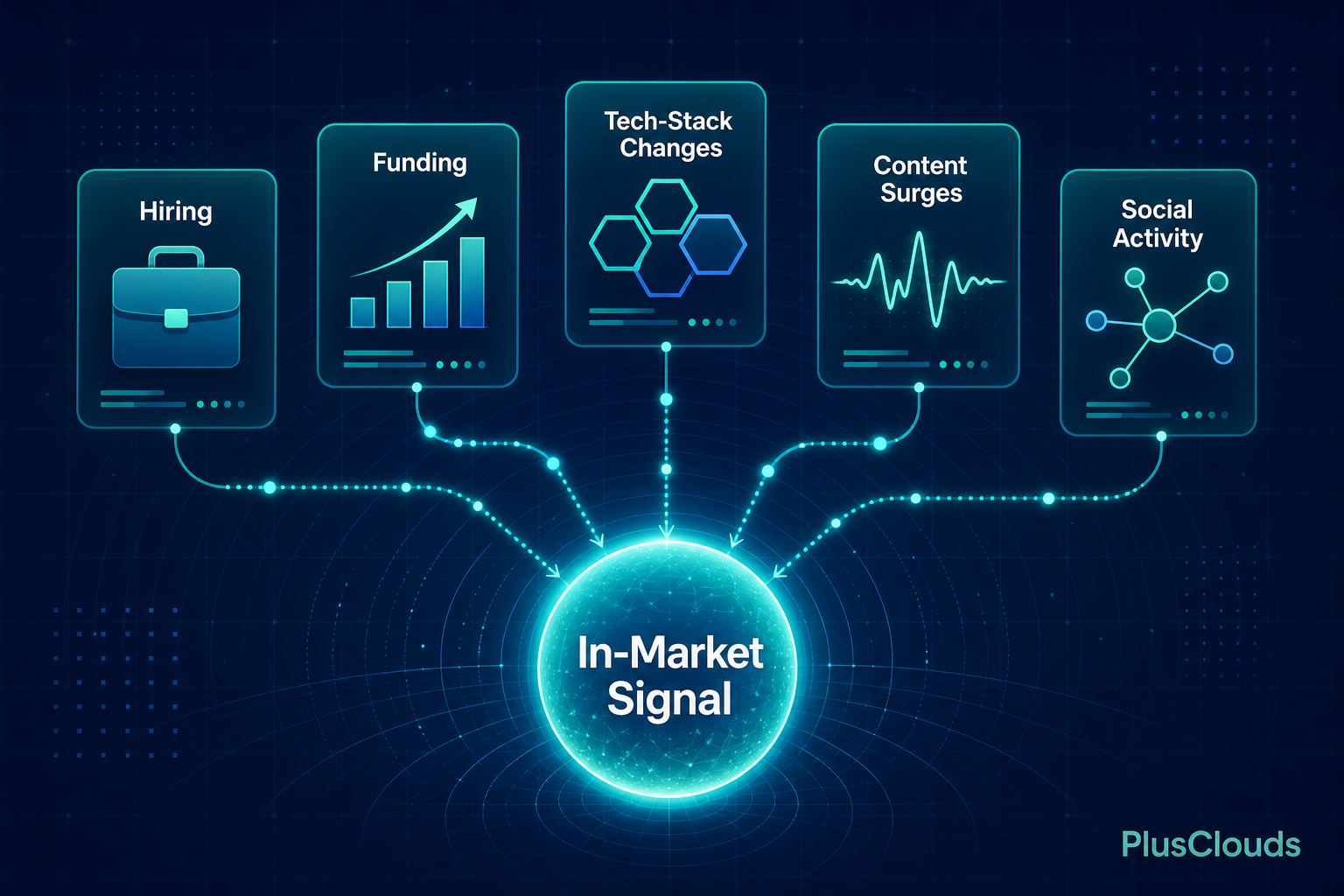
You cannot see inside the dark funnel directly. But accounts leave traces. The companies actively evaluating solutions in your category behave differently from those that are not, and those behavioral differences are detectable if you know where to look.
Hiring signals are among the most reliable. A company posting three new roles for Salesforce administrators, a Head of Revenue Operations, and a Sales Enablement Manager within a 30-day window is almost certainly building or overhauling a sales tech stack. That is not a coincidence. It is a buying signal hiding in plain sight on LinkedIn and job boards.
Funding events compress timelines. A Series B announcement means a company has 18 to 24 months to show growth metrics that justify the raise. New budgets get allocated fast. If your product helps companies scale revenue or reduce operational cost, a freshly funded account is one of the warmest prospects you will ever find, and the window is narrow.
Tech-stack changes tell you about dissatisfaction and transition. When a company drops a tool from their stack, adds a new infrastructure layer, or starts advertising for skills in a competing platform, they are in evaluation mode. Tools like BuiltWith and job description parsing can surface these shifts before any human announces them publicly.
Content consumption surges are harder to detect without third-party data, but they are real. When multiple people from the same IP range or company domain start consuming content about your category across review sites, industry publications, and comparison pages, that cluster of activity indicates coordinated research, not casual browsing.
Social activity is the most underestimated signal. LinkedIn posts where a decision-maker asks their network for vendor recommendations, comments on competitor content, or engages with thought leadership in your category are public and timestamped. They are also almost never systematically monitored by sales teams.
Combining two or more of these signals for the same account dramatically increases your confidence that the company is in-market. One signal is a hint. Three signals is a pipeline opportunity.
Why Traditional Intent Data Produces False Positives and What Sales Signals Actually Mean
The intent data industry has a credibility problem that nobody talks about loudly enough. Most traditional intent platforms work by aggregating anonymous cookie-based or IP-based content consumption data from a network of publisher sites. When enough consumption of content tagged to a particular topic is detected from an IP address, the platform flags that IP as showing "intent" for the associated category.
The problem is that this methodology is riddled with noise. A company's IP address might show intent signals because a junior analyst was doing competitive research for a presentation. A single person reading three articles about cybersecurity does not mean the CISO has budget approval for a new vendor. IP-level data cannot distinguish between a decision-maker actively evaluating solutions and an intern writing a market overview document.
Research into B2B buyer intent trends consistently shows that sales teams acting on raw intent scores without additional qualification waste significant prospecting time chasing accounts that are not actually in a buying cycle. The intent score looks compelling in the dashboard. The account does not pick up the phone.
What actually predicts buying behavior is a combination of signals that are specific, verifiable, and recent. A job posting for a specific role. A LinkedIn comment from a named decision-maker. A verified funding announcement. A documented tech-stack addition. These signals are not probabilistic. They are facts about observable company behavior.
The shift from intent scores to verified sales signals is not semantic. It changes who you call, what you say, and how quickly you move. If you are building your prospecting motion on a foundation of signal quality rather than signal volume, you will book more meetings with fewer dials. That is the practical payoff.
For teams thinking through the broader architecture of signal-led prospecting, the guide on how to build a signal-led outbound sequence covers the tactical steps from detection to booked meeting in detail.
How to Build a Dark Funnel Detection Workflow: From Signal Identification to Contact Enrichment
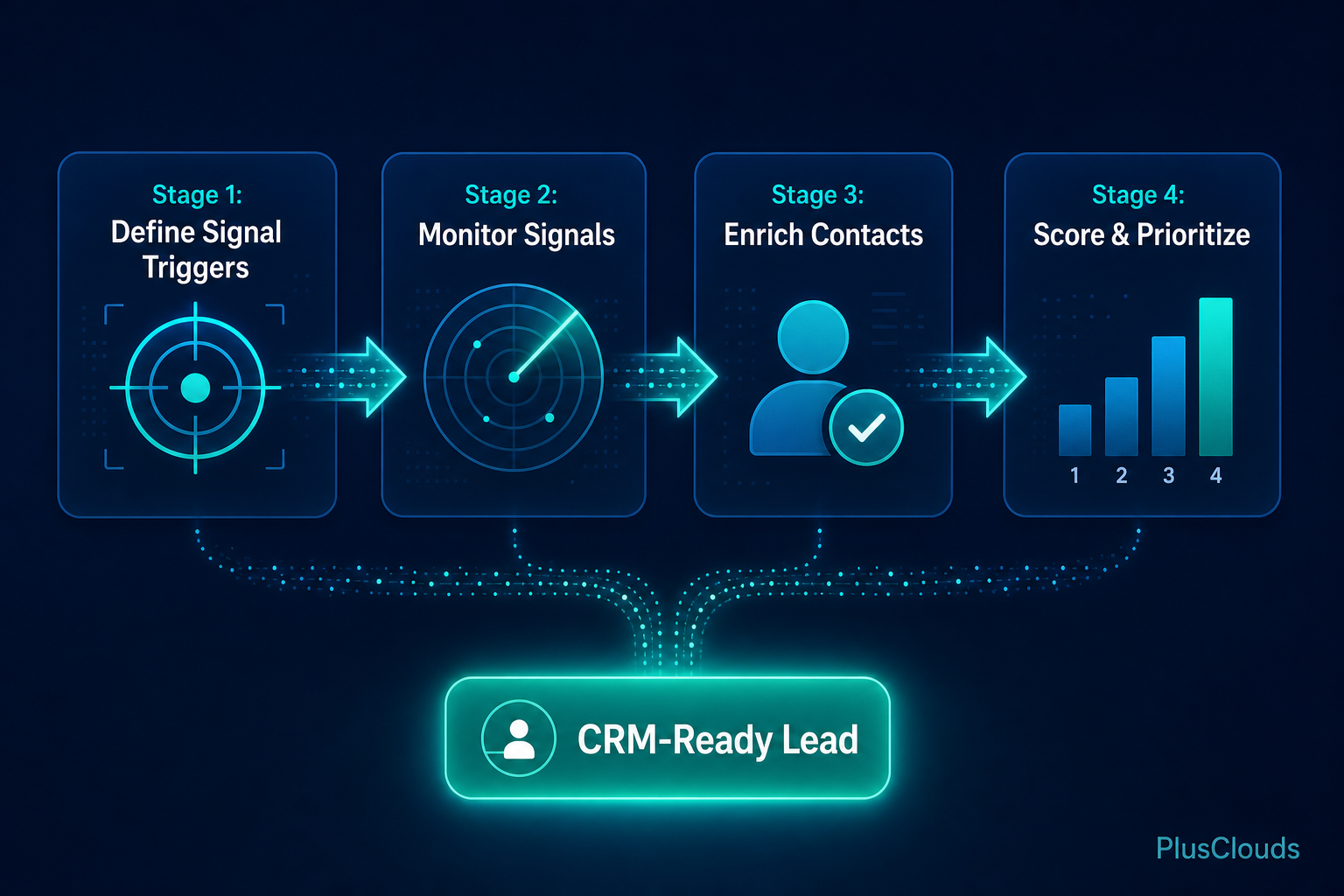
A dark funnel detection workflow has four sequential stages. Skipping any one of them produces either too much noise or too little coverage.
Stage 1: Define your signal triggers. Before you can detect anything, you need to decide which signals matter for your specific ICP (Ideal Customer Profile). A cybersecurity vendor cares about different triggers than a payroll software company. Document your top three to five signal types and the specific criteria that qualify each one. "Hiring a Head of RevOps" is a trigger. "Hiring anyone in sales" is too broad to be useful.
Stage 2: Build or buy signal monitoring. You can monitor some signals manually using LinkedIn Sales Navigator alerts, Google Alerts for funding announcements, and job board RSS feeds. This works at small scale. At anything beyond 200 target accounts, you need automated monitoring. Platforms that scan company data at scale surface signals faster and more consistently than any manual process.
Stage 3: Enrich triggered accounts with verified contacts. A signal tells you which company is in-market. It does not tell you who to contact. Contact enrichment maps the signal to the right decision-maker: the person with budget authority and business pain relevant to your solution. This step requires verified data, not scraped LinkedIn profiles that may be six months out of date.
Stage 4: Score and prioritize. Not every triggered account deserves immediate outreach. Score accounts by signal recency, signal count, and ICP fit. An account that matches your ICP perfectly, just raised a Series A, and posted two relevant job openings in the past two weeks goes to the top of the queue. An account with a single weak signal and marginal ICP fit can wait.
LeadOcean by PlusClouds is built around exactly this workflow. Its AI Match Engine scans data across 1.8 billion-plus companies, surfaces buying signals across hiring, funding, and tech-stack categories, and delivers verified decision-maker contacts directly into your prospecting queue. The signal detection and contact enrichment happen in a single step rather than across four disconnected tools.
Turning Raw Signals into Personalised First Outreach with AI
Detecting a signal is the easy part. Writing a first message that references the signal without sounding like you have been stalking someone is where most teams stumble.
The principle is relevance without creepiness. "I saw you just raised a Series B, congratulations" is fine. "I noticed your CFO liked a post about financial planning software last Tuesday" is not. The former is public, professional, and widely known. The latter is surveillance-adjacent and will kill your reply rate immediately.
Effective signal-based personalization follows a simple structure:
- Reference the observable signal (the trigger)
- Connect it to a business outcome your prospect cares about
- Offer a specific, low-friction next step
Here is an example built around a hiring signal:
"Hi Sarah, noticed Acme is building out a RevOps function, three new roles posted in the last month. Teams scaling their revenue infrastructure often hit the same data quality problem around contact enrichment. Happy to share how [Company] handled it in 90 days. Worth a 20-minute call?"
That message took a public, verifiable signal, connected it to a known pain point in the buying stage implied by the signal, and offered a concrete next step. It did not require the prospect to do any mental work. It did not make them feel watched.
According to research on AI-powered sales prospecting in 2026, AI-generated personalization at scale now matches or exceeds human-written outreach quality when the underlying signal data is accurate. The leverage comes from combining high-quality signals with AI that can generate contextually relevant first lines at volume, without the copy-paste fatigue that kills SDR productivity.
Eaglet by PlusClouds handles this layer of the workflow. It takes the signals and verified contacts surfaced by LeadOcean and generates personalized outreach sequences calibrated to the specific trigger type, the prospect's role, and your value proposition. The result is outreach that reads like it was written by your best SDR, at the speed of automation.
How to Sync Signal-Qualified Leads Directly into HubSpot and Salesforce for Instant Action
Speed matters more than most sales leaders acknowledge. Research consistently shows that the probability of qualifying a lead drops dramatically with every hour that passes after a buying signal is detected. An account that posted a relevant job opening today may have already spoken to two competitors by Thursday.
The gap between signal detection and CRM entry is where most teams lose the speed advantage. If a signal is detected on Monday, manually reviewed on Wednesday, enriched by Friday, and finally entered into Salesforce the following Monday, you have spent a week losing ground.
The fix is direct, automated CRM sync. Signal-qualified accounts should flow into your CRM within minutes of detection, pre-enriched with verified contacts, tagged with the specific signal type that triggered them, and automatically assigned to the right SDR based on territory or account ownership rules.
This requires your signal detection platform to have native integrations with HubSpot and Salesforce, not CSV exports and Zapier workarounds. Native integrations preserve field mapping, respect existing account ownership, and allow you to build CRM-native sequences that trigger automatically when a signal-qualified record lands.
LeadOcean's HubSpot and Salesforce integrations are built for exactly this use case. Signal-qualified leads arrive in your CRM with buying signal data attached as properties, so your SDRs see not just who to contact but why, and can personalize their outreach immediately without switching tools.
For teams that have built out their broader prospecting automation architecture, the guide on how to automate your entire B2B prospecting workflow covers the full stack from lead discovery through to booked meeting.
Measuring Dark Funnel ROI: Signal-to-Meeting Conversion as Your New North Star Metric
Most sales teams measure prospecting performance by volume metrics: emails sent, calls made, sequences enrolled. These metrics are easy to track and almost entirely useless for evaluating signal-based prospecting.
The metric that matters is signal-to-meeting conversion rate: the percentage of accounts that trigger a qualifying signal and subsequently book a meeting with your team. This metric captures the full value of your dark funnel detection workflow, from signal quality through to outreach effectiveness.
A healthy signal-to-meeting rate varies by industry and ICP, but a well-tuned signal-based program should outperform cold outreach to non-signaled accounts by a factor of three to five. If your cold outreach books one meeting per 100 contacts, your signal-based outreach to triggered accounts should book three to five.
Track this alongside:
- Signal-to-opportunity rate: How many signal-qualified meetings convert to active pipeline opportunities.
- Signal-to-close rate: How many signal-qualified opportunities close, and at what average contract value.
- Signal lag: The average time between signal detection and first outreach. This is your speed indicator.
These metrics will tell you which signal types produce the highest quality pipeline, which allows you to double down on the signals that convert and deprioritize the ones that generate noise. Over time, your signal scoring model gets sharper, your outreach gets more targeted, and your pipeline gets more predictable.
How LeadOcean and Eaglet Close the Gap Between Signal Detection and Booked Meeting
The dark funnel problem is ultimately a workflow problem. The signals exist. The buyers are out there, researching actively, leaving traces across dozens of platforms. The challenge is assembling those traces into actionable intelligence fast enough to matter, and then converting that intelligence into conversations before your competitors do.
Most revenue teams solve this with a patchwork of tools: one platform for intent data, another for contact enrichment, a third for outreach sequencing, and a fourth for CRM sync. Each handoff between tools introduces delay, data loss, and manual work. The result is a workflow that is theoretically sound and operationally slow.
LeadOcean by PlusClouds consolidates signal detection, contact enrichment, and CRM integration into a single platform. Its AI Match Engine monitors buying signals across 1.8 billion-plus companies continuously, surfaces triggered accounts that match your ICP, enriches them with verified decision-maker contacts, and pushes them directly into HubSpot or Salesforce. The time from signal to CRM-ready lead is measured in minutes, not days.
Eaglet by PlusClouds handles the outreach layer. It generates personalized, signal-aware email sequences and follow-up cadences that reference the specific trigger event, calibrated to the prospect's seniority, industry, and your value proposition. SDRs review and send rather than write from scratch. Managers see meeting conversion rates rather than activity volume.
Together, the two platforms cover the full arc from dark funnel signal to booked meeting, without the tool sprawl that slows most teams down. For revenue operations leaders thinking about how this fits into a broader account-based motion, the article on account-based marketing meets AI prospecting covers the strategic layer in depth.
The dark funnel will not get smaller. Buyers will continue to self-educate, avoid sales conversations until they are ready, and make shortlists that exclude vendors who showed up too late. The teams that build systematic signal detection into their prospecting motion now will have a structural advantage that compounds over time.
If you want to see how LeadOcean surfaces in-market accounts from your ICP before they ever fill out a form, the platform is worth exploring directly at plusclouds.com/us/leadocean. Your next best opportunity is probably already in the dark funnel. The question is whether you find it first.