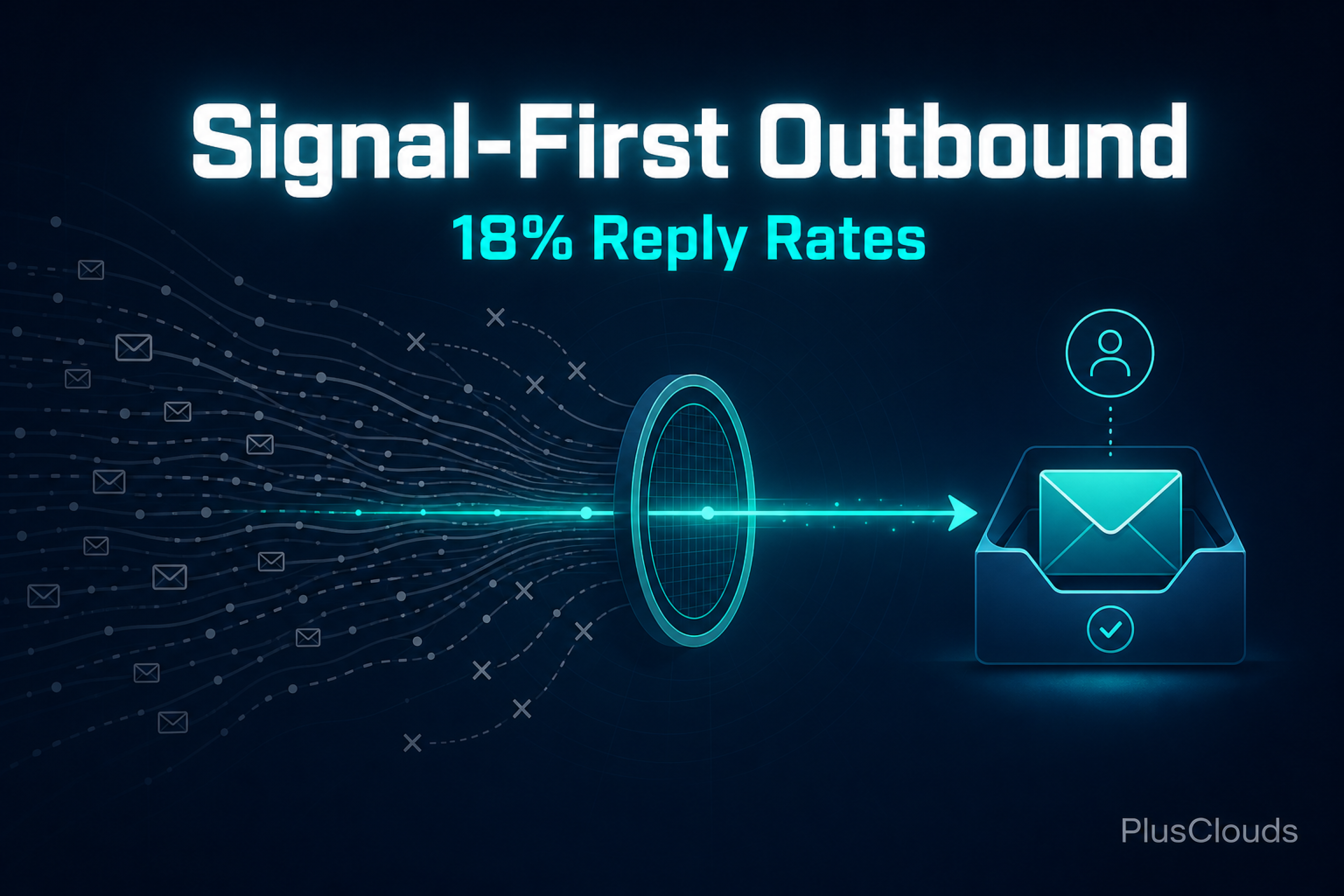
Inboxes in 2026 are not just crowded. They are hostile. The average B2B decision-maker receives somewhere between 100 and 150 cold emails per week, and the vast majority of those messages share the same structure: a compliment that sounds like it was written by a bot, a pitch that could apply to any company in any industry, and a call to action asking for 15 minutes of time the recipient was never going to give. The result is a market-wide reply rate that has collapsed below 2% for generic outbound sequences.
The teams still booking meetings consistently are not sending more email. They are sending smarter email, triggered by real events, personalized at a level that makes the recipient wonder how the sender knew. This guide walks you through the complete operational system for building that kind of outbound motion, from the signals you track to the sequences you write to the weekly rhythm that keeps it running.
Key Takeaways
- Generic B2B cold email reply rates have collapsed below 2% in 2026; signal-first outreach consistently achieves 15 to 20%.
- Effective personalization has four layers; only Layer 4 (signal personalization referencing a specific trigger event) meaningfully moves reply rates.
- Pre-enriching accounts with company data, buying signals, and verified contacts cuts per-prospect research time from 30 minutes to 30 seconds.
- Tiering your list (Dream Accounts, strong ICP fit, broad ICP) lets you deliver the right personalization depth to the right accounts at scale.
- Coordinated multi-channel sequences across email, LinkedIn, and phone outperform single-channel outreach when properly spaced.
- LeadOcean (signal detection and enrichment) and Eaglet (personalized sequence automation) together automate the full signal-to-booked-meeting workflow.
Table of Contents
- Why Generic Outreach Is Dead: The Data Behind 2% Reply Rates
- The Signal-First Shift: Triggering Outreach on Real Buying Events, Not Fixed Cadences
- The Four Layers of B2B Personalization (and Which One Actually Moves Reply Rates)
- How to Pre-Enrich Target Accounts So Reps Spend 30 Seconds, Not 30 Minutes, Per Email
- Tiering Your Prospect List: Full Personalization for Dream Accounts, Efficient Templates for the Rest
- Multi-Channel Coordination: Sequencing Email, LinkedIn, and Phone Without Burning Your List
- Measuring What Matters: Reply Rate, Meeting Rate, and Pipeline, Not Open Rate
- How LeadOcean and Eaglet Automate the Signal-to-Message Workflow End-to-End
- Putting It All Together: A Weekly Outbound Operating Rhythm
Why Generic Outreach Is Dead: The Data Behind 2% Reply Rates
The math is simple and brutal. If your average reply rate is 2%, you need 500 touches to generate 10 replies. If your meeting conversion from reply is 30%, that is 3 meetings from 500 emails. The cost in rep time, domain reputation, and prospect goodwill makes that a losing trade.
The collapse happened for a predictable reason: the barrier to sending cold email dropped to near zero. AI writing tools made it trivial to generate thousands of "personalized" messages that all follow the same formula. Prospects learned to pattern-match these messages in under two seconds and delete them without reading past the first line. Research on outbound personalization trends confirms that surface-level personalization, inserting a first name or a company name into a template, no longer moves reply rates meaningfully. The bar has shifted to relevance, and relevance requires context.
Context comes from signals. A company that just raised a Series B is in a fundamentally different buying posture than the same company six months earlier. A VP of Sales who just joined from a competitor has different priorities than one who has been in the seat for three years. Generic outreach ignores all of that. Signal-first outreach is built entirely around it.
The Signal-First Shift: Triggering Outreach on Real Buying Events, Not Fixed Cadences
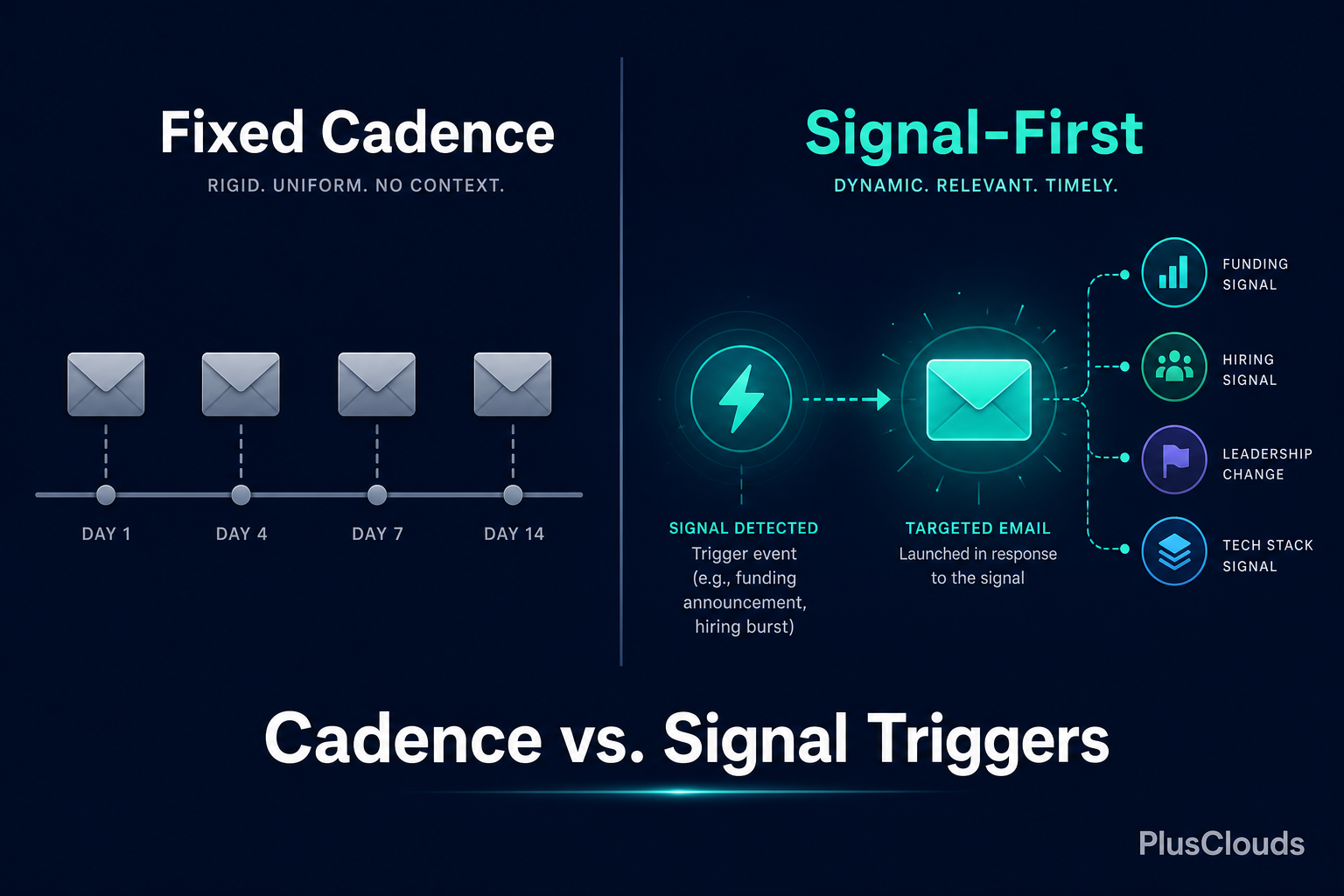
A fixed cadence says: "We reach out to every account in our ICP on Day 1, Day 4, Day 7, and Day 14." A signal-first approach says: "We reach out to this specific account because something just happened that makes our solution relevant right now."
The signals worth tracking fall into a few categories:
- Hiring signals: A company posting for a Head of Revenue Operations is likely evaluating new sales tech. A sudden burst of engineering hires suggests a product expansion.
- Funding signals: Series A through Series C rounds create budget and urgency simultaneously.
- Leadership changes: New C-suite or VP-level hires are actively building their own vendor stacks in their first 90 days.
- Technology signals: A company switching from one CRM to another, or adding a specific tool to their stack, reveals priorities and pain points.
- Intent signals: Content consumption patterns, review site visits (G2, Capterra, TrustRadius), and job description language that mirrors your solution's value proposition.
The operational shift is significant. Instead of a weekly batch send to a static list, your sequence trigger is the signal itself. When a target account hits a defined threshold, the sequence starts. This is covered in depth in How to Build a Signal-Led Outbound Sequence: From Buying Signal to Booked Meeting in 5 Steps, but the core principle is timing: outreach sent within 48 hours of a relevant event gets meaningfully higher engagement than the same message sent cold two weeks later.
The Four Layers of B2B Personalization (and Which One Actually Moves Reply Rates)
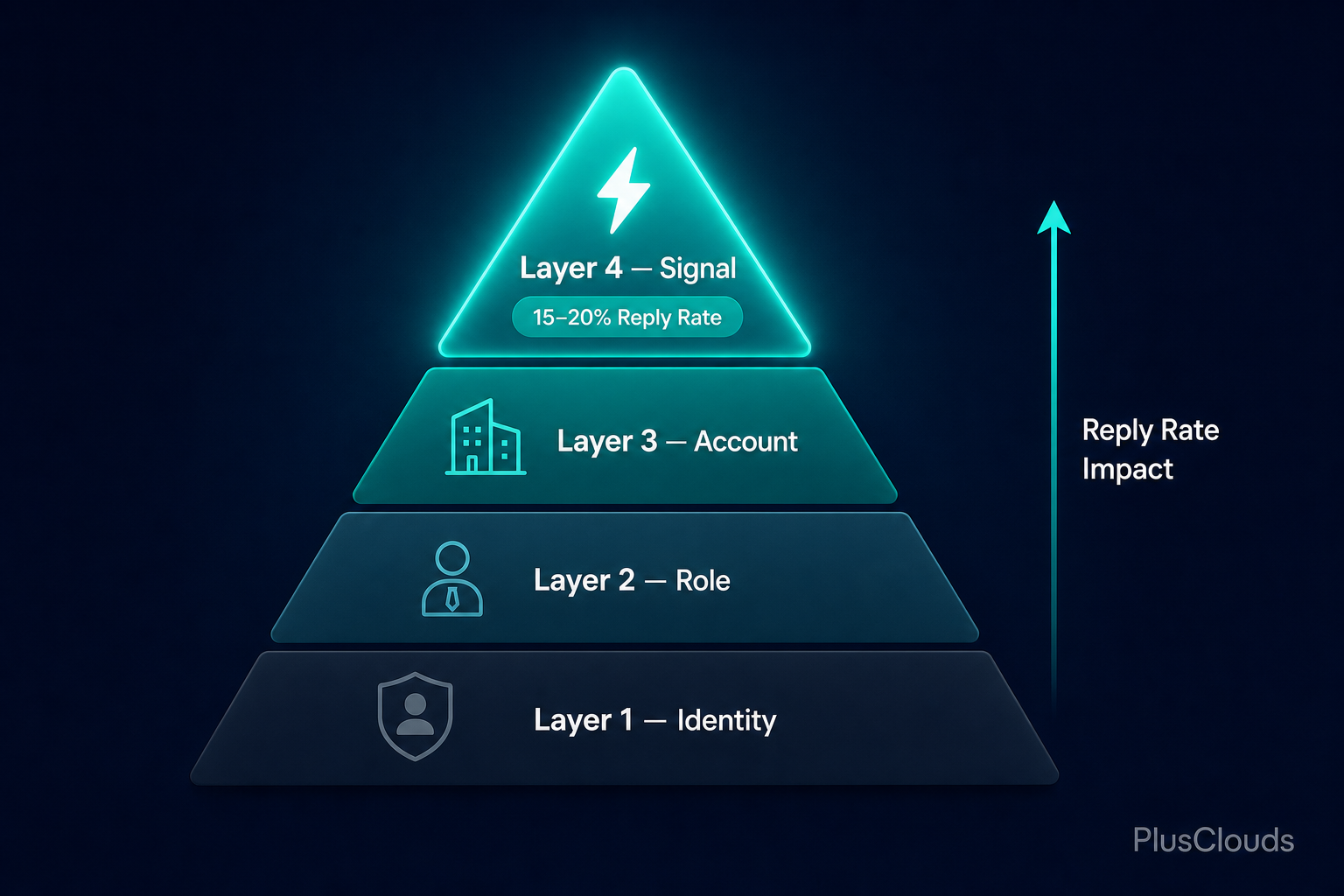
Not all personalization is equal. There are four distinct layers, and most teams stop at the first two.
Layer 1: Identity personalization. First name, company name, industry. This is table stakes. It does not move reply rates in 2026.
Layer 2: Role personalization. Messaging adapted to the prospect's function, common pain points for their title, and relevant metrics. Better, but still generic. A VP of Sales at a 200-person SaaS company gets the same message as a VP of Sales at a 2,000-person manufacturing firm.
Layer 3: Account personalization. Messaging built around what is actually happening at the specific company: their recent product launches, their public earnings commentary, their job postings, their tech stack. This is where reply rates start to move. Studies on B2B outreach personalization consistently show that account-level context is the variable that separates 2% reply rates from 10%+ reply rates.
Layer 4: Signal personalization. Messaging that references the specific event that triggered the outreach. "I saw you just brought on a new CRO" or "Congrats on the Series B, I noticed you're now hiring for three revenue roles simultaneously." This is the layer that produces 15 to 20% reply rates, because it demonstrates that you did actual research and that your outreach is genuinely timely.
The honest constraint is that Layer 4 personalization at scale requires automation. A human rep writing a fully signal-personalized email for every prospect in a 500-account list would spend their entire week on research. The solution is pre-enrichment, which is where the real operational leverage lives.
How to Pre-Enrich Target Accounts So Reps Spend 30 Seconds, Not 30 Minutes, Per Email
Pre-enrichment means assembling all the context a rep needs to write a Layer 3 or Layer 4 email before they ever open a draft. When a prospect lands in the rep's queue, the enrichment data is already there: recent news, funding history, tech stack, hiring trends, relevant LinkedIn activity, and the specific signal that triggered the outreach.
The enrichment workflow has three stages:
- Account-level data pull: Company size, revenue range, industry, tech stack, and recent funding from a database source such as Crunchbase, LinkedIn Sales Navigator, or a dedicated B2B data platform.
- Signal capture: The specific event (job posting, funding announcement, leadership change, technology adoption) that qualified this account for outreach right now.
- Contact-level verification: Confirmed email address, LinkedIn profile URL, direct dial if available, and current title verified against a live data source.
With all three layers pre-populated, writing a personalized email takes 30 seconds. The rep reviews the context, adjusts the AI-drafted message if needed, and sends. Without pre-enrichment, the same task takes 20 to 30 minutes of research per prospect.
LeadOcean by PlusClouds is built specifically for this workflow. Its AI Match Engine searches across 1.8 billion company records to identify accounts that match your ICP, surfaces verified decision-maker contacts, and flags active buying signals, so your reps arrive at every outreach task with the context already assembled. The buying-signal detection layer is particularly useful here: it monitors trigger events across your target account list and queues prospects for outreach at the moment of highest relevance.
Tiering Your Prospect List: Full Personalization for Dream Accounts, Efficient Templates for the Rest
Trying to deliver Layer 4 personalization to every prospect on a 10,000-account list is not realistic, and it is not necessary. The right approach is tiering.
Tier 1 (Dream Accounts, typically 5 to 10% of your list): These are the accounts where a single closed deal would be transformative. They get full signal personalization, custom research, multi-channel sequences, and rep involvement at every touch. Budget 15 to 20 minutes of human review per account even with AI assistance.
Tier 2 (Strong ICP fit, typically 25 to 30% of your list): These accounts match your ideal customer profile well and have shown at least one buying signal. They get account-level personalization (Layer 3) with AI-generated first lines referencing a specific data point, combined with a strong role-based template for the body. Reps review and approve but rarely rewrite.
Tier 3 (Broad ICP, the remaining 60 to 70%): These accounts are worth reaching but do not justify deep research. They get role-personalized templates with dynamic fields populated from enrichment data. The goal is volume with relevance, not bespoke craftsmanship.
This tiering framework is closely related to the account-based approach covered in Account-Based Marketing Meets AI Prospecting: How to Build a Target Account List That Actually Converts. The key is that your Tier 1 list should be small enough that you can actually execute against it with high quality. Fifty dream accounts worked properly will outperform 500 accounts worked halfheartedly every time.
Multi-Channel Coordination: Sequencing Email, LinkedIn, and Phone Without Burning Your List
Single-channel outreach is a ceiling. The teams hitting 18%+ reply rates are using coordinated multi-channel sequences, but coordination is the operative word. Hitting the same prospect with an email, a LinkedIn connection request, and a phone call in the same 24-hour window is not coordination. It is spam with extra steps.
A well-structured multi-channel sequence for a Tier 1 account looks something like this:
- Day 1: LinkedIn profile view (no message yet, just a visibility signal to the prospect).
- Day 2: Personalized email referencing the trigger signal. Subject line specific, opening line tied to the event.
- Day 4: LinkedIn connection request with a short, non-pitchy note referencing the same context.
- Day 7: Follow-up email, different angle, adds value (a relevant benchmark, a piece of original research, or a specific question).
- Day 10: Phone call or voicemail if you have a verified direct dial.
- Day 14: Final email, explicit breakup framing, keeps the door open for a future conversation.
The spacing matters as much as the channels. Too tight and you look desperate. Too spread out and the signal context goes stale. For Tier 2 and Tier 3 accounts, compress the sequence and reduce the channel count. Email plus LinkedIn is usually sufficient.
One practical note on LinkedIn: connection acceptance rates drop sharply when the note is a pitch. Keep the connection message to one sentence that references something specific and non-commercial. The pitch comes later, once you are connected.
Measuring What Matters: Reply Rate, Meeting Rate, and Pipeline, Not Open Rate
Open rate is the metric that feels meaningful but predicts almost nothing. Apple's Mail Privacy Protection and similar features from Google and Microsoft have made open rate data unreliable at the individual level, and a high open rate with a low reply rate just means your subject lines are working but your emails are not.
The metrics that actually tell you whether your system is working:
Reply rate: Aim for 8 to 12% as a baseline for a well-tiered list with signal personalization. Above 15% means your triggers and messaging are genuinely resonant. Below 5% means something is broken, usually the ICP definition, the signal selection, or the first line of the email.
Positive reply rate: Total replies include opt-outs and "not interested" responses. Track the percentage of replies that are positive (interested, asking for more information, willing to meet). A 12% reply rate where 40% are positive is better than a 15% rate where 20% are positive.
Meeting booked rate: Meetings booked divided by prospects contacted. This is the number that connects directly to pipeline. For a healthy outbound motion, 2 to 4% of contacted prospects should convert to a booked meeting.
Pipeline generated per sequence: Attribute revenue opportunity to specific sequences so you can double down on what works and cut what does not.
Drop open rate from your weekly review entirely. It creates false confidence and leads to optimizing for the wrong variable.
How LeadOcean and Eaglet Automate the Signal-to-Message Workflow End-to-End
The operational challenge with everything described above is that it involves a lot of moving parts: signal monitoring, account enrichment, contact verification, message generation, sequence management, and CRM logging. Without automation, this workflow requires a full-time researcher plus a full-time SDR just to keep it running for a modest account list.
LeadOcean by PlusClouds handles the front end of that workflow. It continuously monitors your target account list for buying signals, enriches new accounts against the 1.8 billion company database, verifies decision-maker contacts, and surfaces the right prospects at the right moment. Its HubSpot and Salesforce integrations mean that enriched contacts flow directly into your CRM without manual data entry.
Eaglet by PlusClouds handles the back end. Once a signal-qualified prospect is identified, Eaglet generates a personalized outreach message using the enrichment context, manages the multi-channel sequence across email and LinkedIn, tracks engagement, and routes replies back to the appropriate rep. The combination covers the full signal-to-message loop: LeadOcean finds the right account at the right moment, Eaglet delivers the right message and manages the follow-through.
For teams currently doing this manually, the practical impact is that reps shift from spending 70% of their time on research and admin to spending 70% of their time on actual conversations. That reallocation is where the meeting rate improvements come from. You can also explore how this kind of workflow integrates with broader prospecting automation in How to Automate Your Entire B2B Prospecting Workflow: From Lead Discovery to Booked Meeting.
Putting It All Together: A Weekly Outbound Operating Rhythm
A system that works once is a tactic. A system that works every week is a process. Here is what the weekly operating rhythm looks like for a team running signal-first outbound properly.
Monday (30 to 60 minutes): Review the signal queue. LeadOcean surfaces accounts that hit a trigger event in the past 7 days. The team reviews, confirms ICP fit, and assigns tier designations. New Tier 1 accounts get assigned to specific reps.
Tuesday and Wednesday: Reps work Tier 1 accounts. AI-drafted messages are reviewed and refined. LinkedIn engagement begins. Tier 2 sequences are approved and launched in bulk.
Thursday: Tier 3 sequences are launched. Reply management begins for sequences that have been running for 4 or more days. Positive replies get moved to meeting scheduling immediately.
Friday (30 minutes): Weekly metrics review. Reply rate, positive reply rate, meetings booked, and pipeline generated are reviewed against the prior week. One sequence variant is identified for A/B testing the following week.
This rhythm keeps the system running without consuming the entire team's schedule. The automation handles the volume. The humans handle the judgment calls: which accounts to prioritize, which messages to refine, which signals are genuinely meaningful versus noise.
Generic outbound is not coming back. The noise floor in B2B inboxes is too high, and buyers have become too good at filtering. The teams that will consistently book meetings in 2026 and beyond are the ones that treat outreach as a research and relevance problem, not a volume problem.
The system described here, signal detection, account tiering, pre-enrichment, multi-channel sequencing, and rigorous metric tracking, is not theoretical. It is the operational pattern behind the reply rates that look impossibly high to teams still running spray-and-pray campaigns.
If you are ready to build this kind of motion, LeadOcean by PlusClouds gives you the signal detection and enrichment infrastructure to make it real, and Eaglet handles the personalized outreach automation that turns those signals into booked meetings. Start with your Tier 1 list, run the system for four weeks, and compare the results against whatever you were doing before.