Most sales teams are sitting on a goldmine they keep burying. They have access to intent data, trigger alerts, and signal feeds. They know a target account just hired a new VP of Sales, or that three people from the same company spent forty minutes on their pricing page. And then they wait. They add the account to a nurture sequence. They mention it in the next weekly pipeline review. By the time an SDR actually reaches out, it is Tuesday of the following week, and the competitor who moved on Monday already has a discovery call on the calendar.
The problem is not signal access. The problem is activation speed. This guide covers exactly that: how to build a 48-hour activation discipline, which signals decay fastest, and how to wire together a workflow that turns a raw signal into a personalised, booked meeting before your competitor even opens their CRM.
Key Takeaways
- Trigger-event emails achieve an 18% reply rate vs. 3.4% for generic outreach, more than 5x the return for the same effort.
- Buying signals decay rapidly: pricing page visits expire in under 24 hours; funding rounds give you five to ten days at most.
- Only about 25% of B2B companies use intent data tools systematically, meaning early movers still hold a significant competitive advantage.
- The critical gap is between signal detection (Hour 0) and first touch (Hour 1). Manual processes kill this window. Automation closes it.
- Signal-to-meeting conversion rate (target: 8% to 15%) is the only metric that truly measures whether your activation workflow is working.
- LeadOcean and Eaglet by PlusClouds automate the full loop: signal detection, contact matching, personalised outreach, and CRM sync.
Table of Contents
- Why Signal Timing Beats Signal Volume: The 5x Reply-Rate Difference in 2026 Data
- The Anatomy of a Buying Window: What Changes at a Company in the 7 to 30 Days After a Signal Fires
- The Nine Signals That Consistently Open Pipeline: Ranked by Urgency and Decay Rate
- The 48-Hour Clock: How to Build an Activation Workflow That Acts Before the Window Closes
- How LeadOcean's Match Engine Identifies the Right Decision-Maker the Moment a Signal Fires
- From Signal to Personalised First Touch in Under 60 Minutes: An Eaglet Sequence Blueprint
- Connecting LeadOcean and Eaglet to HubSpot and Salesforce: Automating the Full Activation Loop
- Measuring What Matters: Signal-to-Meeting Conversion Rate as Your North-Star Metric
- Common Mistakes That Waste Buying Signals: Stale Data, Wrong Personas, and Slow Follow-Up
Why Signal Timing Beats Signal Volume: The 5x Reply-Rate Difference in 2026 Data
Here is a number worth sitting with: emails that reference a specific trigger event achieve an 18% response rate, compared to a 3.4% average for generic outreach. That is more than five times the reply rate for roughly the same effort, assuming you have the right tooling in place.
The reason is not mysterious. A buying signal tells you that something has changed inside the target account. A new budget has been approved. A competitor was just displaced. A pain point became urgent. When your outreach arrives at that exact moment and names the change, the prospect feels seen rather than spammed. The message lands as relevant, not random.
Volume thinking pulls teams in the wrong direction. The instinct is to collect more signals, cover more accounts, and run bigger sequences. But if your activation lag is five days, you are competing against teams with a two-hour activation lag, and no amount of signal volume closes that gap. Timing is the variable that actually moves reply rates.
The other uncomfortable truth is that only about 25% of B2B companies currently use intent or signal data tools in any systematic way. That means the competitive moat for teams who move fast is still enormous. The early-activation advantage has not been arbitraged away yet.
The Anatomy of a Buying Window: What Changes at a Company in the 7 to 30 Days After a Signal Fires
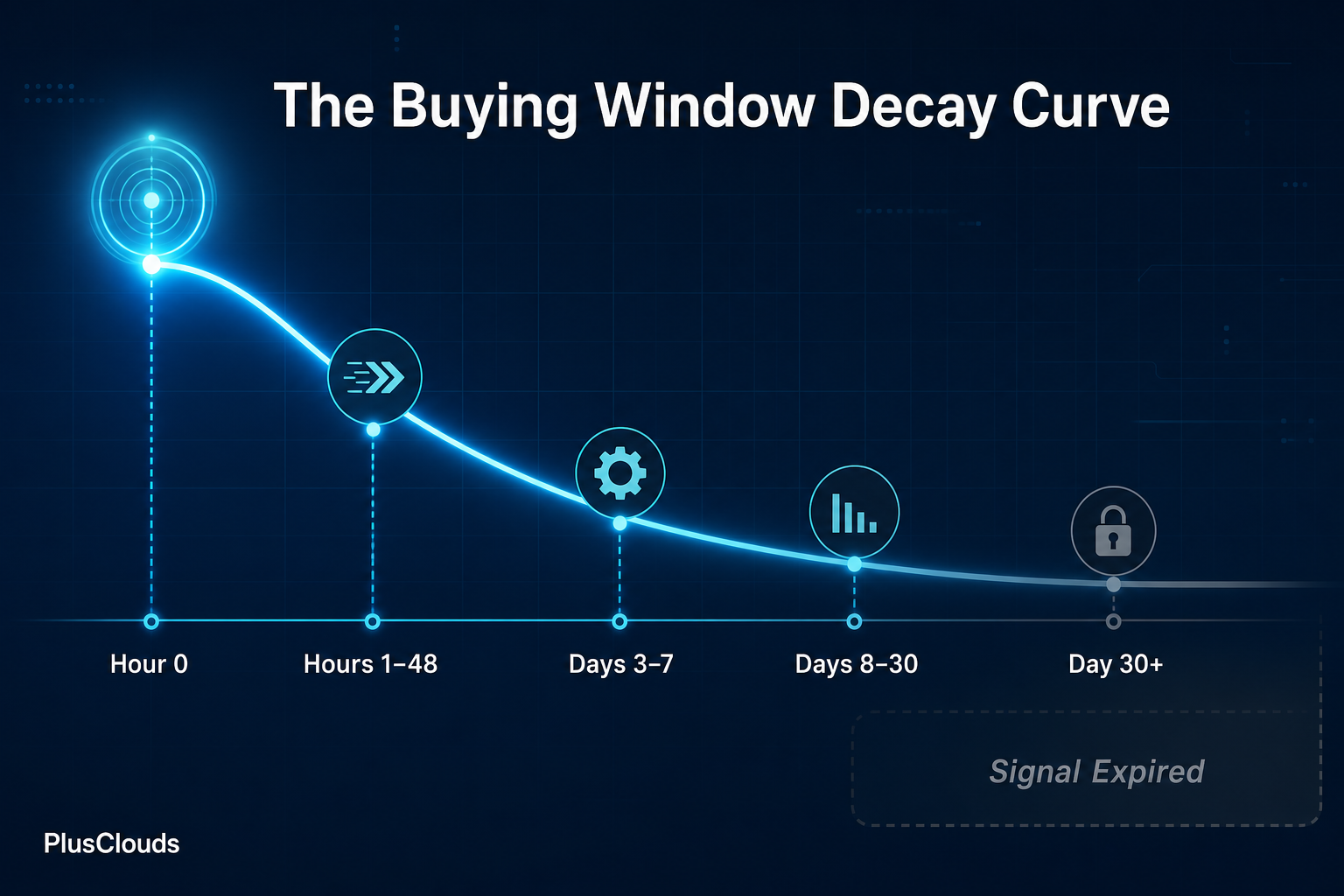
A buying signal does not flip a switch. It opens a window. Understanding what happens inside that window explains why signal-based outreach timing matters so much.
In the first 24 to 48 hours after a signal fires, the relevant stakeholder is in active problem-solving mode. They are Googling, asking peers, and mentally shortlisting vendors. Their attention is high and their calendar is not yet full of demos. This is the highest-value moment for any intent signal outreach.
Between days three and seven, internal conversations begin. A budget owner gets looped in. A shortlist starts forming, often informally. If you are not already in the conversation, you are competing for a slot on a list that is already taking shape.
Between days eight and thirty, the evaluation process formalises. RFPs go out, demos get scheduled, procurement gets involved. You can still win here, but you are working harder for a smaller edge. Your pitch has to be better because your B2B signal timing was not.
After thirty days, most signals have fully decayed. The company has either solved the problem, chosen a vendor, or deprioritised the initiative. Cold outreach at this point is essentially generic, because the context that made the signal meaningful has evaporated.
This decay curve is why the 48-hour activation window is not an arbitrary rule. It reflects the actual decision-making timeline inside a B2B account. If you want to understand how first-party intent data feeds into this window before a signal ever reaches your outreach queue, the guide on building a first-party intent stack that feeds LeadOcean covers that upstream layer in detail.
The Nine Signals That Consistently Open Pipeline: Ranked by Urgency and Decay Rate
Not all signals are equal. Some expire in hours. Others stay warm for weeks. Here is how the most reliable B2B buying signals rank by urgency and decay rate, from fastest to slowest:
- Pricing page visit (3+ pages, 5+ minutes): Decay rate is extremely fast, often under 24 hours. Someone is actively evaluating right now.
- Job posting for a role your product replaces or enables: Decay rate is fast, one to three days. The hiring decision signals a budget and a direction.
- New executive hire in a relevant function: Decay rate is moderate, three to seven days. New leaders re-evaluate vendors in their first 90 days.
- Competitor displacement announcement: Decay rate is fast, one to three days. The account is actively in-market and the incumbent is gone.
- Funding round announcement: Decay rate is moderate, five to ten days. Fresh capital means new initiatives and new budgets.
- Technology install or uninstall detected: Decay rate is moderate, three to seven days. A stack change signals a broader evaluation across tools like Salesforce, HubSpot, or category-specific platforms.
- Content engagement on high-intent topics: Decay rate is slower, seven to fourteen days. Research behaviour precedes purchase behaviour.
- Company expansion or new office opening: Decay rate is slow, ten to twenty days. Growth creates operational problems your product may solve.
- Regulatory or compliance change affecting the industry: Decay rate is slowest, two to four weeks. These create durable, category-wide demand.
The practical implication is that signals one through four require same-day or next-day activation. Signals five through nine give you a slightly longer runway, but "slightly longer" still means days, not weeks. For a deeper look at how dark funnel signals fit into this picture, the post on dark funnel B2B prospecting covers the detection layer for signals that never surface in public data.
The 48-Hour Clock: How to Build an Activation Workflow That Acts Before the Window Closes
The 48-hour buying signal activation window is not a metaphor. It is a literal operational constraint. Here is what a working activation workflow looks like:
Hour 0: Signal fires and is captured. Your signal source, whether that is a website visitor tracker, a job board scraper, a news feed, or a dedicated platform like LeadOcean, detects the event and logs it.
Hour 0 to 1: Enrichment and persona matching. The account is enriched with firmographic data from a verified B2B database. The right decision-maker contact is identified based on the signal type. A pricing page visit routes to a commercial or procurement persona. A new VP of Sales hire routes to the CEO or CRO.
Hour 1 to 2: Personalised first touch is drafted and queued. The outreach references the specific signal. Not vaguely ("I noticed you've been growing") but precisely ("I saw you posted a Head of Revenue Operations role last week, which usually means...").
Hour 2 to 48: Sequence executes across channels. Email goes first. A LinkedIn connection request follows within a few hours. A follow-up email on day two closes the initial window. Each touch reinforces the signal reference without repeating it verbatim.
The failure mode in most teams is not the sequence design. It is the gap between hour zero and hour one. That gap is where signals go to die. Manual enrichment, manual persona research, and manual drafting turn a two-hour process into a two-day one. The only way to close the gap is automation in your AI prospecting workflow.
How LeadOcean's Match Engine Identifies the Right Decision-Maker the Moment a Signal Fires
Identifying the right person to contact is where most signal-based workflows break down. A funding announcement at a 200-person company could mean reaching out to the CFO, the VP of Engineering, or the Head of Procurement, depending on what you sell. Getting this wrong wastes the signal entirely.
LeadOcean by PlusClouds solves this with an AI Match Engine that maps signals to decision-maker personas automatically. When a signal fires, the engine searches across a database of 1.8 billion-plus company records to surface verified contact information for the right person at the right level, based on the signal type, your Ideal Customer Profile, and the account's organisational structure.
The practical effect is that the gap between hour zero and hour one collapses. Instead of an SDR manually researching who to contact, the system surfaces a verified name, title, email, and LinkedIn profile alongside the signal context. The SDR's job shifts from research to review and send. That is not a minor efficiency gain. It is the difference between acting inside the buying signal activation window and missing it entirely.
From Signal to Personalised First Touch in Under 60 Minutes: An Eaglet Sequence Blueprint
Speed without personalisation is just noise. The reason trigger-event emails achieve 18% reply rates is not because they arrive fast. It is because they arrive fast and they are relevant. Relevance requires personalisation at the signal level, not just the persona level.
Here is what a 60-minute activation sequence looks like in practice, built on Eaglet's outreach automation:
Touch 1: Signal-specific email (sent within 60 minutes of signal capture)
Subject: [Company name]'s [specific trigger, e.g., "new RevOps hire"]

Hi [First name],

I noticed [Company] just posted a Head of Revenue Operations role,
usually a sign that the team is formalising the go-to-market stack.

We help [ICP description] teams like yours [specific outcome] in the
first 90 days of a RevOps build-out. Happy to share what's worked
for [similar company in their space].

Worth a 20-minute call this week?

[Signature]
Touch 2: LinkedIn connection request (sent 4 to 6 hours after Touch 1)
Short note referencing the same signal, no pitch. The goal is to be visible on a second channel before the follow-up email lands.
Touch 3: Follow-up email (sent 24 to 36 hours after Touch 1)
Subject: Re: [Company name]'s [trigger]

Hi [First name],

Wanted to follow up briefly. If the timing isn't right, no problem,
I can reach back out in a few weeks. But if you're actively thinking
through the [relevant problem area], I have 20 minutes open Thursday
or Friday morning.

[Signature]
Touch 4: Break-up email (sent 48 hours after Touch 1)
Short, low-pressure, leaves the door open. No new pitch.
Eaglet by PlusClouds automates this entire sequence from signal to send, including the personalisation layer. The AI generates the signal-specific first line based on the trigger event, so each email reads as individually written rather than templated. The sequence pauses automatically when a reply is detected, so prospects never receive a follow-up after they have already responded.
For more on building out the full sequence architecture, the guide on signal-led outbound sequences covers the five-step structure in detail.
Connecting LeadOcean and Eaglet to HubSpot and Salesforce: Automating the Full Activation Loop
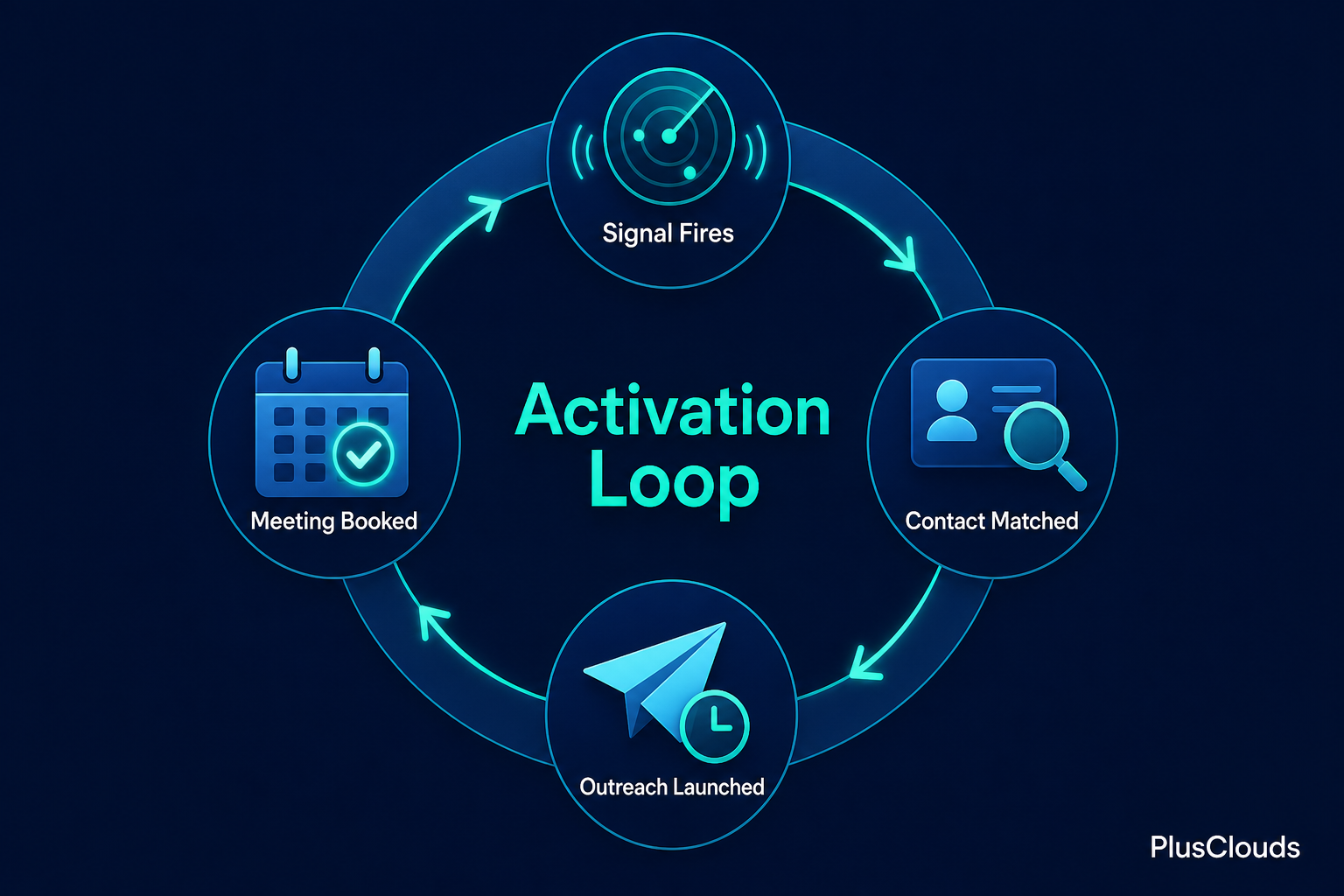
The workflow above only works at scale if it runs without manual intervention. That requires your signal platform, your contact enrichment layer, and your outreach tool to talk to your CRM in real time.
LeadOcean integrates natively with both HubSpot and Salesforce. When a signal fires and a contact is matched, the account and contact records are created or updated in your CRM automatically. Signal context is logged as a custom property, so your team always knows why a prospect entered the pipeline, not just that they did.
Eaglet picks up from there, enrolling the contact in the appropriate sequence based on signal type and persona. Sequence activity, reply detection, and meeting bookings sync back to the CRM, keeping the pipeline record current without any manual data entry.
The result is a closed loop: signal fires, contact is identified, outreach launches, activity is logged, and the meeting appears in your calendar. The SDR's role in this loop is to review flagged signals, approve or adjust the first-touch copy, and handle replies. Everything else is automated by the AI prospecting workflow.
This kind of automation is also what makes it possible to run signal-based outreach across dozens of accounts simultaneously without quality degrading. Manual workflows collapse under volume. Automated loops scale linearly. For teams building out a fully automated prospecting workflow from scratch, the post on automating your entire B2B prospecting workflow walks through the full architecture.
Measuring What Matters: Signal-to-Meeting Conversion Rate as Your North-Star Metric
Most sales teams measure outbound by reply rate or sequence open rate. These are vanity metrics for signal-based selling. The number that actually tells you whether your activation workflow is working is signal-to-meeting conversion rate: the percentage of fired signals that result in a booked discovery call.
Here is how to calculate it:
Signal-to-Meeting Rate = (Meetings Booked from Signal Outreach) /
                         (Total Signals Activated) x 100
A well-tuned activation workflow targeting high-urgency signals should produce a signal-to-meeting rate of 8% to 15%. Below 5% usually indicates one of three problems: wrong persona matching, activation lag beyond 48 hours, or poor signal quality.
Secondary metrics worth tracking alongside the north-star:
- Activation lag: Average time from signal fire to first touch sent. Target is under two hours for Tier 1 signals.
- Signal decay rate by type: Which signal categories produce the most meetings when activated quickly? This tells you where to prioritise automation investment.
- Reply rate by touch number: If most replies come on Touch 3 or 4, your Touch 1 copy needs work. If most replies come on Touch 1, you are nailing the signal reference.
- Meeting-to-opportunity rate from signal pipeline: Are signal-sourced meetings converting to pipeline at a higher rate than non-signal outbound? They should be, significantly.
Review these metrics weekly, not monthly. Signal-based outreach moves fast enough that a week of bad activation lag can cost you a meaningful number of pipeline opportunities.
Common Mistakes That Waste Buying Signals: Stale Data, Wrong Personas, and Slow Follow-Up
Teams that have signal data but are not seeing results are almost always making one of these mistakes.
Using stale contact data. A signal fires at an account, but the contact information in your database is six months old. The VP of Sales you are emailing left the company in January. The email bounces, or worse, it reaches the wrong person and damages your sender reputation. Signal-based outreach is only as good as the contact data underneath it. Verified, recently refreshed data is not optional.
Matching signals to the wrong persona. A technology uninstall signal at a Series B SaaS company does not route to the CEO. It routes to the CTO or VP of Engineering. A funding announcement does not automatically mean the CFO is your buyer. Persona matching needs to be signal-specific, not just ICP-level.
Treating all signals as equal urgency. A pricing page visit and a regulatory change affecting the industry are both signals, but they operate on completely different timescales. Applying a 72-hour activation workflow to a pricing page visit is roughly equivalent to calling a fire department three days after the fire. Tier your signals by decay rate and build separate activation workflows for each tier.
Slow follow-up after a reply. This one is less discussed but equally damaging. A prospect replies to your signal-referenced email within an hour of receiving it. Their intent is at its peak. If your SDR responds eight hours later, you have already lost some of that momentum. Reply speed matters almost as much as outreach speed.
Over-personalising at the expense of speed. Some teams spend so long crafting the perfect signal-specific email that they miss the window entirely. Good enough and fast beats perfect and late, every time. Automate the personalisation layer so you do not have to choose.
Signal-based selling is genuinely one of the most effective outbound approaches available to B2B teams right now. The data on reply rates is clear, the competitive advantage for early movers is real, and the tooling to operationalise it at scale exists today. The only thing standing between most teams and an 18% outbound response rate is the activation discipline to act within 48 hours, every time.
If you are ready to stop letting signals expire in your queue, LeadOcean by PlusClouds gives you the signal detection, contact matching, and CRM integration to build the activation loop described in this guide. Pair it with Eaglet for the automated outreach layer, and your team can go from signal to personalised first touch in under 60 minutes, without adding headcount. The window is open. The question is whether you move before it closes.