Your pipeline has a headcount problem, and it's not what you think. Most sales leaders assume the answer to flat outbound numbers is more SDRs, better scripts, or a new sequencing tool. So they hire, train, ramp, and six months later they're looking at the same reply rates and wondering why the math never works.
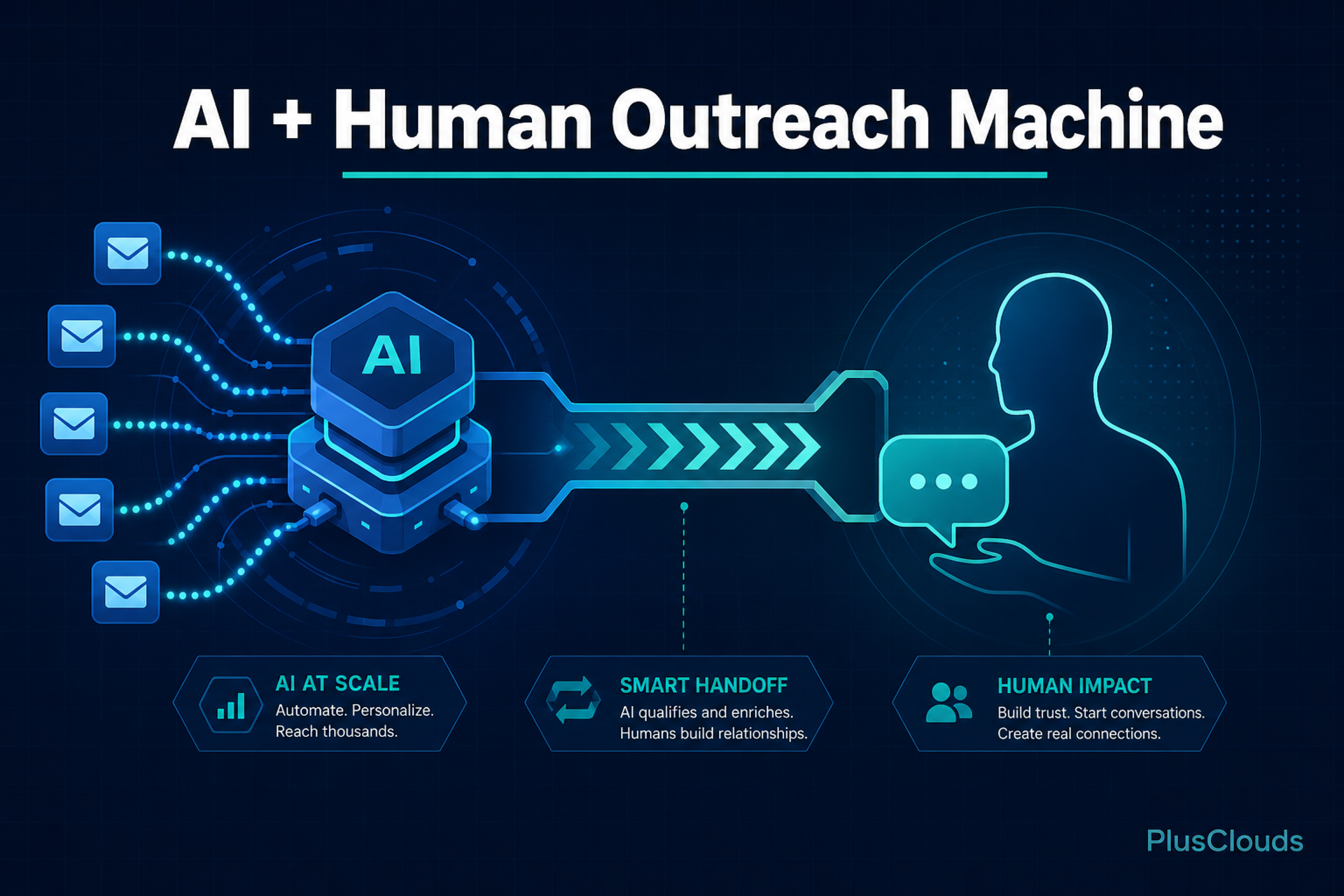
The real bottleneck isn't human effort. It's the ratio of high-quality prospecting activity to the hours in a working day. A skilled SDR can research, personalize, send, and follow up on maybe 40 to 60 touchpoints per day before quality degrades. AI doesn't have that ceiling. But AI also can't read a prospect's tone, handle an objection on a discovery call, or build the kind of trust that turns a "maybe" into a signed contract.
The teams booking the most meetings in 2026 aren't choosing between AI and humans. They're engineering systems where each does what it's actually good at, and handing off cleanly between them. Here's how to build that system.
Key Takeaways
- AI SDRs excel at high-volume, rule-based tasks: research, enrichment, first-touch email, and follow-up sequencing.
- Human SDRs own reply handling, objection management, and relationship-building from first response through closed deal.
- 61% of B2B teams now use AI for lead scoring, up from 23% in 2024, signaling augmentation, not replacement.
- A clean three-stage handoff model (AI-owned prospecting, human-owned reply handling, AI-assisted meeting logistics) is the core architecture of a successful hybrid model.
- The quality of your sales intelligence platform sets the ceiling for everything your AI SDR can accomplish.
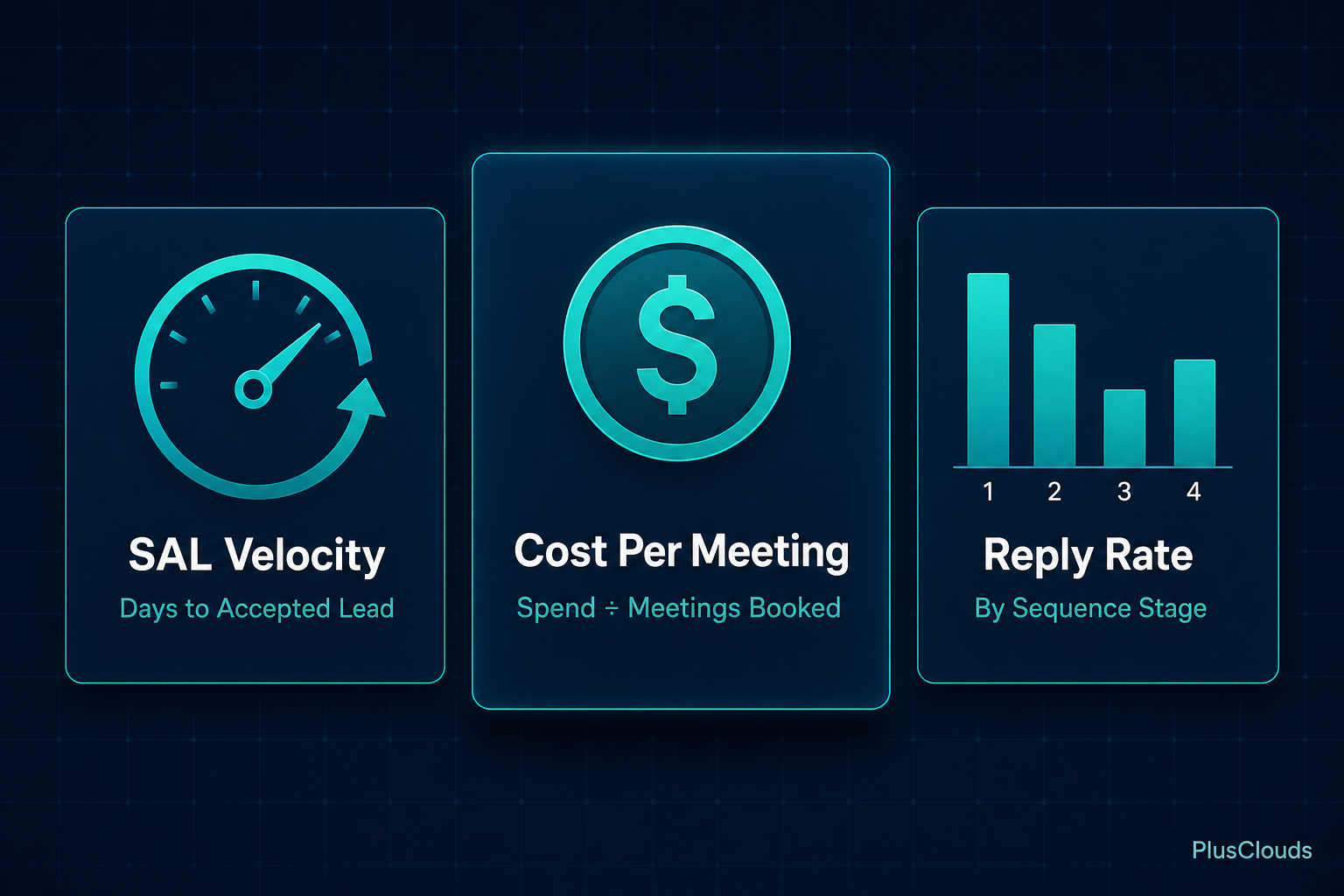
- SAL velocity, cost per booked meeting, and reply rate by sequence stage are the three metrics that reveal whether the hybrid model is working.
Table of Contents
- Why the AI SDR vs. Human SDR Debate Is the Wrong Question
- What AI SDRs Actually Do Well (and Where They Fall Flat)
- The Five Outreach Tasks You Should Automate First
- How to Sequence AI Prospecting with Human Follow-Up
- Choosing the Right Sales Intelligence Platform to Fuel Your AI SDR
- Measuring the Hybrid Model: SAL Velocity, Cost Per Booked Meeting, and Reply Rate
- Common Mistakes When Deploying AI Outreach Automation
- How to Get Started: A 30-Day Hybrid Outreach Rollout Plan
- Building the Outbound Machine That Keeps Running
Why the AI SDR vs. Human SDR Debate Is the Wrong Question
Framing this as a competition misses the point entirely. Asking whether AI or humans are better at sales development is like asking whether a GPS or a driver is better at road trips. One handles navigation and route optimization continuously without fatigue. The other handles the judgment calls, the unexpected detours, and the actual driving.
The debate persists because AI SDR tools have been marketed aggressively as human replacements, which makes sales leaders defensive and SDRs anxious. Neither reaction is useful. What's actually happening in the market is more nuanced: according to recent B2B lead generation data, 61% of B2B teams now use AI for lead scoring, up from 23% in 2024. That's not replacement. That's augmentation at scale.
The organizations seeing the biggest gains have stopped asking "AI or human?" and started asking "which tasks belong where, and how do we connect them?" That question has a concrete answer.
What AI SDRs Actually Do Well (and Where They Fall Flat)
AI outreach tools have become genuinely capable at a specific cluster of tasks: data aggregation, pattern matching, personalization at volume, and timing optimization. Feed a well-configured AI SDR a list of target accounts and it will research firmographics, identify decision-makers, pull relevant signals (recent funding, job postings, technology stack changes), draft personalized first-touch emails, and schedule follow-up sequences, all before your human SDR has finished their morning coffee.
Where AI falls apart is anywhere the task requires genuine contextual judgment. A prospect replies with "we just went through a restructuring, reach back out in Q3." A human SDR reads that as a warm lead with a clear timeline. Many AI systems will either drop the contact or fire off an automated follow-up three days later that completely ignores what was said. That kind of tone-deafness doesn't just lose the deal, it damages the relationship.
AI also struggles with:
- Complex objection handling in multi-turn email conversations
- Reading organizational politics when the stated contact isn't the real decision-maker
- Referral-based outreach where the message needs to feel genuinely personal
- Late-stage re-engagement of dormant accounts that require a human touch to revive
The practical implication: AI should own the top of the funnel almost entirely, and humans should own everything that requires interpretation, judgment, or relationship capital.
The Five Outreach Tasks You Should Automate First
Not all outreach tasks are equally good candidates for automation. Start with the ones that are high-volume, rule-based, and time-sensitive, where speed and consistency matter more than nuance.
1. Initial prospect research and enrichment. Pulling contact data, verifying emails, appending company attributes, and flagging buying signals is pure data work. Automating this alone can give each human SDR back two to three hours per day.
2. First-touch cold email. A well-structured AI system can generate personalized first-touch emails that reference specific company attributes, recent news, or trigger events. These aren't generic blasts. They're templated with variable personalization fields populated from enriched data.
3. Follow-up sequences (touches 2 through 4). The majority of replies come after the first email, but most SDRs give up too early because manual follow-up is tedious. Automating touches two through four, with slight variation in angle and timing, keeps the sequence alive without burning SDR time.
4. Meeting confirmation and reminder workflows. Once a meeting is booked, the logistics of confirmation, calendar invites, reminder emails, and pre-call prep documents are fully automatable and should be.
5. Lead routing and CRM updates. Automatically routing inbound replies to the right SDR based on territory, industry, or deal size, and logging all activity to your CRM without manual entry, removes a significant source of data hygiene failures.
If you want a practical framework for structuring the email templates that feed into these automated sequences, the 11 Best B2B Lead Generation Email Templates post covers proven formats for each stage of outreach.
How to Sequence AI Prospecting with Human Follow-Up
The handoff between AI and human is where most hybrid models break down. The AI does its job, a reply comes in, and then the reply sits in a queue for 18 hours because nobody defined who owns it or when.
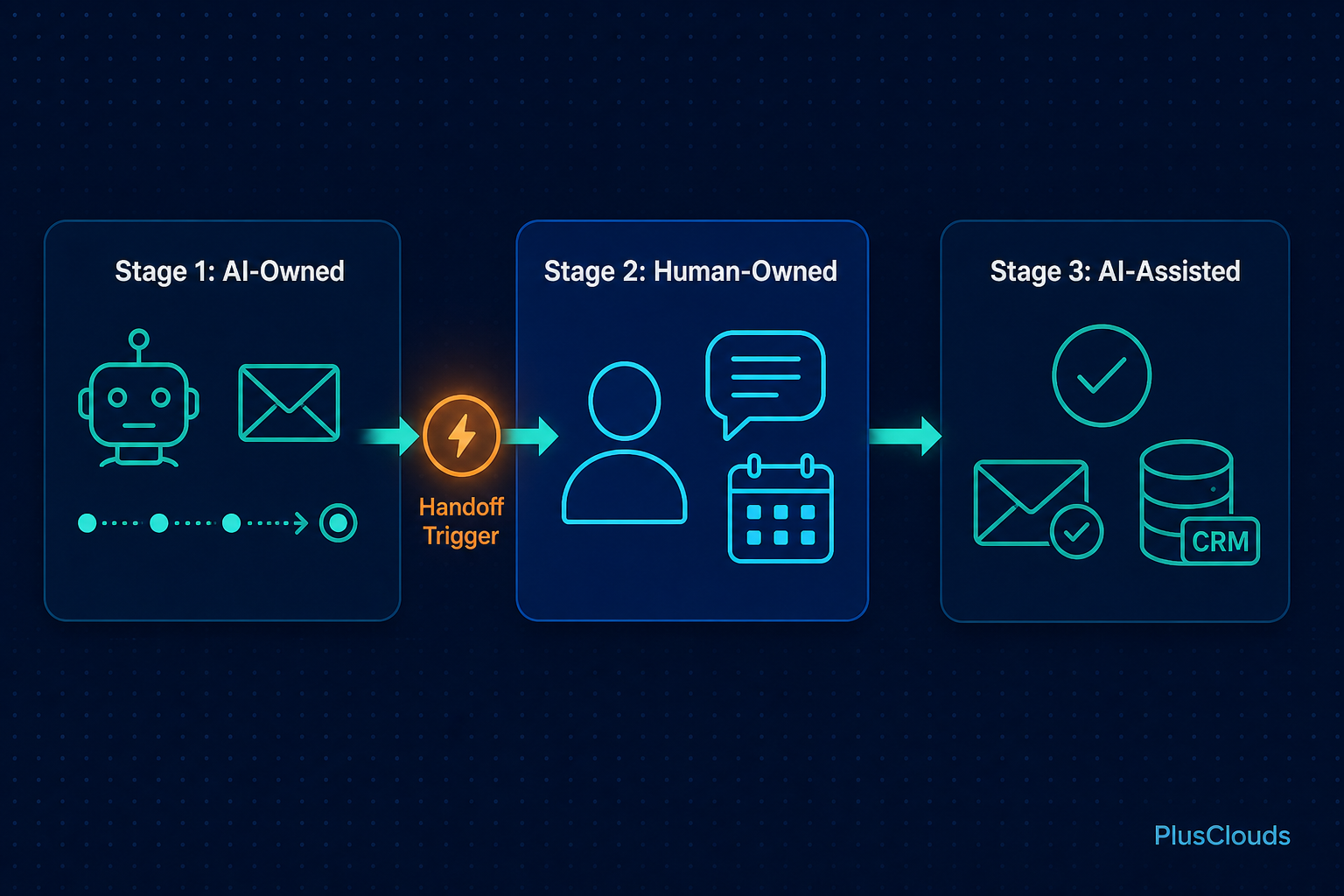
A clean handoff model looks like this:
Stage 1 (AI-owned): Prospect to first reply. AI handles research, enrichment, first-touch email, and automated follow-up through touch four. Any positive reply, any out-of-office with a return date, or any reply that isn't a hard "remove me" triggers an immediate human handoff.
Stage 2 (Human-owned): Reply to booked meeting. The SDR picks up the conversation within one hour of a positive reply. They have full context because the AI has logged everything. Their job is to continue the conversation naturally, handle any objections, and get the meeting on the calendar.
Stage 3 (AI-assisted): Meeting to pipeline. After the meeting is booked, AI handles confirmation logistics. After the meeting happens, AI can draft follow-up email suggestions based on call notes, which the SDR reviews and sends.
The critical rule: define your handoff triggers explicitly before you deploy anything. A positive reply, a question about pricing, a request for a case study, these should all route to a human within a defined SLA. Leaving this ambiguous is the single biggest reason hybrid models underperform.
Choosing the Right Sales Intelligence Platform to Fuel Your AI SDR
Your AI SDR is only as good as the data it runs on. Garbage in, garbage out is a cliche because it's true. If your contact database has outdated job titles, missing emails, and no signal data, your automated sequences will bounce, reach the wrong people, and generate noise instead of pipeline.
A proper sales intelligence platform needs to do three things well. First, it needs to surface verified decision-maker contacts at your target accounts, not just company-level data. Second, it needs to detect buying signals, things like recent funding announcements, executive hires, technology changes, or expansion into new markets, so your outreach lands when the prospect is actually in a position to buy. Third, it needs to integrate cleanly with your CRM and sequencing tools so data flows without manual intervention.
LeadOcean by PlusClouds is built specifically for this workflow. It searches across 1.8 billion company records to surface verified decision-maker contacts, uses an AI Match Engine to score and prioritize accounts based on your ideal customer profile (ICP), and detects buying signals that indicate active purchase intent. It integrates directly with HubSpot and Salesforce, so the enriched contacts flow straight into your sequences without a manual export step.
The quality of your data layer determines the ceiling of everything your AI SDR can accomplish. Get this right before you invest heavily in sequencing tools.
Measuring the Hybrid Model: SAL Velocity, Cost Per Booked Meeting, and Reply Rate
You can't optimize what you don't measure, and the wrong metrics will send you in the wrong direction. Vanity metrics like emails sent and open rate tell you very little about whether your hybrid outreach model is actually working.
The three metrics that matter most:
Sales Accepted Lead (SAL) velocity. How many days does it take from first outreach to a lead being accepted by your sales team? This measures the efficiency of your entire top-of-funnel motion, including both AI and human stages. A healthy hybrid model should reduce SAL velocity compared to a purely human model because AI compresses the early stages.
Cost per booked meeting. Take your total outbound spend (tools, headcount, data) and divide by meetings booked. This is the number that tells you whether your hybrid model is actually more efficient than your previous approach. Most teams see a meaningful reduction here within 90 days of a well-implemented hybrid rollout, because AI handles volume tasks at a fraction of the per-unit cost of human time.
Reply rate by sequence stage. Track reply rates at each touch separately, not just as an aggregate. This tells you where your sequences are losing momentum. If touch one has a 4% reply rate but touch three has a 0.2% rate, your follow-up messaging needs work, not your initial email.
Set baselines before you deploy anything. You need a pre-hybrid benchmark to know whether the model is actually improving your numbers.
Common Mistakes When Deploying AI Outreach Automation
Most hybrid model failures aren't technology failures. They're configuration and process failures that get blamed on the technology.
Over-automating too early. Teams get excited about what's possible and automate 10 touches before they've validated that the first two are working. Start with two automated touches maximum, measure, then extend.
Skipping personalization at scale. "AI personalization" does not mean inserting {{first_name}} and {{company}} into a generic template. It means using signal data to write a first line that references something specific and timely. If your AI-generated emails read like a mail merge from 2015, your reply rates will reflect that.
No defined handoff SLA. As mentioned above, leaving the human handoff timing undefined is a reliable way to let warm replies go cold. Define it. Enforce it.
Using the same sequence for every persona. A VP of Sales and a Director of Revenue Operations have different pain points, different vocabularies, and different buying criteria. One sequence does not fit both. Segment your sequences by persona before you automate anything.
Ignoring deliverability. High-volume automated outreach can destroy your domain reputation if you don't warm up sending infrastructure properly, monitor bounce rates, and rotate domains for large sends. Deliverability is a technical problem that lives upstream of your sequencing tool.
For teams thinking about the infrastructure side of running outbound sales automation at scale, it's worth understanding how the underlying systems connect, a topic covered well in the context of building automated outbound workflows on virtual servers.
How to Get Started: A 30-Day Hybrid Outreach Rollout Plan
Thirty days is enough time to have a functioning hybrid model generating real pipeline data, if you don't try to do everything at once.
Week 1: Data and targeting. Define your ideal customer profile (ICP) in precise terms: industry, headcount range, geography, technology stack, and funding stage. Build your first target account list using a verified data source. Audit your CRM for data quality issues that will cause problems downstream.
Week 2: Sequence design. Write two to three email sequences for your primary personas. Keep them short: three to four touches maximum, with each touch taking a different angle. Do not automate these yet. Have a human SDR send them manually to a small test group of 50 accounts to validate messaging before you scale.
Week 3: Automation configuration. Connect your data source to your sequencing tool. Configure the first two automated touches. Set up handoff triggers and define your reply SLA. Test the entire workflow end to end with a small batch before opening the throttle.
Week 4: Launch and measure. Launch to your full target list. Monitor reply rates daily for the first week. Watch for deliverability issues (bounce rates above 3% are a warning sign). Hold a weekly review with your SDR team to capture qualitative feedback on lead quality and conversation quality.
By day 30, you should have enough data to make informed decisions about what to optimize in month two.
Eaglet by PlusClouds is designed to support exactly this kind of rollout, handling AI-driven outreach automation that connects cleanly to your prospecting data and CRM. Whether you're running it as a standalone tool or paired with LeadOcean for end-to-end prospecting through outreach, it gives your team the infrastructure to run a hybrid model without building custom integrations from scratch.
Building the Outbound Machine That Keeps Running
The best outbound teams in 2026 don't look like traditional SDR teams with some AI bolted on. They look like small, highly skilled human teams running high-volume, high-quality outreach operations that would have required three times the headcount two years ago.
That's the actual opportunity here. Not replacing SDRs, but multiplying what each SDR can accomplish by removing the work that doesn't require human judgment. When your best people spend their time on conversations instead of research and data entry, the quality of those conversations improves too.
The hybrid outreach model isn't a future state. Teams are running it right now, and the gap between those who have built it and those who haven't is widening every quarter.
If you're ready to see what a properly fueled AI outreach system looks like in practice, explore LeadOcean for decision-maker prospecting and Eaglet for the outreach automation layer. Both are built to work together, and both are ready to run from day one.