Regulators do not send warning letters. They send fines. And in 2026, those fines increasingly arrive because an organization could not answer one deceptively simple question: where, exactly, was that data processed?
For IT directors and compliance officers at regulated enterprises across Europe and the Middle East, data sovereignty has moved from a legal footnote to an infrastructure requirement. The question is no longer whether you need to keep workloads inside national borders. The question is how to do it without turning your architecture into a slow, expensive, operationally painful mess. This guide walks you through a practical, technically grounded approach to sovereign infrastructure, from workload classification to audit trail generation, covering the regulatory triggers, the architectural patterns, and the decision frameworks you need to get this right.
Key Takeaways
- Data sovereignty is now an infrastructure design constraint, not a policy checkbox. GDPR, NIS2, DORA, and national laws across the EU and Middle East impose verifiable localization requirements.
- Public hyperscalers (AWS, Azure, Google Cloud) cannot fully eliminate sovereignty risk because of the US CLOUD Act and globally distributed control planes.
- Workloads should be classified into three tiers: Sovereignty-Critical (bare metal only), Residency-Required (contractually guaranteed in-country cloud or colocation), and Standard Compliance (standard cloud regions with Data Processing Agreements).
- A defensible audit trail requires physical location certificates, tamper-evident access logs, data flow maps, and ISO 27001 or SOC 2 certifications, all stored in-jurisdiction.
- Network segmentation (private, VPN, DMZ, and management zones) is as important as physical server location: data can reside in-country and still leak across borders through misconfigured network paths.
Table of Contents
- What Data Sovereignty Actually Means in 2026 (and Why It Is No Longer Optional)
- The Regulatory Framework Driving Data Localization: GDPR, NIS2, DORA, and National Data Laws
- Why Public Hyperscalers Cannot Fully Solve a Sovereign Cloud Problem
- Workload Classification: Which Systems Must Stay On-Premises or In-Country
- Bare-Metal and On-Premises Servers as the Data Sovereignty Anchor
- Private Networking and DMZ Zones: Locking Down Cross-Border Data Flows
- Cloud Storage Tiering for Sovereign Workloads: Hot, Warm, and Cold Within Borders
- Building an Audit Trail: How to Prove GDPR Data Residency to a Regulator
- Decision Framework: Bare Metal vs. Cloud VM for Each Sovereignty Tier
- Action Checklist: 10 Steps to a Sovereignty-Ready Infrastructure Stack
- Sovereignty Is an Infrastructure Problem, Not Just a Legal One
What Data Sovereignty Actually Means in 2026 (and Why It Is No Longer Optional)
Data sovereignty is the principle that data is subject to the laws and governance of the country in which it is collected, stored, or processed. That sounds straightforward until you realize that most cloud architectures were never designed with borders in mind. Data flows where capacity is available. Backups replicate to geographically distributed regions. CDN edge nodes cache content in dozens of countries simultaneously.
In 2026, the gap between how cloud infrastructure behaves by default and what regulators now require has become a serious liability. According to Corporate Compliance Insights, geopolitical fragmentation is one of the dominant macro-trends reshaping risk and compliance this year, with data localization mandates proliferating faster than most enterprise legal teams can track. The result is that sovereignty is now an infrastructure design constraint, not a policy checkbox.
Data residency is the narrower, more operationally concrete concept: the physical location where data is stored at rest. You can have data residency without full sovereignty (if foreign laws can still compel access to data stored locally), but you cannot have meaningful sovereignty without residency. Both concepts matter, and regulators are testing both.
The Regulatory Framework Driving Data Localization: GDPR, NIS2, DORA, and National Data Laws
The European Union's General Data Protection Regulation (GDPR) established the baseline: personal data about EU residents cannot be transferred to third countries without adequate protections. Article 46 transfer mechanisms, Standard Contractual Clauses, and adequacy decisions have all been litigated and, in some cases, struck down. The Schrems II ruling in 2020 already invalidated the EU-US Privacy Shield. The current EU-US Data Privacy Framework is under legal challenge again as of 2025.
NIS2 (the Network and Information Security Directive, transposed into national law across EU member states by October 2024) adds a different dimension. It requires operators of essential services and important entities to implement technical measures that include geographic control over where data is processed. NIS2 data locality obligations are not just about breach notification; they are about demonstrable control over your infrastructure.
DORA (the Digital Operational Resilience Act) applies specifically to financial entities and their ICT service providers. It requires contractual guarantees about data location and the right to audit. If your bank or insurer uses a cloud provider that cannot produce a signed contract specifying which country processes your data, that is a DORA compliance failure.
Beyond the EU, the picture gets more complex. Saudi Arabia's Personal Data Protection Law (PDPL) requires that certain categories of personal data remain within the Kingdom. The UAE's Federal Decree-Law No. 45 of 2021 on personal data protection has similar localization provisions. Turkey's KVKK imposes explicit cross-border transfer restrictions. These laws do not always align with each other, which means a multinational enterprise operating across the EU and the Middle East may face genuinely conflicting requirements that only physical infrastructure separation can resolve.
Data Center Knowledge notes that 2026 marks an inflection point: enforcement actions are accelerating, and regulators are moving beyond paper audits to technical inspections of infrastructure configurations.
Why Public Hyperscalers Cannot Fully Solve a Sovereign Cloud Problem
AWS, Azure, and Google Cloud all offer region-specific deployments. You can specify eu-west-1 or me-south-1 and be reasonably confident your primary data store sits in that geography. That is a good start. It is not enough.
The problem operates at several layers. First, hyperscaler support and operations staff are globally distributed. A support engineer in the United States accessing your tenant to diagnose an issue is, depending on interpretation, a cross-border data transfer. Second, hyperscaler control planes are not always region-bound. Management metadata, billing data, and telemetry often flow through US-based systems regardless of where your workloads run.
Third, and most critically, hyperscalers are subject to the CLOUD Act (US Clarifying Lawful Overseas Use of Data Act), which allows US law enforcement to compel American cloud providers to produce data held anywhere in the world, including EU data centers. The European Data Protection Board has been explicit: this creates a structural incompatibility with GDPR for certain categories of data.
Fourth, hyperscaler "sovereign cloud" offerings, such as Microsoft Cloud for Sovereignty or AWS Dedicated Local Zones, are expensive, limited in feature parity, and still ultimately governed by contracts with US-incorporated entities. They reduce risk; they do not eliminate it.
This is not an argument against using public cloud. Most enterprises will run hybrid architectures. It is an argument for being clear-eyed about what public cloud can and cannot guarantee, and for anchoring your most sensitive workloads on infrastructure where you control the physical and legal chain of custody.
Workload Classification: Which Systems Must Stay On-Premises or In-Country
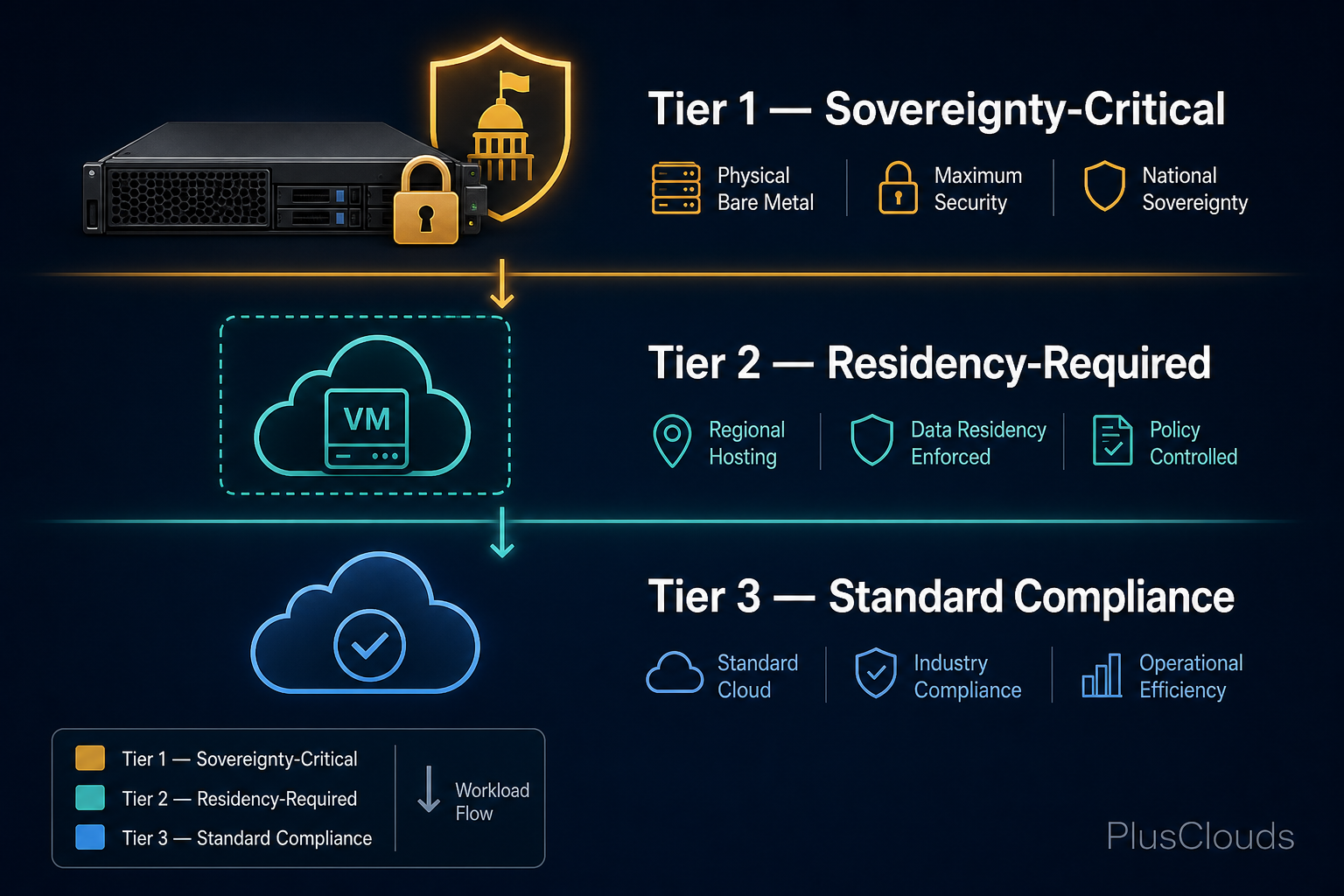
Not every workload carries the same regulatory weight. A practical data sovereignty architecture starts with honest classification. Broadly, workloads fall into three tiers:
Tier 1 (Sovereignty-Critical): Systems that process or store data subject to strict localization requirements. This includes citizen or patient records, financial transaction data under DORA, critical national infrastructure control systems under NIS2, and anything classified under national security frameworks. These workloads must run on infrastructure where you can physically and legally verify the data never crosses a border. On-premises or in-country bare-metal servers are the only credible answer.
Tier 2 (Residency-Required): Systems where data must remain within a defined geographic boundary but where the physical vs. virtual distinction is less critical, provided the cloud provider can contractually guarantee and technically demonstrate in-country processing. Sovereign cloud VMs with strong contractual controls, private colocation, or dedicated hosted infrastructure qualify here.
Tier 3 (Standard Compliance): Systems where standard GDPR transfer mechanisms are sufficient and no specific localization mandate applies. Development environments, analytics pipelines over anonymized data, and non-personal-data workloads generally fall here. Standard cloud regions with appropriate Data Processing Agreements are adequate.
The classification exercise is not a one-time event. As regulations evolve and as your data flows change, workloads move between tiers. Build the classification into your change management process.
Bare-Metal and On-Premises Servers as the Data Sovereignty Anchor
For Tier 1 workloads, the architectural answer is bare metal. A dedicated physical server in a known, auditable location eliminates the ambiguity of shared virtualization infrastructure. There is no hypervisor layer managed by a third party. There is no noisy neighbor. There is no question about whether another tenant's workload shares the same physical memory bus.
The Dell-certified Leo CN servers from PlusClouds are purpose-built for exactly this use case: on-premises deployment in your own facility or in a Tier 3 colocation facility, with full hardware ownership and no shared-tenancy risk. For workloads that also require GPU acceleration (AI inference, large-scale data processing), the X7000 series bare-metal systems from PlusClouds Bare-Metal provide dedicated GPU resources without the data-leaving-the-building problem that GPU cloud instances create.
The operational case for bare metal in a sovereignty context is also stronger than many architects expect. Bare-metal servers eliminate the "noisy neighbor" performance variance that plagues shared cloud instances. For database workloads processing sensitive records, consistent sub-millisecond latency matters. For compliance logging systems that must capture every transaction, predictable I/O throughput is not optional.
If you are evaluating whether to repatriate existing cloud workloads to bare metal as part of a sovereignty program, the cloud repatriation migration playbook covers the cost and performance analysis in detail.
Private Networking and DMZ Zones: Locking Down Cross-Border Data Flows
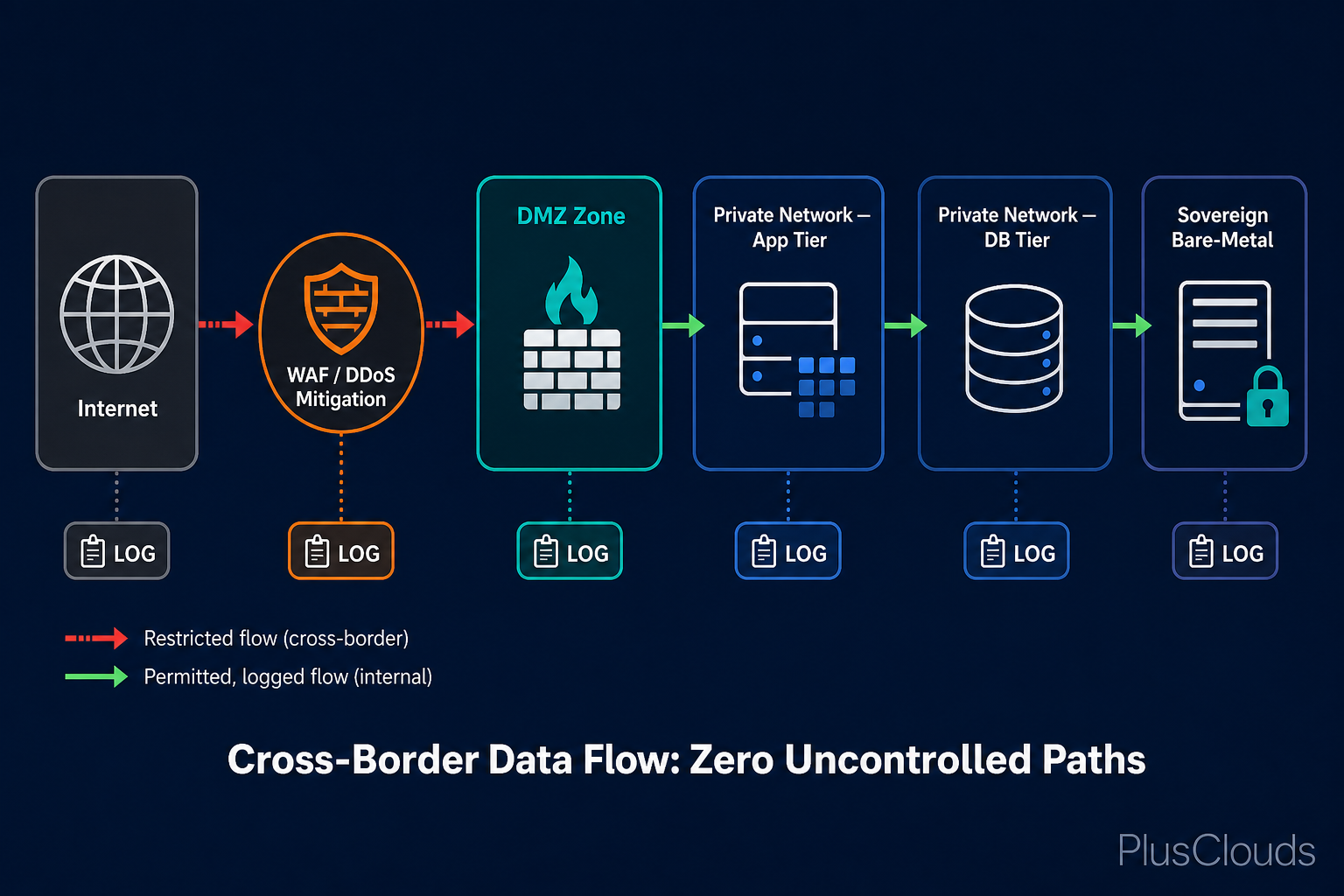
Physical data residency is necessary but not sufficient. Data can sit in a server in Frankfurt and still leak across borders through poorly configured network paths. The network layer is where sovereignty architectures either hold together or fall apart.
The core principle is network segmentation by data classification. Tier 1 systems should communicate exclusively over private networks that never traverse public internet infrastructure. This means:
- Private network segments for all east-west traffic between sovereign workloads. No public IP addresses assigned to Tier 1 systems.
- VPN tunnels for any administrative access, with endpoints physically located in the same jurisdiction as the data.
- DMZ zones as the controlled boundary between your sovereign environment and any systems that interact with external networks. A DMZ does not eliminate the boundary; it makes it explicit, auditable, and controllable.
- Management networks isolated from production traffic, ensuring that operational access paths are separate from data paths and can be independently audited.
PlusClouds Networking and Load Balancers supports all five network types (public, private, VPN, management, and DMZ) from a single control plane. This matters operationally: managing five different network configurations across five different tools creates the kind of human error that produces compliance failures. A unified control plane means your network topology is codified, repeatable, and auditable.
A practical DMZ configuration for a sovereign workload looks like this:
[Internet] --> [WAF / DDoS Mitigation] --> [DMZ Zone]
                                              |
                              [Application Tier - Private Network]
                                              |
                              [Database Tier - Private Network, no external route]
                                              |
                              [Sovereign Bare-Metal Host - Management Network only]
No direct path from the internet to your data tier. Every hop is logged. Every crossing of a zone boundary is an auditable event.
Cloud Storage Tiering for Sovereign Workloads: Hot, Warm, and Cold Within Borders
Data sovereignty applies to stored data, not just live systems. Your backup archives, your log retention, your document storage, your cold analytics data: all of it must comply with the same localization requirements as your production databases.
Storage tiering within a sovereign context means selecting the right medium for each data temperature, while keeping all tiers inside the same jurisdictional boundary:
- Hot storage (NVMe SSD): Active production data, real-time transaction logs, session data. Latency-sensitive. Must be co-located with or directly attached to your compute tier.
- Warm storage (SSD): Recent backups, frequently queried historical data, compliance logs for the current year. Accessible within seconds but not required to be on the fastest medium.
- Cold storage (HDD): Long-term archives, historical audit logs, regulatory retention data. Access time is measured in minutes, not milliseconds. Cost per gigabyte is the primary driver.
The critical constraint is that all three tiers must remain within the same jurisdictional boundary. This rules out the common practice of archiving cold data to a hyperscaler's cheapest storage tier in whatever region happens to be cheapest globally. PlusClouds Cloud Storage provides pooled storage across tiered HDD, SSD, and NVMe within a defined datacenter footprint, which means you can implement a complete hot-warm-cold tiering strategy without data ever leaving the facility.
For backup specifically, the 3-2-1-1 backup architecture remains the gold standard for resilience, but in a sovereignty context you need to verify that the "offsite" copy in the 3-2-1-1 model goes to a secondary facility in the same jurisdiction, not to a geographically convenient but legally problematic location.
Building an Audit Trail: How to Prove GDPR Data Residency to a Regulator
Saying your data stays in-country is not the same as proving it. Regulators increasingly want technical evidence, not assertions. The audit trail for data residency has several components:
Infrastructure documentation: Physical server location certificates from your colocation or datacenter provider. Network topology diagrams showing that no cross-border routes exist for Tier 1 systems. IP geolocation records confirming that all assigned addresses resolve to the correct jurisdiction.
Access logs: Every administrative access to Tier 1 systems must be logged with the source IP, timestamp, user identity, and action taken. These logs must themselves be stored in a tamper-evident, in-jurisdiction location. Logs that can be deleted or modified by the same administrator who generated them do not satisfy regulatory scrutiny.
Data flow maps: A current, version-controlled map of every system that touches personal data, where it is stored, how it moves between systems, and which third parties (if any) have access. This is a living document, not a one-time exercise.
Certification evidence: ISO 27001 and SOC 2 certifications from your infrastructure provider demonstrate that the security controls around your data have been independently audited. PlusClouds Cloud Security carries ISO 27001 and SOC 2 compliance alongside GDPR-aligned controls, which means the certifications your auditor will ask for are already in place at the infrastructure layer.
Incident records: Any event that could have resulted in data leaving the jurisdiction, even if it did not, must be documented with the root cause analysis and remediation steps. Regulators view the absence of incident records with as much suspicion as the presence of them.
Decision Framework: Bare Metal vs. Cloud VM for Each Sovereignty Tier
Use this framework when deciding where a specific workload belongs:
| Criterion | Bare Metal | Cloud VM (In-Jurisdiction) |
|---|---|---|
| Physical location certainty | Absolute | Contractual |
| CLOUD Act exposure | None (non-US provider) | Depends on provider |
| Performance predictability | High | Medium |
| Deployment speed | Hours to days | Minutes |
| Cost at scale | Lower (no per-vCPU markup) | Higher |
| Compliance auditability | Hardware-level | Hypervisor-level |
| Suitable for Tier 1 workloads | Yes | With caveats |
| Suitable for Tier 2 workloads | Yes | Yes |
| Suitable for Tier 3 workloads | Overengineered | Yes |
The practical rule: if a regulator could theoretically challenge the sovereignty claim in court and you would need to produce hardware serial numbers and datacenter access logs to defend yourself, use bare metal. If contractual guarantees from a compliant, non-US provider are sufficient for your regulatory context, a cloud VM in the right jurisdiction works.
The PlusClouds Datacenter infrastructure, built on Tier 3 facilities with N+1 redundancy and a 40 Gbps backbone, provides the physical foundation for both bare-metal and cloud VM deployments within a single, auditable location. That matters when a regulator asks for a single address to put in the data processing agreement.
For the security controls layered on top of whichever compute model you choose, the zero trust security guide covers the network and identity controls that complement a sovereignty architecture without requiring a six-figure security budget.
Action Checklist: 10 Steps to a Sovereignty-Ready Infrastructure Stack
Work through these steps in order. Each one builds on the previous.
Classify your workloads into Tier 1, Tier 2, and Tier 3 using the framework above. Document the classification rationale for each system.
Map your current data flows end to end. Identify every point where data crosses a jurisdictional boundary, intentionally or otherwise. CDN configurations, backup destinations, and monitoring tools are common sources of unintended cross-border flows.
Audit your cloud provider contracts. Verify that your Data Processing Agreements specify the physical country of processing, not just the cloud region name. Confirm there is no CLOUD Act exposure for your Tier 1 and Tier 2 data.
Deploy bare-metal infrastructure for Tier 1 workloads. Use Dell-certified Leo CN servers or equivalent on-premises hardware in a Tier 3 facility within your jurisdiction. Verify the physical address in writing.
Segment your networks. Create separate private, VPN, management, and DMZ zones. Ensure no Tier 1 system has a public IP address or an outbound route that crosses a jurisdictional boundary.
Implement in-jurisdiction storage tiering. Move all backup and archive destinations to in-country storage. Verify that your backup tool is not silently replicating to a geographically optimized but legally problematic endpoint.
Enable comprehensive access logging. Every administrative action on Tier 1 systems must be logged to a tamper-evident, in-jurisdiction log store. Configure alerts for any access from IP addresses outside the jurisdiction.
Obtain and document infrastructure certifications. Collect ISO 27001, SOC 2, and any relevant national certifications from your infrastructure provider. Store these alongside your Data Processing Agreements.
Build a data residency evidence pack. This is the folder you hand to a regulator: physical location certificates, network topology diagrams, access log samples, certification documents, and your data flow map. Keep it current.
Schedule quarterly sovereignty reviews. Regulations change. Your infrastructure changes. New workloads get deployed. A sovereignty architecture that was correct in Q1 may have drifted by Q3. Build the review into your governance calendar.
Sovereignty Is an Infrastructure Problem, Not Just a Legal One
Legal teams can write policies. Compliance officers can draft frameworks. But data sovereignty ultimately lives or dies in the infrastructure layer, in the physical location of servers, in the routing tables that govern network traffic, in the configuration of backup destinations, and in the access logs that either exist or do not when a regulator asks for them.
The enterprises that will handle the wave of 2026 enforcement actions with confidence are the ones that treated sovereignty as a first-class infrastructure requirement, not an afterthought. They classified their workloads honestly, anchored their most sensitive systems on bare metal with verifiable physical locations, segmented their networks so cross-border flows are impossible rather than merely discouraged, and built audit trails that can survive a technical inspection.
If you are building or rebuilding your infrastructure stack to meet these requirements, PlusClouds provides the physical and logical building blocks: bare-metal X7000 and Leo CN servers for Tier 1 sovereignty anchors, in-jurisdiction cloud storage across all three tiers, five-network-type infrastructure for complete segmentation, and ISO 27001 / SOC 2 / GDPR-compliant security controls across the entire stack. The Tier 3 datacenter backbone means you are not trading performance for compliance.
Start with your workload classification. Everything else follows from that. And if you want to see how the infrastructure pieces fit together for your specific regulatory context, the PlusClouds infrastructure team can walk you through a reference architecture built around your jurisdiction and your compliance requirements.