If your reply rate on outbound sequences has quietly dropped from 8% to 2% over the past two years, you are not imagining things, and you are not alone. The tactics that filled pipelines in 2022, a generic cold email with a first-name personalization token followed by three "just bumping this up" follow-ups, have been so thoroughly exhausted by so many teams that buyers have developed an almost reflexive immunity to them. The problem is not outbound itself. The problem is that most sequences still treat every prospect the same, regardless of what that prospect is actually doing right now.
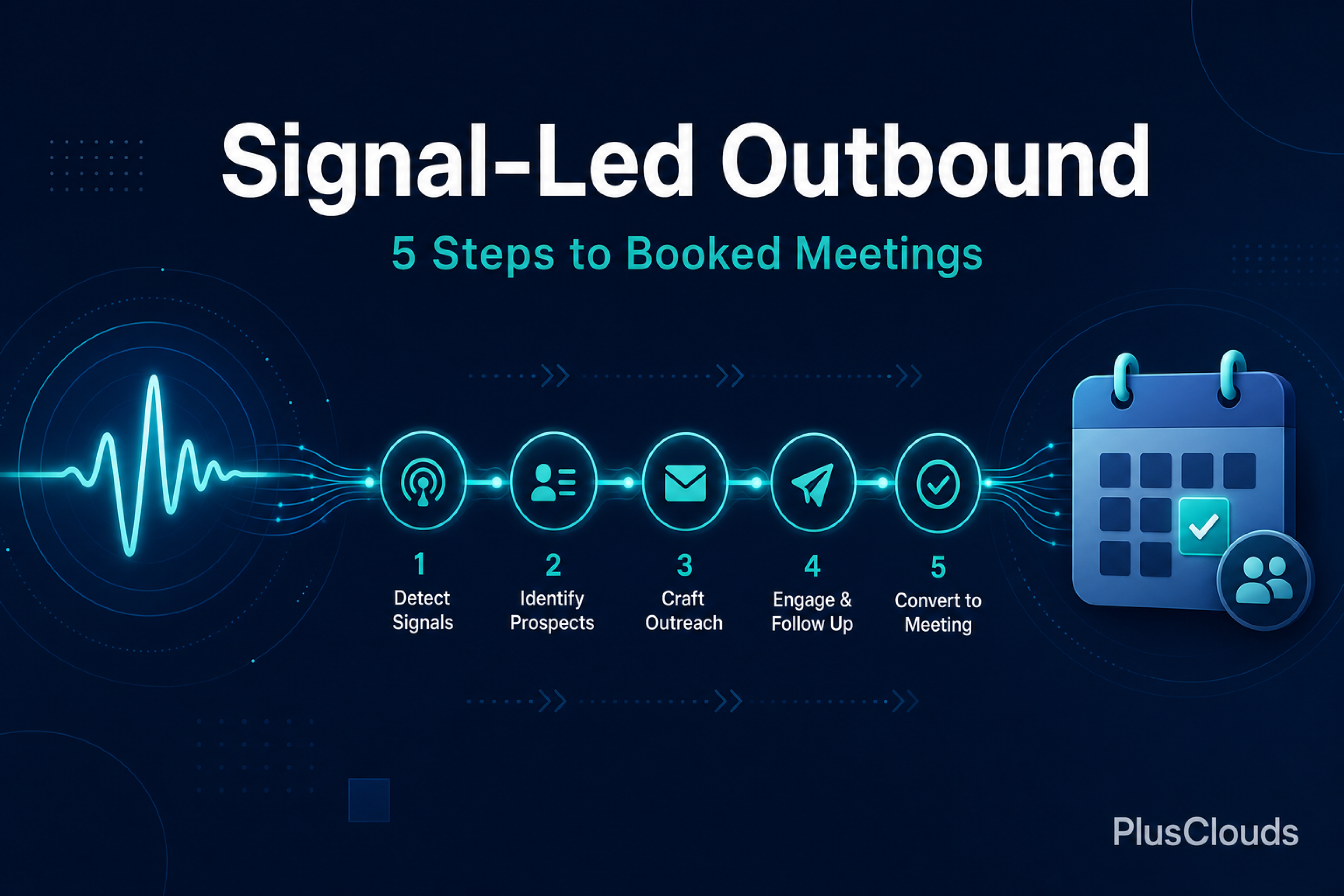
Signal-led outbound is the correction. Instead of blasting a static list with a templated sequence, you trigger outreach the moment a prospect does something that suggests they are ready to buy, grow, or change vendors. Done right, you reach the right person, with the right message, at the exact moment they are most likely to respond. This guide walks you through a five-step workflow for building that kind of sequence, from detecting the initial buying signal all the way to a booked meeting sitting in your CRM.
Key Takeaways
- Reply rates on generic cold outbound have collapsed; signal-led sequences consistently outperform static list outreach by a wide margin in 2026.
- A buying signal is any observable external event, such as a funding round, leadership change, tech stack shift, or content engagement, that indicates an active buying cycle.
- The five-step workflow is: detect the signal, enrich the contact in real time, personalize the first touch to the specific trigger, automate multi-channel follow-ups with engagement detection, and route hot replies instantly into your CRM.
- Reply rate by signal type, meeting rate, and signal-to-close time are the three metrics that matter most for optimizing a signal-led outbound program.
- LeadOcean and Eaglet by PlusClouds automate this entire workflow from signal detection through CRM pipeline update, eliminating the manual handoffs that slow most outbound teams down.
Table of Contents
- Why Generic Outreach Sequences No Longer Book Meetings in 2026
- What a Buying Signal Actually Is (and Where to Find Them)
- Step 1, Identify the Signal: Job Change, Funding Round, Tech Stack Shift, or Content Engagement
- Step 2, Enrich the Prospect: Verify Contact and Firmographic Data in Real Time
- Step 3, Personalize the First Touch Using the Specific Signal
- Step 4, Automate Follow-Ups Across Email and LinkedIn Without Burning the List
- Step 5, Route Hot Replies Directly into Your CRM and Trigger Pipeline Stages
- How LeadOcean's Buying-Signal Detection and Eaglet's AI Outreach Automation Power This Workflow End to End
- Metrics to Track: Reply Rate, Meeting Rate, and Signal-to-Close Time
- Putting It All Together
Why Generic Outreach Sequences No Longer Book Meetings in 2026
The math has shifted. Buyers receive more cold outreach than ever, and they have better tools to filter it out. Spam classifiers have gotten smarter. LinkedIn's connection request limits are tighter. And decision-makers at companies with 50 to 500 employees, the sweet spot for most SDR teams, have simply been burned enough times to default to ignoring anything that reads like a template.
The structural problem with generic sequences is timing. You build a list, load it into your sequencing tool, and fire. But the list was built on static criteria: industry, company size, job title. None of those criteria tell you whether that prospect is actually in a buying moment right now. They might have signed a three-year contract last month. Or they might be two weeks away from issuing an RFP. You have no way to know, so you treat both the same.
Research from multiple sales intelligence sources in 2026 consistently shows that AI-powered, signal-triggered outreach produces dramatically higher engagement rates compared to static list outreach. The gap is not marginal. When outreach is triggered by a real event in a prospect's business life, relevance is built in from the first word. You are not interrupting them; you are responding to something they already did.
The teams winning in outbound right now are not the ones with the biggest lists or the most aggressive follow-up cadences. They are the ones who can detect a buying signal, respond within hours, and say something that proves they were paying attention.
What a Buying Signal Actually Is (and Where to Find Them)
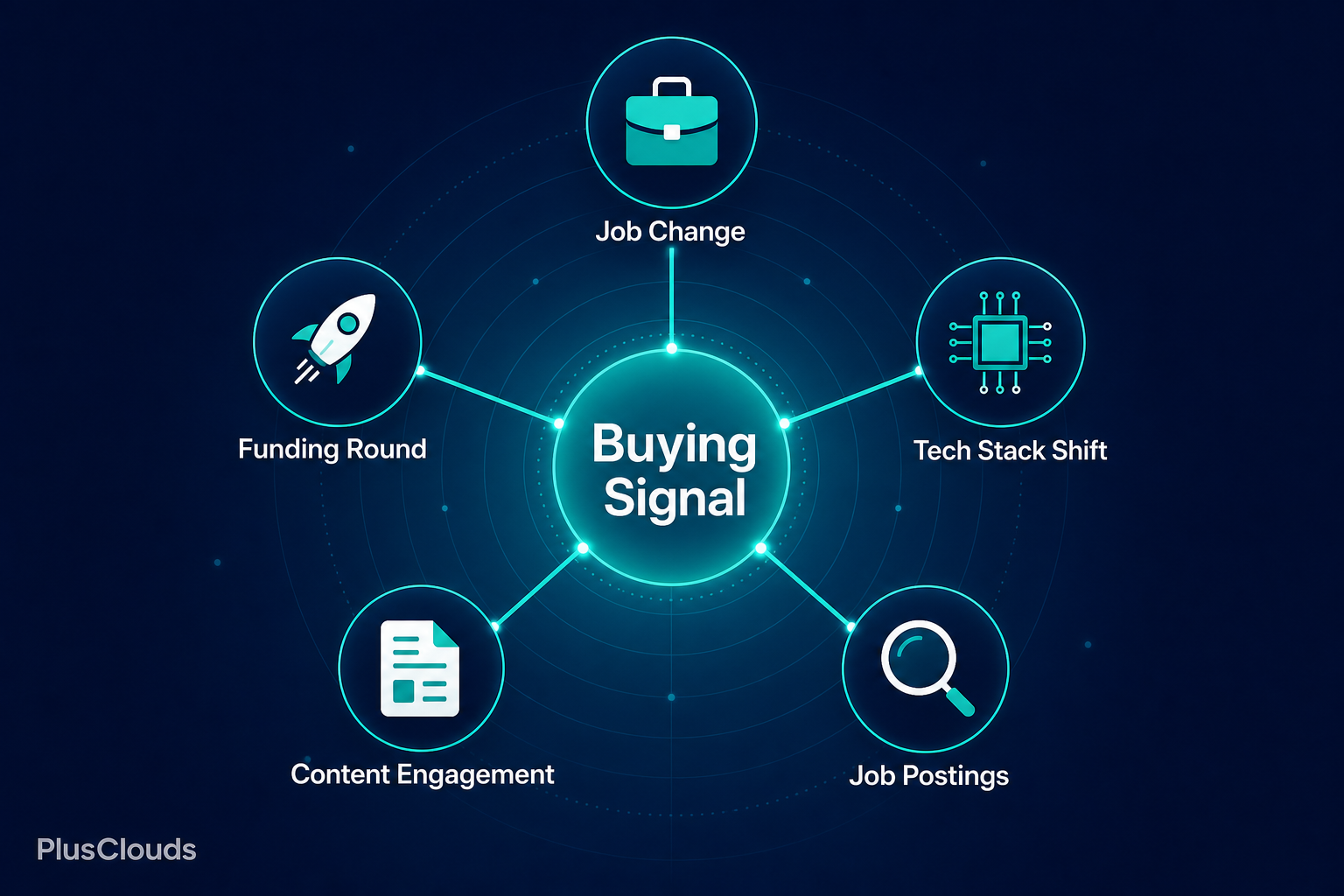
A buying signal is any observable event that meaningfully increases the probability that a prospect is in an active buying cycle, or will be soon. The keyword is observable. You need signals that are detectable from outside the company, because you are not inside the building.
The most reliable categories of B2B intent signals for outbound prospecting are:
- Job changes: A new VP of Sales, CTO, or Head of Operations often brings new budget and a mandate to evaluate vendors. New executives tend to make 60 to 70 percent of their vendor decisions in the first 90 days.
- Funding rounds: A Series A or B announcement almost always precedes a hiring surge and a technology investment cycle. The company now has money and pressure to deploy it.
- Technology stack changes: A company that just adopted Salesforce is probably in the market for tools that integrate with Salesforce. A company that dropped a competitor's product is actively looking for a replacement.
- Content engagement: A prospect who downloaded your whitepaper, visited your pricing page, or attended a webinar has self-identified as interested. This is the warmest signal of all.
- Job postings: A company hiring five SDRs is scaling its sales motion. A company posting for a "Head of Revenue Operations" is building out infrastructure. Both are signals for the right vendor.
These signals live in different places: LinkedIn announcements, Crunchbase funding data, G2 review activity, intent data platforms such as Bombora or G2 Buyer Intent, and your own marketing automation system. The challenge, historically, has been aggregating them fast enough to act on them. That is exactly where modern sales intelligence tools have changed the outbound prospecting workflow.
Step 1, Identify the Signal: Job Change, Funding Round, Tech Stack Shift, or Content Engagement
Signal identification is the foundation of the entire workflow. If you get this wrong, everything downstream is wasted effort. The goal is to define, in advance, which signals are most predictive of a closed deal for your specific product.
Start by mapping your best closed-won accounts from the last 12 months. What was happening at those companies in the 30 to 90 days before the deal started? Look for patterns. If 60 percent of your wins followed a leadership change in the buying department, job change signals should be your primary trigger. If your product replaces a specific legacy tool, tech stack departure signals are your gold mine.
Once you know which signals predict your wins, you need to monitor for them at scale. Manual monitoring, checking LinkedIn and Crunchbase every morning, does not scale past 50 accounts. You need a system that watches your target account list continuously and surfaces new signals as they appear. The practical setup looks like this:
- Define your Ideal Customer Profile (ICP) criteria: industry, headcount range, revenue range, geography.
- Build a monitored target account list inside your sales intelligence platform (such as LeadOcean, Apollo, or ZoomInfo).
- Set signal triggers for each category: funding events, leadership changes, tech stack installs, and relevant job postings.
- Route new signals into a prioritized queue, not a flat list.
The prioritization step matters more than most SDRs realize. A company that just raised a Series B and posted three new sales leadership roles is a much higher-priority B2B intent signal than a company that simply changed its CTO. Stack-rank your signals by predictive value before you write a single word of outreach.
Step 2, Enrich the Prospect: Verify Contact and Firmographic Data in Real Time
A signal without accurate contact data is useless. You know a company just raised $20 million, but if you have a six-month-old email address for the wrong person, you are not going to book a meeting.
Real-time enrichment means pulling verified contact data at the moment the signal fires, not from a stale export you ran last quarter. The fields you need, at minimum, are:
- Direct email address (verified, not catch-all)
- LinkedIn profile URL
- Current job title and department
- Company headcount and revenue range
- Tech stack (at least the categories relevant to your product)
- Recent news or trigger event that caused the signal
Firmographic accuracy matters as much as contact accuracy. Reaching out to a 12-person startup with enterprise pricing is a waste of a good signal. Reaching out to a 400-person company with a self-serve pitch undersells your product. The enrichment step is where you confirm the prospect actually fits your ICP before spending any outreach capacity on them.
LeadOcean by PlusClouds handles this step by searching across 1.8 billion company records to surface verified decision-maker contacts with real-time firmographic data. Its AI Match Engine cross-references the incoming signal with your ICP criteria and scores the prospect before a human ever looks at it, so your SDRs spend time on the accounts most likely to convert, not the ones that merely match a keyword.
Step 3, Personalize the First Touch Using the Specific Signal
This is where most signal-led sequences still fail. Teams detect a good signal, enrich the contact correctly, and then send a generic email anyway. The signal becomes decoration rather than the actual message.
The first touch should make it unmistakably clear that you are reaching out because of the specific thing that just happened. Not "I saw your company is growing", that is vague. "I noticed you just closed your Series B and posted two SDR roles this week" is specific. Specific is what gets replies.
A first-touch cold email triggered by a funding round might look like this:
Subject: Congrats on the Series B, [First Name]

Hi [First Name],

Saw the announcement this morning. Congrats on the round.

Companies at your stage usually hit the same wall around month 3 post-funding:
the outbound motion that worked at 20 reps starts breaking down at 40,
because the list-building and personalization can't keep up with headcount.

We help revenue teams at Series B companies scale outbound without scaling
the manual research burden. [One-sentence proof point with a named customer
or metric.]

Worth a 20-minute call this week to see if it's relevant?

[Name]
Short. Specific. One clear ask. The signal is in the first two sentences, and the relevance is established before the prospect reaches the third line. For more proven structural approaches to B2B cold email, the 11 Best B2B Lead Generation Email Templates guide covers formats that consistently generate replies across different signal types.
The personalization does not need to be long. It needs to be accurate and signal-specific. One sentence that proves you were paying attention is worth more than three paragraphs of generic value proposition.
Step 4, Automate Follow-Ups Across Email and LinkedIn Without Burning the List
The first touch gets maybe 20 to 30 percent of your eventual replies. The rest come from follow-ups. But follow-up strategy in 2026 requires more care than it did three years ago, because over-sequencing has trained buyers to disengage the moment a sequence feels mechanical.
The principles for multi-channel follow-up that does not burn your list:
- Space follow-ups by value, not by calendar. Each touch should add something: a relevant case study, a data point related to their industry, a question that opens a new angle. "Just following up" is not a follow-up; it is noise.
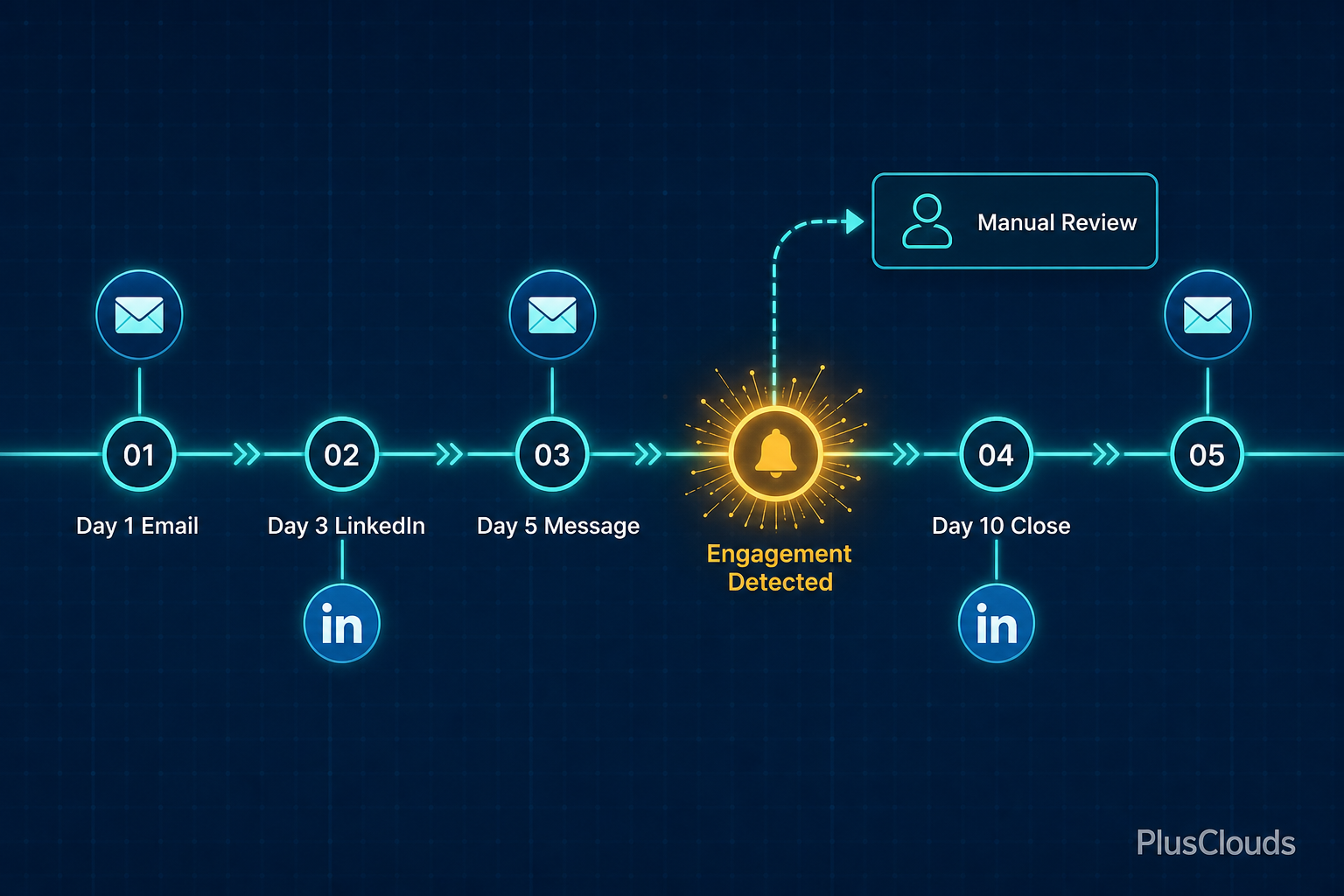
- Mix channels deliberately. Email on day 1, LinkedIn connection request on day 3 (no message yet), LinkedIn message on day 5 that references the email, a final email on day 10 with an explicit "closing the loop" framing.
- Keep the sequence short. Five to seven touches over 14 to 18 days is the ceiling for cold outbound. Beyond that, you are not being persistent; you are being annoying.
- Pause the sequence the moment any engagement happens. A profile view, an email open on two devices, a link click. These are micro-signals that warrant a manual, personalized response, not the next automated step.
Eaglet by PlusClouds manages multi-channel follow-up sequences with built-in engagement detection, so the AI outreach automation pauses and flags the prospect for manual intervention the moment behavior changes. That distinction, between a contact who is cold and one who is warming up, is what separates sequences that book meetings from sequences that generate unsubscribes.
Step 5, Route Hot Replies Directly into Your CRM and Trigger Pipeline Stages
A hot reply sitting in an SDR's inbox for four hours is a deal that might not happen. Speed-to-response after a positive reply is one of the most underrated variables in outbound conversion. Studies on B2B lead response times consistently show that responding within the first hour dramatically outperforms responses that come later in the day, even if the later response is more polished.
The routing workflow should be automatic, not dependent on an SDR checking their inbox at the right moment:
- Incoming reply is classified by intent: positive, objection, referral, unsubscribe.
- Positive replies trigger an immediate CRM record creation or update in HubSpot, Salesforce, or your platform of choice.
- The prospect is moved to the appropriate pipeline stage (typically "Meeting Requested" or "Engaged").
- The owning AE or SDR receives an immediate notification with the full conversation context.
- A meeting link is included in the auto-acknowledgment, or a calendar invite is triggered directly.
CRM integration is not optional at this stage. If your outbound sequence lives in a tool that does not talk to your CRM, you will lose deals in the handoff. For teams using HubSpot or Salesforce, the LeadOcean integration maps signal data, enrichment fields, and sequence engagement directly into deal records, so the AE picking up the conversation has full context before the first call. You can see how that pipeline automation works in practice in the LeadOcean and PlusClouds CRM integration guide.
How LeadOcean's Buying-Signal Detection and Eaglet's AI Outreach Automation Power This Workflow End to End
Each step above can be assembled from point solutions: a signal monitoring tool, an enrichment API, a sequencing platform, a CRM. Many teams do exactly that, and they spend 30 percent of their time managing integrations instead of selling.
The reason the LeadOcean and Eaglet combination is worth examining is that it collapses those separate systems into a single outbound prospecting workflow. LeadOcean by PlusClouds handles signal detection across job changes, funding events, and tech stack shifts, runs real-time enrichment through its 1.8 billion record database, and scores prospects against your ICP before they ever reach an SDR's queue. The AI Match Engine does not just find contacts; it surfaces the contacts most likely to convert given your historical win data.
Eaglet by PlusClouds takes the enriched, signal-scored prospect and runs the personalized multi-channel sequence, pausing on engagement signals, routing hot replies, and pushing closed-loop data back into the CRM. The two tools share a data layer, so there is no CSV export between signal detection and sequence launch. According to current B2B lead generation research, companies using AI-powered systems for this kind of end-to-end workflow report up to 50 percent more sales-ready leads compared to manual or partially automated approaches.
For an SDR team of five, that means fewer hours spent on list hygiene and more hours spent on conversations that are already warm before the first call.
Metrics to Track: Reply Rate, Meeting Rate, and Signal-to-Close Time
You cannot optimize what you do not measure, and the right metrics for signal-led outbound are slightly different from what you track in a static-list sequence.
Reply rate by signal type is the most important leading indicator. Break your reply rate down by the trigger that started the sequence. Funding round signals might convert at 12 percent reply rate. Job change signals might convert at 8 percent. Content engagement signals might convert at 18 percent. If you do not track this by signal type, you will optimize the wrong thing.
Meeting rate is your conversion from reply to booked meeting. A healthy signal-led sequence should convert 40 to 60 percent of positive replies into meetings, because the prospect was already warm when they replied. If you are below 30 percent, the problem is usually in the routing step: too slow, or the AE's response does not match the context of the original signal.
Signal-to-close time measures how long it takes from the moment a signal fires to a closed deal. This metric tells you which signal types produce the fastest revenue, which is critical for prioritizing where to focus your monitoring. A funding round signal that closes in 45 days is worth more to your quota than a content engagement signal that takes 90 days, even if both convert at the same rate.
Track these three metrics weekly, not monthly. Signal-led outbound moves fast, and a sequence problem that goes undetected for a month will have burned through a significant portion of your addressable market before you catch it.
Putting It All Together
Generic outbound is not dying because buyers have become harder to reach. It is dying because buyers have become better at recognizing when they are not the real audience for a message. Signal-led outreach solves that problem at the root: you only reach out when you have a legitimate reason, and that reason is built into the message from the first sentence.
The five-step workflow, detect the signal, enrich in real time, personalize to the trigger, automate follow-ups intelligently, and route replies instantly, is not complicated. What makes it hard to execute manually is the speed and scale required. A human team cannot monitor thousands of accounts for simultaneous buying signals, enrich contacts in seconds, and launch personalized sequences within the hour. That is the gap that modern sales intelligence and AI outreach automation tools are built to close.
If your team is running outbound sequences manually today and wondering why reply rates have stalled, the answer is almost certainly timing and relevance, not effort. The LeadOcean and Eaglet platforms from PlusClouds are built specifically for this workflow. Start with your ICP definition and your best closed-won signal patterns, and see how much of the manual work can be handed to the system.